Today’s headlines, today’s Word

I begin my days in God’s Word.  Though I retrieve the morning newspaper to read at some point ( I still prefer printed vs electronic versions), I no longer allow my eyes to glance the headlines before getting to a God’s Word.  Through a God lens, the news of the world just reads differently.  I find with God’s Word at the forefront of my brain, I am able to read the news of the world with less anxiousness.

But sometimes the headlines inform my reading of the Word, anxiously.

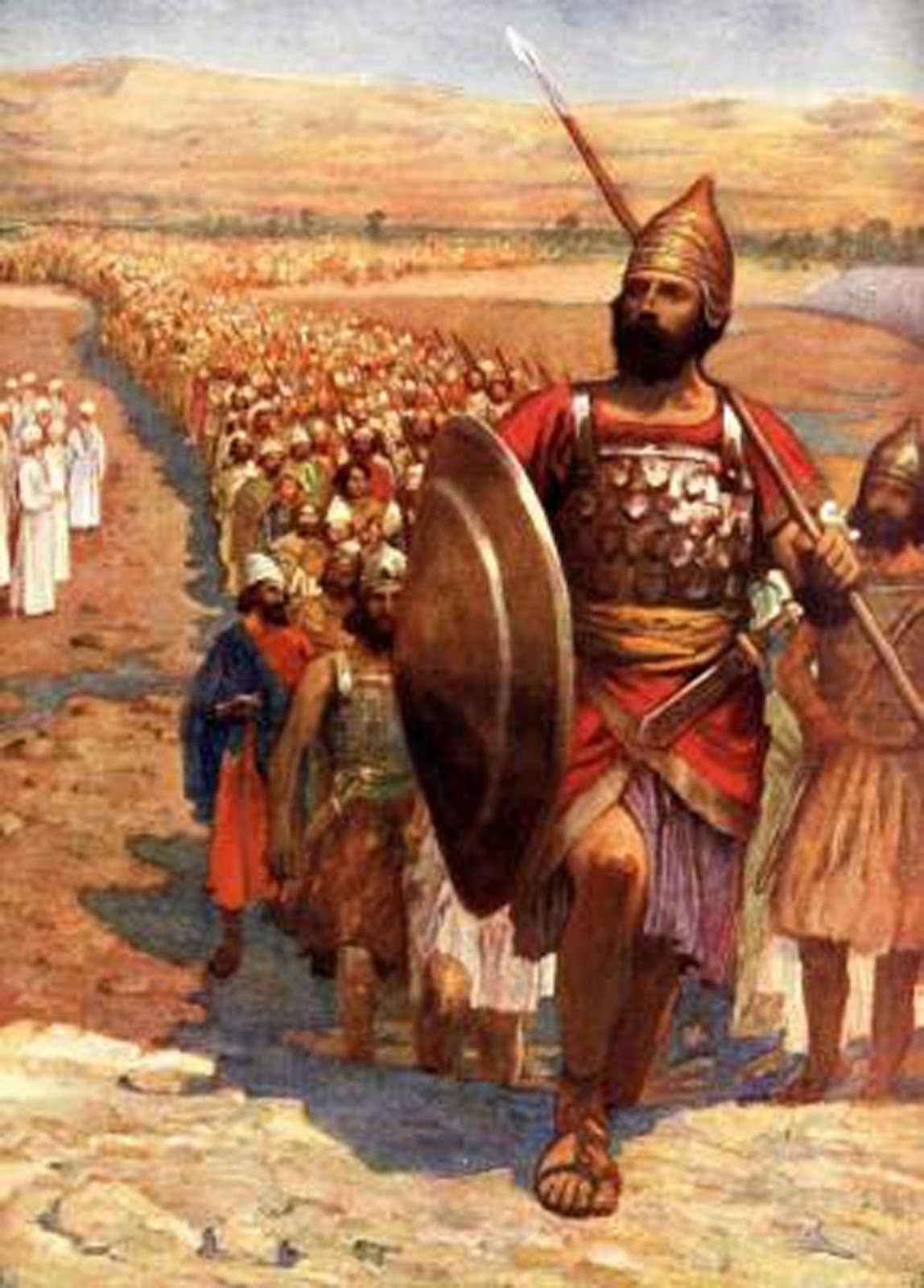
Today’s Old Testament passage from Joshua joshua-leadsreports the prophet’s last commands to the Israelites; his summation of Israel’s triumphant occupation of the promised land, delivered to them by the Lord, God and the warning not to mingle with the conquered inhabitants, but to remain separate to ensure their salvation and survival in the occupied land.

23:11Be very careful, therefore, to love the Lord your God.12For if you turn back, and join the survivors of these nations left here among you, and intermarry with them, so that you marry their women and they yours, 13know assuredly that the Lord your God will not continue to drive out these nations before you; but they shall be a snare and a trap for you, a scourge on your sides, and thorns in your eyes, until you perish from this good land that the Lord your God has given you.

There’s more to this than irony given the headlines.  I turned to the newspaper for an update of what has taken place in the last week in God’s Holy Land.  And I was troubled to see how Joshua’s word to the Israelites functions as a root cause for the war and divisiveness raging today.

Is there a time-date-context stamp on any of Scripture?  I wonder how, if at all, the revelation in God’s Word is heard differently over time.  Perhaps, like God’s revelation in Creation that God’s people perceive and come to know, Scripture, too, is heard and known, differently.

The created universe provides ongoing revelation to humanity through the ages.  At any given time, new discoveries have pushed the horizons of our knowing how vast and connected all the dots of the universe really are.  And yet, at any given time, the universe is comprehended differently.  The Earth as the center of the universe and that Earth is flat are just two examples of the misconceptions.

israel invades gazaSo, I wonder about God’s Holy Land and its inhabitants, today.  Was the Word Joshua proclaimed to the people meant for those living there, today?  What does a Palestinian Christian hear the Spirit saying in today’s Old Testament reading?  What does the Christian church in Jerusalem glean from Joshua’s account?

I only wonder today.  I have no answers to my own questions.  Only this.  For me, the headlines trump the Word from Joshua and I join all the inhabitants of God’s holy land in prayer for peace.  May the Lord, God deliver us all to His peace, which passes my feeble attempt at understanding.

Lectionary Readings: Psalm 55; PM Psalm 138,139:1-17(18-23)
Joshua 23:1-16; Rom. 15:25-33; Matt. 27:11-23


Posted in Whispers | Tagged , , , , , , | Leave a comment

Lest we forget

The Holy Spirit lead me to a new insight this morning with the reading of Psalm 50 – a deeper understanding of the what it takes for a believer’s memory to be refreshed, renewed, and restored.  It’s a question more than a deeper understanding – what does it take to recall God the Creator in all things, so that I go to the Lord first with praise and thanksgiving and always in times of trouble?

Money motivates and triggers memory, as illustrated by the comic Dan Piraro, memorybut what about those of us professing a kingdom-living life?  What motivates and triggers our memories – the most important of all, that the Lord, God is all.

It is easy to forget, day in day out, that all of life, all of my life – this world, the generation into which one is born, the chaos and the order, family, friends, enemies, homes, livelihoods, children, intelligence, curiosities, provision, mountains, seas – well, you get the idea – all of it comes from the Lord, God.  And knowing – being aware as the psalm opens that…

1 The mighty one, God the Lord,
speaks and summons the earth
from the rising of the sun to its setting. 
2 Out of Zion, the perfection of beauty, God shines forth…

should be enough to ground all our comings and goings on any given day.    So what does it take?

Does it take a blessing to refresh our memories of God – to not forget God?  It feels like that, sometimes.  People are quick to give God praise and thanks when it’s all working out as they had hoped.  Whether its provision, a promotion, a new this, a new that.  Believers are quick to offer God praise and thanksgiving.  Is that what it takes to ‘not forget God,’ as Psalm 50 warns? Seems simple enough.  Begin with praise of God, give thanks to God at my awakening, and I’m good to go for another day. As one of the most popular social media posts reminds:

tumblr_mkyqrkwPUV1r87u1io1_1280But though I know this, I do forget.

What this psalm suggested to me anew is that we believers forget because we do rely on blessings to trigger our memory that all comes from God.  We look to blessings to tell us we are living as we are called to live.  But, hmmm…there’s a warning in this psalm about those of us who fall into the praise camp.

I haven’t before understood the ‘wicked’ as believers-gone-bad, but instead, as the other – the non-believer, the gentile, not of Israel.  But that’s not the case. God is speaking to me – to us – to those of us who should know better.

22 ‘Mark this, then, you who forget God,
or I will tear you apart, and there will be no one to deliver. 
23 Those who bring thanksgiving as their sacrifice honour me;
to those who go the right way*
I will show the salvation of God.’

Believers cannot just give lip service to Lord, God.  God doesn’t want the false praise, the vacuous thanksgivings.  God wants all of who I am.

If I am not turning to the Lord in times of trouble, trusting God to deliver me, but instead deferring to my own law-driven pull myself up by my own bootstraps thinking, then I am forgetting God.  If I praise God for the blessings but try to keep away from God my troubles, try to take care of them in my own way, then I am forgetting God.

Believers who forget, who stay away from God when things go badly, trusting no one but their own version of things , thinking they know what the other side looks like, thinking they can figure the mess out before too long, going dark, going within…those are the wicked of today’s psalm.  Those are the ones who forget God.

The Lord, God gives us a simple – not easy – but simple way to not forget Him.  Come to me, as Jesus says later, come to me all who are heavy burdened and I will refresh you. This is the trigger, the motivator to my memory of the Lord, God.  Thanksgiving.  Not denying the trials, the troubles, the despair, the darkness, but thanking the Lord for them.

14 Offer to God a sacrifice of thanksgiving,*   and pay your vows to the Most High. 15 Call on me in the day of trouble; I will deliver you, and you shall glorify me.’

Praise Him.

Lectionary Readings: AM Psalm 50; PM Psalm [59, 60] or 66, 67
Joshua 9:3-21; Rom. 15:1-13; Matt. 26:69-75

Posted in Whispers | Tagged , , , , , , , , | Leave a comment

Happy are those….

Welcoming-Church-SmallerI was stopped in my tracks this morning at the first reading from the psalter. Psalm 41. It begins with a punch:

1 Happy are those who consider the poor;*
the Lord delivers them in the day of trouble. 
2 The Lord protects them and keeps them alive;
they are called happy in the land.
You do not give them up to the will of their enemies. 
3 The Lord sustains them on their sickbed;
in their illness you heal all their infirmities.*

And then, like many of David’s psalms, it moves quickly to a second set of couplets that deal with David’s personal situation, his personal angst. In Psalm 41, David writes at verse 4, As for me, I said, ‘O Lord, be gracious to me; heal me, for I have sinned against you.’   These are the words and expressions I know I look forward to getting to – the personal petitions for healing.  I find I gravitate to them most when I turn to God’s word for discernment.  For the nugget.  For the way out of a particular mess, or the way forward to a decision. It’s a selfish me-focused reading of the psalm.  I know I skip over parts of God’s word to get to the part I believe is meant to speak to me.  And so it was with the first psalm reading.  I sort of skipped over it, anticipating the personal lament and petition was to come soon enough.

But the image that came before me in the first verse wouldn’t go away, preventing access to any word I anticipated would be sent to me this morning, to comfort just me.

Outsiders_Poverty-24-1The first line triggered a memory of a face I glanced yesterday in worship.  A most sad, life-torn, weathered, too much age on the face of a seemingly young man.  A dirty face.  Blond bushes of hair bluntly cut at his neck sticking out here and there from a worn baseball cap.[1]

The memory of the man trumped all intentions of making the psalm speak to me and my particular circumstance.

Here’s how it unfolded, beginning with yesterday’s worship.

I went to 8 o clock.  As I approached the parish steps, I heard first, then noticed a homeless man (grocery cart stuffed with blankets and clothing at his side) conversing loudly with the sole greeter.  No one else was around – no clergy, no other people approaching for worship. A very quiet Sunday morning moment in the neighborhood but for the very loud, not angry or yelling, just inappropriately loud voice of the young homeless man.  I could not hear the greeter.  I didn’t know what they were saying to one another.   I was grateful to see a way inside that took me around the two, thinking I wasn’t noticed by either.  As I entered, the greeter came in behind me to hand me a bulletin and take his post at the entrance doors.  The homeless man was wandering away.  As I was paused in the narthex with the greeter, I heard the young man yell back to him,  “the 8 o clockers are so much nicer.”  Hmm, I thought.  He’s a regular – on the steps of the church Sunday morning in anticipation of folks walking by maybe with a dollar or more to spare.  The weekday street crowds nowhere to be seen on the sidewalk this morning – just the 8 o’clockers at this little urban church – the few that there are.

The service began.  About five minutes in an audible sobbing traveled from the outside, in – from the open doors at the back of the church, all the way through the center aisle and to the altar.  The presider lifted his head and looked straight back.  Not everyone turned around.  I did.

The homeless man had returned and was sitting on the steps with the greeter.  The doors were still open.  Worship continued with no interruption.  We all sang and prayed through the sobbing.

Then, it stopped.  A few minutes later the homeless man walked confidently down the center aisle sniffing, looking for a front row pew. He slid his hands over the tops of each pew, testing it for what I don’t know. He selected the third pew on the left in the front.  No one in front of him.  He sat down.  Took off his hat.  Lifted his head to the front.

The service proceeded.  No interruptions.  No acknowledgments.  I began to think about what I would do if I were presiding.  Clearly the priest had heard him, noted his entrance.  So far, there was no need to do anything differently.  But I wondered, what if things got out of hand?  What if he began to sob again? I anticipated the outburst. Thought about all the mentally ill living on the streets and where they can go, and where they aren’t welcome. Of all places a Sunday morning worship community should be accessible.

But it’s tricky. Sometimes the mental illness of a worshiper makes the rational, heart-felt welcome hard on others and interferes with the worship so that no one is praising God, but instead distracted by the activity of just one.  Or worse, indifferent.

This is where my mind was wandering and I had concluded that if I had been at the altar and things began to get out of hand, I would just name the elephant in the room.  I’d stop the service, leave the altar and come down to wonder with the good folks who showed up that morning, what we thought we should do?  Was there a way of praying the Eucharist differently that particular morning so that we could welcome the young man to the table with love, authentically- not be indifferent and at the same time reverential?

Anyway, the mind wandered, and then I noticed he was on the ground at the kneeler. Suddenly he stood up and crossed the aisle to ask a parishioner something. He then went to the restroom. Crying could be heard from the restroom. Then it stopped. Maybe he left. A minute later he walked again down the aisle this time with a tissue in his hand. He sat down.  Listened to the sermon.  There was devil language in the gospel.  I wondered if the preacher would speak about the gospel.  I wondered what he would hear.  She didn’t.  He didn’t appear to hear much of anything.  He got up part way through the sermon and went to the restroom again.  No crying.

The worship ended.  As I exited the building first, I noticed a different homeless person asleep on the church steps.  I was able to walk by without disturbing him.  I got in my car across the street and glanced back at the church steps. The sleeping homeless man had stood up.  He was facing the exiting parishioners.  He had some sort of sign in his hand. A box at his feet for donations.  The 8 o’clockerssleeping-outside-church were now streaming out.  I didn’t notice if anyone stopped.  I drove away, thinking about where I would get my cup of coffee and where I could write down my notes about the gospel that the preacher didn’t preach.

Oh my God, really?  Yes.  That is really what happened and how I responded.  It was all in my head.  I thought about the dilemmas, the sadness, the poverty. I thought about what I would do if…and yet, I did nothing.  Nothing but think about it.

Then this morning at the psalm I remember it all, and I wonder to myself, as I recalled his sobbing, ‘how has the Lord saved him?’ Made him happy?”

And then in it hits me and I realize this psalm is not speaking of the poor – people like the crying homeless man who didn’t stay for the Eucharist, or the man on the front steps who hadn’t come into worship at all but only to the steps just before it was over to catch those leaving.

No, this psalm wasn’t speaking to them or about them but to and about ‘those who consider the poor‘…and there was only one person who fit the bill on that Sunday morning…the greeter. This was about the that saint – the one sole greeter who talked with, sat with, guided, invited and welcomed him to join the other saints in worship – this grieving young man on the street.

And it was the greeter who opened the doors at the end of the service who then must have encountered the sleeping man on the steps. He must not have awakened him or asked him to move so the 8 clockers could exit easily.

tec-welcome-bold-ybg-roundedChurches talk a lot about being a welcoming place, especially on Sunday mornings when the entire purpose is corporate prayer and praise for the Lord, God.

It happens – really happens – not because the doors are open and words of welcome are posted, but because of saints like the greeter – happy saints who consider the poor.

Praise the happy heart.  Praise Him.

Lectionary Readings:AM Psalm 41, 52; PM Psalm 44
Joshua 7:1-13; Rom. 13:8-14; Matt. 26:36-46

Footnotes:

[1] I wondered about the appropriateness of inserting an image here in order to give the reader some idea of what I saw. During the internet search I came across a photographer who had, with their permissions, taken head shots of different individuals who had found themselves homeless for one reason or another.  The professional photographer is Tom Stone and here is his website http://tomstoneartist.com/#/outsiders–poverty/Outsiders_Poverty-24.   I am using one of his photographs here because of the similarity, profound similarity, to the young man I saw yesterday and will speak of in this post.  Though it wasn’t him, the features, eyes, youth, coloring and even the hat were what I saw on the sad face yesterday.  I insert it here just to give you some idea, not to exploit.


Posted in Whispers | Tagged , , , , , | Leave a comment

How to tell a story

gandhi

The screenplay of Gandhi is available as a published book. The film opens with a statement from the filmmakers explaining their approach to the problem of filming Gandhi’s complex life story: “No man’s life can be encompassed in one telling. There is no way to give each year its allotted weight, to include each event, each person who helped to shape a lifetime. What can be done is to be faithful in spirit to the record and to try to find one’s way to the heart of the man.” Is this true of the Gospel and Jesus, too? Mystery and unknowing as much a part of knowing God through the Word and Creation.

Posted in A Thousand Words | Tagged , | Leave a comment

Remove your sandals

Joshua 5:14…And Joshua fell on his face to the earth and worshipped, and he said to him, ‘What do you command your servant, my lord?’ 15The commander of the army of the Lord said to Joshua, ‘Remove the sandals from your feet, for the place where you stand is holy.’ And Joshua did so.

Pause.  First question the Spirit brings to me, Is the place holy because the Lord God is there present?  Or is it holy because it was the promised land?

Push play.  With a couplet from today’s psalm meandering about my head and heart, I am moved to wonder about the sandals.  Is it possible the sandals are like a barrier, as a “city under siege” is a barrier to seeing or being seen by the Lord God?   Sandals are human-made constructions to make life easier.  But like walls around a city, another human-made construction, do the sandals stand between Joshua and the Lord, God?  Does removing them help Joshua know God’s presence through every cell of his being?

I have felt more than distance from the Lord of late, ‘driven from his sight’ as David recalls feeling ‘beset as a city under siege.’  Unconnected is the best I can describe it – disconnected? – not feeling God’s animating Spirit in my head and heart, not knowing through every fiber of my being that I am on holy ground.

A new season began for me in June.  I found myself on a new path without any expectation, let alone any idea, where it might lead or land.  A part of me envisioned the new path as leading to greener pastures.  greener on the other sideBut, I have been walking this path with sandals on, encountering road blocks and barriers and unable to sense the holy ground and get any sure footing.

I have looked to the Lord, God, for direction – to follow where He would lead me.  I seek His guiding hand in His Word, at Worship, in prayer, in theological reflection with others. But since stepping onto it, I have experienced more of benign disappointment and depression than anything that animates, enthuses, energizes me to walk the walk, move forward to greener pastures.

I am so conflicted internally it’s as if the Word doesn’t know where to land.  I read it, pray it, think about it, breathe it in – but like a city under siege the words just wander aimlessly inside, not sticking anywhere, not connecting to the fibers of my head and heart, my being and certainly not convicting or animating day to day life.

And then, it all changes up, today.  I hear the Word in a whisper.  The Lord, God says to me this day – take off your sandals.  Hmm.

No matter how this passage has been preached or what I’ve learned about sandals, and holy ground, and all the interesting contextual, particular meanings mined out of the Lord’s instruction to Joshua here and to Moses first (Exodus 3), what the Spirit brought to me on this day was the realization that I have erected some barriers to entry.  That I have been – am always – on Holy Ground – that the Lord God is always there, present to me – that I am not a city under siege, unseen by the Lord, and that any distance I am experiencing from Him is of my own doing.

It’s enough of a wake-up call to animate my reflecting here, today.  But not enough, yet, to know what barriers – what sandals – I have to remove.

Where am I to go?  Am I on the right path?  What is standing in my way forward to the greener pastures?  Am I where the Lord, God, sees me?  Where I see Him?

I wasn’t able to move into the other readings, today, paused at the whisper to face the truth that I am in my own way.  feet-sandalsI have been walking the walk with sandals on and try as I might to remove, I haven’t.

That is the Word that landed today.  Took hold.  Found a place in my head and heart.  It’s a hard one to accept.

But I do.  I hear you, Lord.

Praise Him.

Lectionary Readings:  AM Psalm 31; PM Psalm 35
Joshua 4:19-5:1,10-15; Rom. 12:9-21; Matt. 26:17-25


Posted in Whispers | Tagged , , , , , , , | 2 Comments

Portent = Pay attention

Quite a bunny trail this morning – one that began with a word search, intersected with my present search for a sign, a bunny trail wondering about God’s will distinguished from my own and landing in a place of gratitude today for simply noticing.  That’s it.  I am so thankful for having a heart and mind that notices seemingly disparate dots – thoughts, scripture, people, places – and knowing they come from and are connected by our loving abba, Father.

Having completed the Daily Office and the readings, I returned to Psalm 71 to look deeper into a word I had skimmed over but that hung around like a little dark cloud.  I had lifted my eyes and wondered about the word, but thought of it more as a distraction than a spirit-moment of teaching.  Portent.  It read and sounded like a word I would encounter in Twilight or the more benign, Harry Potter, but not in scripture.  But there it was, in today’s psalm:

7 I have been like a portent to many,
but you are my strong refuge.

Portent means omen or prognostics[1] – a foretelling of something grave, grim, mysterious.  A sign?  It appears in Scripture more than a dozen times, in a variety of Old Testament books, and in Luke/Acts once, and, predictably, Revelation, three times.  Often portent references false teachers, other times as a way of describing the activity of prophets like Isaiah.

How does Isaiah fit in with PORTENT?

How does Isaiah fit in with PORTENT?

Which is interesting.  The seemingly disconnected ‘dot’ of Isaiah was brought onto my radar screen just recently in a discussion I was having with a priest about discernment.

We were talking about discernment as the means for identifying what spirit is at work in a situation: the Spirit of God or some other spirit. How can we evaluate whether a call springs from a desire for security or comfort or success, rather than from God? How can we verify that a call comes from God? [2].  Discernment helps a person understand the source of a call, to whom it is directed, its content, and what response is appropriate. Discernment also involves learning if one is dodging a call, is deaf to a call, or is rejecting a call.

No rules provide definitive answers to these questions. And some rules that do exist provide poor or incomplete guidance.

God sign 2I had just re-read Loving Hearts – one of the go-to books for people called to ordained ministry in the diocese in which I am canonically resident – and shared with my friend the following example of ‘rules’ that had led some faithful astray:

The experiences of the early Quakers illustrate this. One test some Quaker sects used to confirm God’s call was that a “true” call was always contrary to one’s own will.  The assumption that a “cross to the will”  meant taking up the cross of Christ often produced absurd results. For example, some Friends walked naked in the streets because it was “contrary to [their] own will or inclination” and, therefore, “in obedience to the Lord.”  Another test was reliance on a selected passage of Scripture. Frequently, however, this meant (and can still mean) merely choosing some biblical passages and ignoring others to confirm a pre-charted course.

This is where the ‘dot’ Isaiah comes in.  My friend reminded me that it was Isaiah who had had ‘walked naked in the streets’ at one point, per God’s call!  And not only that, Isaiah did this to be…wait for it, a sign and portent!

Isaiah 20 In the year that the commander-in-chief, who was sent by King Sargon of Assyria, came to Ashdod and fought against it and took it— at that time the Lord had spoken to Isaiah son of Amoz, saying, “Go, and loose the sackcloth from your loins and take your sandals off your feet,” and he had done so, walking naked and barefoot. Then the Lord said, “Just as my servant Isaiah has walked naked and barefoot for three years as a sign and a portent against Egypt and Ethiopia, so shall the king of Assyria lead away the Egyptians as captives and the Ethiopians as exiles, both the young and the old, naked and barefoot, with buttocks uncovered, to the shame of Egypt. And they shall be dismayed and confounded because of Ethiopia their hope and of Egypt their boast. In that day the inhabitants of this coastland will say, ‘See, this is what has happened to those in whom we hoped and to whom we fled for help and deliverance from the king of Assyria! And we, how shall we escape?’ ”

I am in awe of how seemingly disparate dots, unconnected threads, divided lands, strangers, eras…how chaos organizes and connects and makes sense in the one reality of our Creator.

And I am equally awed at the God-given heart and mind to simply notice.   In noticing a word that feels odd  – portent – in noticing an internal search for a sign – in noticing a need to discern – my Lord, God opens up His Word and world beyond my imagination.

God is always present – always communicating His will to me, calling me to serve, sending me signs and portents.  The simple act of noticing.  That’s all God asks, really. Pay attention.  Notice.

Thy will be done.

Praise Him.

Lectionary Readings: AM Psalm [70], 71; PM Psalm 74
Eccles. 11:1-8; Gal. 5:16-24; Matt. 16:13-20
[1] Prognostic, interesting enough, comes from the Greek word, gnosis, which is also the root of Gnostic and Gnosticism, meaning esoteric mystical knowledge

[2] Definitions and quotes from the book, Listening Hearts: Discerning Call in Community. Farnham, Suzanne G.; Ward, Susan M.; Gill, Joseph P.; McLean, R. Taylor (2011-04-01).  Kindle Edition.

Posted in Whispers | Tagged , , , , , | Leave a comment

This is a compression posture, people!

Galatians 5:14For the whole law is summed up in a single commandment, ‘You shall love your neighbour as yourself.’

These words from Paul are really so very beautiful, so encouraging.  Love one another.  Do all things in and through love.  Be love.

At the same time, the words Paul uses to get there – to get to the final expression of what he is saying to the Gauls of Galatia – well, they are distracting at minimum, cumbersome, most often  – or at least they used to be to me.

I used to read Paul’s letters with some dread and lack of patience, murmuring to myself, “Just get to the point, Paul!”    And really?  Why does he use metaphors and illustrations that seem to contradict the truth that in Christ, we are one body, that each and every person is my brother or sister, that I am not to judge the heart of another.

I am paused today at the realization that the final expression of something – gospel message or in my everyday life, a job or a relationship – cannot be attained (absorbed) or lived into by short cuts, simplification, arrogance, ignorance, or temporary feelings. How I get to the final expression of something is important – it matters to the lived experience of that something.

I get so much more out of Paul’s letters when I mine the depths of his cumbersome, complicated, sometimes counterintuitive writing.   The Holy Spirit gives breath to Paul’s dense, tightly compressed writing only when I pause at the troubling word – slave, for example – sit with it, unpack it, contextualize, understand all the possible meanings rather than skip over to the good part – the ‘love your neighbor as yourself.’

This post is not so much about the letter to the Galatians that the lectionary is moving the reader through this week, as it is about how to get to the big idea – the broad place – when reading Paul.

“This is a compression posture, people, not a stretching posture!”

I hear this reminder nearly every time I move into the Dandayamana-Bibhaktapada-Janushirasana (Standing Separate Leg Head to Knee) pose in Bikram Yoga[1] class.  The full expression of the posture looks like this:

Forehead to Knee Compression Posture

But just looking at the pose in its final expression and trying to imitate it does not tell you what the position is actually doing.  And if a person skips over the dialogue, doesn’t listen to the instructions, relies on the visual cue to get to the final expression, to get to the ‘good part’  -the apparent stretch and straight leg – well…then that person misses entirely any benefit of the posture.  It looks like a stretching posture.  It is so much more.   One Bikram instructor laments,

I don’t know why, but no matter how many times I say the word forehead to knee for compressionmy students continue to concentrate on stretching their backs, reaching for their feet, getting their chests close the their legs – everything but what I tell them.   The posture is a compression posture, people!

Access to the expansion of your lungs and space within your spinal cord that the position promises to deliver is provided by compression, not stretching.  Compressing all your internal organs for increased breathing room is gleaned by one simple movement – touching your head to your knee.

Getting to the good part, the final expression, has agency in my life when I do it rightly – take no short cuts, go through the hard part.

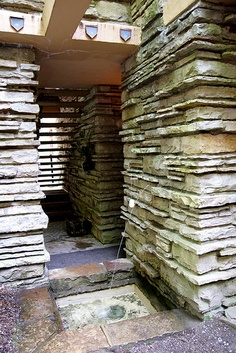
The same principle is at work in many of the homes designed by Frank Lloyd Wright. He employed the idea of compression and broad space incorporating into most of his residential designs compressed entry ways that led the resident or visitor into the broad place.
View of Entry to Falling Water, Pennsylvania

View of Entry to Falling Water, Pennsylvania

Looking at most homes – the final expression, if you will – a visitor expects a broad entryway, a porch, an room even – the entry typically somewhat irrelevant to the experience of the home itself.
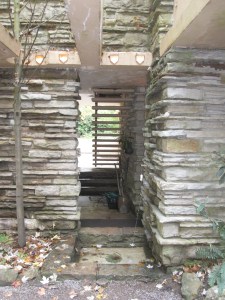
Second View of entry

Second View of entry

On the other side of the entry, the broad place in Falling Water, Pennsylvania.  Here the Living Room.

On the other side of the entry, the broad place in Falling Water, Pennsylvania. Here the Living Room.

But Wright makes sure you don’t just pass through the front door to the full expression – he designs in an experience of compression that a visitor actually viscerally experiences so that the full expression IS realized once inside.

This is how I have come to understand Paul and most especially his letters to the Galatians and Romans.  He writes like FLW designs his homes and like the Bikram pose referenced above – compress open up, compress open up.  The source for the language Paul uses –  his metaphors, illustrations, style – is multi-faceted and all of that plays into his proclamation.

To get the most out of his letters – to hear what the Spirit is saying through Paul’s letters – I am reminded that ‘this is a compression posture’ not a stretching one.  In other words, the ultimate message – in today’s reading it is to live in love, be love, love one another – I get there by touching my head to my knee – absorbing all the particularities in Paul’s vocabulary – slave, freedom, flesh – words that have dense multi-faceted meaning and interpretations accessed by compressing in on them.

Breathing room.  My experience with God’s word is that breathing room is where the Spirit speaks – the space in and around the actual words.  And I have found it most helpful to rest in that space – the broad place – to access that space where the Holy Spirit speaks to God’s people – when I first touch my head to my knee.  When I do the posture correctly – when I read Paul deeply, not at the surface, literal level, –  but contextually (compressed?).  In that way, God’s intended teaching is opened up, given breathing room.

Long winded, today – just like Paul – so apologies and thanks at the same time for hanging with me, if you did.

Praise God.

Lectionary Readings:AM Psalm 72; PM Psalm 119:73-96
Eccles. 9:11-18; Gal. 5:1-15; Matt. 16:1-12

[1] As a reminder, Bikram yoga works 100% of an entire body from the inside out (just as the God’s Word can do :-)).  It is a 90-minute practice of 26 positions; a series of stretches and compressions  which exercise your muscles, joints, ligaments, tendons, organs, nerves and glands. Upon release of a posture, fresh oxygenated blood travels through and rejuvenates the vessels and tissues that were being compressed.


Posted in Whispers | Tagged , , , , , , , , | 1 Comment

Walk the walk

Matthew 28:16 Now the eleven disciples went to Galilee, to the mountain to which Jesus had directed them. 17When they saw him, they worshipped him; but some doubted. 18And Jesus came and said to them, ‘All authority in heaven and on earth has been given to me. 19Go therefore and make disciples of all nations, baptizing them in the name of the Father and of the Son and of the Holy Spirit, 20and teaching them to obey everything that I have commanded you. And remember, I am with you always, to the end of the age.’

My prayer this morning as I walked the labyrinth, came from the gospel reading today and it went like this,

The Lord is with me, always.  The Lord has sent me here.  I, like you, am to to walk the walk, go forth, make disciples.  


IMG_1269

Walk the walk the Spirit whispered.

Praise, Him.

Lectionary Readings:  AM Psalm 8, 47; PM Psalm 24, 96
Dan. 7:9-14; Heb. 2:5-18; Matt. 28:16-20


Posted in Whispers | Tagged , , | 2 Comments

Living into the light

light_at_the_end_of_the_tunnel_by_evgeniasamsonova-d32qr80The end is in sight – light at the end of the tunnel.  I am just beginning to trust that I am on the right path leading me into the fullness of the light and that there are no more unforeseen detours ahead. That being said, today’s gospel stopped me in my tracks.  It is familiar enough of a story – John baptizing in water for redemption, his prophetic ministry fueled by his belief that he was living in the end times – that the light he saw before others was the light at the end of the tunnel – the fulfillment of the Scripture, as Matthew writes. What stopped me in my tracks was the name calling and anger in John’s words.  My eyes lifted from the text.

 Matthew 3:7 But when he saw many Pharisees and Sadducees coming for baptism, he said to them, ‘You brood of vipers! Who warned you to flee from the wrath to come?

I’ve learned that when my eyes lift I am to get in touch with the question before me.  And it was this: I can’t remember why, at this point – before Jesus had come on the radar screen to the Pharisees and Sadducees  – I cannot remember why, exactly, John was so angry with these two factions of Judaism that didn’t see eye to eye on much of anything.  After all these years of seminary, after all I have preached, taught, and written, in this moment, I cannot remember ever pausing here in this text to ask what was behind John’s anger.

Not a terribly insightful pause – in fact rather embarrassing to admit – but a humbling one.  How could it be after all this time that I have forgotten the historical setting for John’s ministry, as related in this story?  How could I possibly be coming to the end of this season and still have these elementary questions?  Is this an unforeseen detour?  Am I being reminded that I am headed to the light at the end of the tunnel prematurely?

I felt not only humbled, but unworthy – again, to have allowed myself to think I have learned enough, remembered enough, to move forward in God’s church as a leader.  It has been such a struggle to get to this point.  Perhaps, its been a struggle because it hasn’t been God’s plan for me or for God’s church.

Yep.  That’s how far down I spun with that little pause.  And as I was writing a reminder to myself to review my exegetical and history notes on the passage, I was paused again.  This time with the words from today’s first reading from the Psalter,  Psalm 26, that when I had first read this morning, had made me think not of me, but of others already in the light, doing work they were called to do as anointed leaders in God’s church. I had thought about the integrity of leadership.   And the psalm reminds such leaders that what God sees and knows is intention – God knows our hearts.

Like the disciples on the road to Emmaus heard retold in Sunday’s gospel.  The light had seemed to them to have been put out.  And yet, there they were literally walking and talking and still trusting, unwaveringly, the Lord.  Though daunted, wounded, and feeling hope-less; wondering if they had gotten it all wrong.   And Jesus shows up, walks alongside – assuring and making himself known to them in the breaking of the bread.

This is what the Spirit whispered in these verses from Psalm 26 that I recalled as I was writing a sticky note reminder.

1 Vindicate me, O Lord, for I have walked in my integrity, and I have trusted in the Lord without wavering. 2 Prove me, O Lord, and try me; test my heart and mind. 3 For your steadfast love is before my eyes, and I walk in faithfulness to you.*

The Holy Spirit touched down on me and the feeling of failure and unworthiness ushered in by the truth of how little I really have learned and mastered was healed.  The Lord just sort of loved me up,  “vindicating me” with the reminder that I have trusted the Lord without wavering.

I heard the Spirit saying, “You have trusted the Lord.  Trust the light you see out there and within. Walk towards it, embrace it.  Living in the light is where all God’s people are to be.  Shine.  Share.  Be not afraid.  Take the next step.  Onward.”

Praise Him.

Lectionary ReadingsAM Psalm 2628; PM Psalm 3639 
Exod. 19:1-16Col. 1:1-14Matt. 3:7-12

Posted in Whispers | Tagged , , , , , , | Leave a comment

Truth told, dude…in God’s time

John 16:7Nevertheless, I tell you the truth…I still have many things to say to you, but you cannot bear them now.13

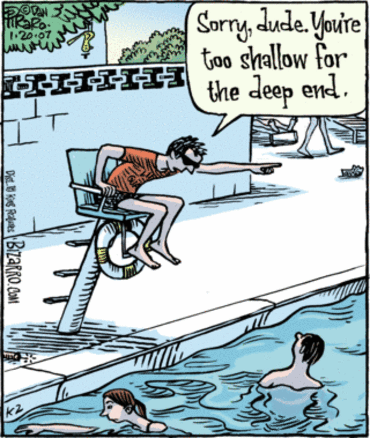
bizarro too shallowToday’s gospel reading had me thinking about truth telling. Apparently there are times better than others to lay it all out and that has something to do with the person to whom the truth teller is talking.

Truth of who Jesus was and what was to come and what God, his Father, was doing through him was revealed in and over God’s time. The disciples weren’t too shallow to know the truth, but Jesus, in his wisdom, knew they had no capacity for understanding it all in one fell swoop.  More than wisdom, actually, it is compassion at play in his words, “you cannot bear them (all the facts) now.”

Personal application?  Truth will be told.  But sometimes the depth, dimension and facts of truth are better revealed over time, with a heart that accounts for the other to whom I tell my truth.  So truth, yes.  Always.  But, not at all costs.  Jesus teaches me here to have compassion for the hearer.  Some truths are too hard to bear, let alone, hear, all at once.

And, too, Jesus teaches me I need and have help. I’m not alone – none of us are alone.  The Spirit of truth is here to help me tell and the hearer to hear.

John 15:13When the Spirit of truth comes, he will guide you into all the truth…

Praise Him.

Saturday Lectionary Readings:  AM Psalm 2021:1-7(8-14); PM Psalm 110:1-5(6-7)116117 Exod. 17:1-161 Pet. 4:7-19John 16:16-33

Posted in Whispers | Tagged , , | Leave a comment