God in all things…

12 Are your wonders known in the darkness,
or your saving help in the land of forgetfulness?

The Spirit has me thinking about all those who are living with Alzheimer’s and dementia – those we would describe as living in ‘the land of forgetfulness.’

And I’m thinking of those I know personally who for all intents and purposes did not know God before the brain cells began to darken and die.  Who did not cry out or need God to save them from anything.  Who lived life up to this point not worshiping the Creator but the creature, as Paul distinguished – and lived it well, by creature-world-view standards.

And I am momentarily saddened.  Doesn’t God live and permeate every space of His creation including the ‘land of forgetfulness?’  But if so, how can He possibly save someone who’s brain function is so compromised at this late point in their life that they have no capacity for memory let alone tracking a biblical storyline?  Who don’t now and never did have even an awareness of needing to be saved by anything, let alone God?  Now in the land of forgetfulness, are they lost forever?

With that sad whisper the psalm ushered into my morning thoughts, I moved forward with the readings with a sense of hopelessness, wondering really if it is even possible for those in the land of forgetfulness to ever know God.  And as the Spirit kept at me, kept that question before me,  I land in the Gospel.

And in the Gospel reading, the troubling lament of the Hebrew psalmist is trumped and the Spirit reminds my saddened heart,

14So it is not the will of your Father in heaven that one of these little ones should be lost.

God is forever and always searching for the lost.  We look at someone who has lost their memory and think they are lost, forever.  But God is different.

First, God is always looking.  And second, He looks at their hearts – not their minds.  Their hearts!  I can’t see someone’s heart…but I can feel it and in the case of those I love who are suffering from dementia-like disease, I feel love.

And finally, only God knows when and how to find the lost to bring them back to His flock.  Like the photo here, the lost sheep stands alone nearing a precipice that it, itself, seems to have no awareness of.  But God does.  God sees.  God knows.

In this I have some comfort.  Letting God do the work only God can do and not fretting that those I love who have ended up in the land of forgetfulness have been for one moment forgotten by God our Father, Son and Holy Spirit.  Or lost.

Posted in Whispers | Tagged , , | Leave a comment

Jesus gets the last word, thank God

The Parable of the Unforgiving Servant from today’s gospel reading has never really grabbed me. Perhaps it is because the characters are a bit shady and the context rather off-putting.  Perhaps, too, because I don’t identify with anyone in the story.  In most of Jesus’ parables it is easy for me to locate myself  – even in parables in which only plant material like trees or mustard seeds are the characters.

But in this one, a story told to Peter to shed light on forgiveness – one of the most important, if not THE most important reasons for Jesus – locating myself amidst this bunch of wealthy landowners, slaves, money made, money owed, men, prison, and torture has not come so easily.

And so when I opened up the reading, I nearly didn’t – read, that is.  Truth be told many times I have to force myself to read stories I already know inside and out – especially gospel stories.  But force myself I did, and praise God, the Spirit got the last word.

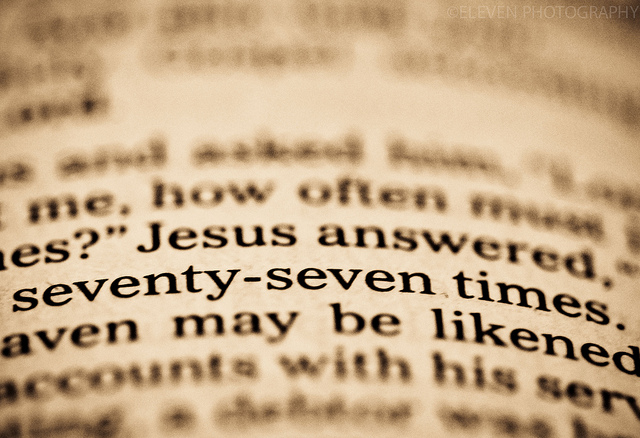
Literally.  The last word.  So after telling Peter the parable, WDJS – what does Jesus say?  Well, nothing about money. Nothing about slaves.  Nothing about men.

…forgive your brother or sister from your heart

Your brother or sister – meaning all with whom we are living alongside.  Jesus thankfully brings this parable out of the unappealing context of its time into God’s time.  Forgive your brother and sister as your Abba Father forgives you.

And from your heart – not your head.  Forgiveness is “beyond calculating.”*  It is authentic only if it comes from the heart.  No calculated gesture or negotiated words – ‘yes, I forgive you for xyz, but…”

Forgiving someone – or for that matter an event or circumstance  – as we are forgiven  is letting go of blame and anger.  Only by forgiving authentically from your heart can the blame and anger that lingers in the “I forgive you but…” expression be released.  Heads negotiate,  calculate, and risk-assess. Hearts let go and let God.

*NSRV footnote:NT pg 27

Posted in Whispers | Tagged , , , | Leave a comment

Piraro’s comics just make me smile.

Piraro's comics just make me smile.

Posted in A Thousand Words | Leave a comment

Just stop already!

Sometimes, I want Paul to stop – stop rambling – stop inserting into his letters contextual particularities and examples that distract from what the Spirit is saying about God, salvation, faith, judgment.  Maybe it was the lawyer in him that prompted him to always add just one more thing.  Whatever the reason, it is tiresome at best but at its worst, his rants, ramblings, examples, often interferes with what the Spirit is saying.   And from my perspective Paul, the creature, the man, the writer directs too much attention to self (“Romans 1:24…worshipped and served the creature rather than the Creator…”).

Today’s reading was no exception for me, though most of the letter to the Romans is not overly wordy like others and at the same time, theologically dense.  I like Romans a lot.

But today,  as I made my way to the Epistle (I read chronologically:  OT, Psalm, Gospel, Epistle) bringing with me whispers from each of the selections about fear, final judgment, hell of fire, prophesy, I had little patience for Paul’s rant on who is saved and who isn’t.

So, I paused, prayed to myself, “Come, Holy Spirit, Come…what do you want me to read, here?  Aha!  Got it.  Just stop Paul when you first sense Paul, the man….Just stop there.  Stop.  Play.  Rewind.”

So, that is what I did.  I read the entire chapter from the beginning and when I first sensed Paul, the man/creature, I stopped.

And here is where I stopped and what I believe the Spirit is saying to God’s people:

Romans 1:16 For I am not ashamed of the gospel; it is the power of God for salvation to everyone…

Now, go tweet that!

Posted in Whispers | Tagged , , , | Leave a comment

What a fool believes he sees

Often when I encounter in scripture talk about the foolish and the wise, a song by the Doobie Brothers plays in my head.  It did so this morning as I read from today’s Epistle selection Paul’s letter to the Romans, which ended in this verse:

22Claiming to be wise, they became fools; 23and they exchanged the glory of the immortal God for images resembling a mortal human being or birds or four-footed animals or reptiles.

What a fool believes, he sees…that is how the lyrics go.  It doesn’t really matter that the  song tells the story of yet another unrequited love; the line and subsequent verse is bigger than the little love story told.

Lyrics that point to something bigger than the particular story in which they are momentarily anchored stick with me.  Lyrics that make me think.

The Holy Spirit is the greatest lyricist of all, in my book.  Scripture is always pointing to something bigger than the particular story in which it is momentarily anchored – like today’s reading from the Psalter.

Psalm 78 recounts the history of God’s people with God – the ever-fluid in and out relationship which Walter Brueggemann in his book The Message of the Psalms, describes as Orientation, Disorientation, and Reorientation.  In the midst of the almost clinical retelling, emerges this “lyric”:

18 They tested God in their heart
   by demanding the food they craved.

I love that.  Big ‘ol idea here that the Holy Spirit points me to asking, can people of faith really test God in their hearts?  How does a person of faith demand something from God?  Does it go like this, “If you give me provision, I will be faithful to you, God?” or “If you, God, will just get me through xyz safely, then I will trust you, believe in you, follow you.”  Is this a faithful prayer?

If-then, conditional prayers;  prayers that demand something or attempts to bargain with God – is there such thing?

I don’t think so.  Rather a foolish thought, if you ask me.

But what a fool believes he sees
No wise man has the power to reason away
What seems to be
Is always better than nothing
There’s nothing at all
But what a fool believes he sees…

Posted in Whispers | Tagged , , | Leave a comment

Cloud cover as guide…am I seeing clearly?

Numbers 9:17-18

17Whenever the cloud lifted from over the tent, then the Israelites would set out; and in the place where the cloud settled down, there the Israelites would camp. 18At the command of the Lord the Israelites would set out, and at the command of the Lord they would camp. As long as the cloud rested over the tabernacle, they would remain in camp.

And so it went for the Israelites through the valley out of the known to the unknown land God had destined for them.   One step at a time, one stop at a time, the people looking to the sky and cloud cover as their guide – a sort of traffic signal.  Cloud hovering over the tent?  Stay put.  Lifted?  Onward through the valley on the road laid out by Him and leading they knew not where.

Gosh, I wish it were that easy.  I live in an area of the country often buried in fog at different times of nearly every day.  And during the summer the cloud cover doesn’t often lift before noon.   As a writer-in-residence once quipped about the place, “The coldest winter I ever spent was a winter here.”

This past week was an exception.  For several days in a row it was spectacularly sunny, hot and clear with nary a cloud to be seen.  Then yesterday the fog returned with some fanfare because a national outdoor event was taking place and the sudden change in the weather invited comment.

It is in this type of exception to normal day to day life that intersects with the scriptural readings of the day in which I find the Spirit speaks – whispers a personal application that would otherwise elude.

Had the weather – cloud cover and fog – not been a hot topic, it wouldn’t have occurred to me to see any relevance in today’s reading from Numbers.   But there it was.  The cloud cover, that is – all the buzz on national television yesterday afternoon and then this morning coming in through the office windows, setting a cooler, calmer tone for the day than a sunny, cloudless one would have.

And in this foggy place, I hear the Spirit in the Numbers reading suggesting this.

If I were to have adopted the Israelites sure-fire method for walking the walk God intends for me, I would have made a lot of progress this past week.  I would have been much closer to the new life I trust He has been leading me to for the better part of three years, now.  Five days of cloudless sunny skies, dry heat and just enough movement in the air so as not to be stifling.   Perfect get up and go weather.

If I were looking to the cloud cover for the signal to move onward into the unknown it would have been so easy to do so.

And this morning, God would have settled me down for a rest stop.  The fog rolled in. If I had been looking to the cloud cover for the signal to STOP, I would be somewhere different than where I am this morning.  I don’t know where that would be, but somewhere different.

I wish it were this easy.  I wish I could know not only where God is taking me, but at the same time be assured that I am on the path He as called me onto.  I wish I could see and hear God in something so explicit as cloud cover.

I suppose the Spirit wants me thinking about this.  To what or to whom do I look to make life-moving-forward decisions?  And to what or whom do I look to see where God is in the decisions I do make?  And if I am not on the journey from here to there alone anymore than the Israelites were, am I reading God’s signals – onward or settle – as they are?

No answers yet.  But I’m grateful for the Spirit speaking to me through the Israelites experience with God’s signals.  It helps and encourages me to think on these things, just as Paul suggests people of faith should do for one another and a good reminder to close off today’s reflection:

12…may (we) be mutually encouraged by each other’s faith, both yours and mine. 13

Posted in Whispers | Tagged , , | Leave a comment

…he spoke the word to them, as they were able to hear it…

I like gospel stories that have Jesus in real dialogue with the disciples in which  the earnest, bright, engaged, intentional Jesus tries out yet a different way to make his point  In today’s story he is saying, “Look, I know you are going to get this someday – that the Kingdom has come and how that is going to rock your world, how it will rock THE world.  It’s my job right now to to break through the barriers in your mind and heart so you understand this, preferably sooner rather than later.   Evidently what I’ve tried so far, hasn’t registered, so,  here’s another parable.  Try this one: the kingdom is like a mustard seed…do you get it?”

The first response I have to this gospel reading, is, yes, I get it, JesusThe parable of the mustard seed works for me – along with nearly all the other parables with which you teach.  

But the Spirit didn’t have me hang out with the parable, today.   Instead, I flashed on this:  Words, in general work for me, Jesus, as a way of understanding you, of knowing from whence I came, of knowing your will, of knowing grace.   That’s why I love your Word.  In it, I am in you, and I am known, loved, know and love.

With this I paused.  I thought about how hard it has been to communicate the truth of the  gospel to my children by using the Word which speaks to me so profoundly as a primary means for speaking to them in the same way.  And I wondered if the Spirit was encouraging me  to find a new way of communicating with them the love and truth of our Abba Father.

With pause button pushed, the Spirit whispered something about love and truth and language and parents (Father’s Day) and teaching and children and I came out on the other end wondering about the responsibility we, who are raising up a flock – whether our own children or God’s church – have to never give up but keep at it as Jesus does, and not accept that some of our flock won’t ever be able to hear or know the truth.  We have to keep at it – find the love language that will connect with our flock at their heart so they will know.

Love Language” is a term that was coined by author and MFT Gary Chapman to describe  a primary way of expressing and interpreting love.   In his book,  The Five Love Languages he delineates the five different ways as

  • Words of Affirmation
  •  Quality Time
  •  Receiving Gifts,
  • Acts of Service
  • Physical Touch

As I recall, one of the experiences that lead Chapman to create the new “Love Language” therapeutic model and book was one that had taken place in his sons youth, but when shared later in a family therapy session, revealed vast interpretative differences that had ushered into the family dynamic much disconnect and discord.   As they shared their different interpretations, Chapman realized the import of knowing the love language of the other  – especially if the other is someone you are responsible for raising up and teaching – so that the truth of something you are trying to communicate to them can be heard, felt, and believed.  Do they get it?

As I recall, the story went this way. Chapman, the father, was on a bike ride with his two sons.  The younger fell off the bike down into a ravine.  The fall took the son a  good way down the hill from the father and older brother and though he was not injured the bike chain had loosed from the frame and would have to be carried back up the hill    Eventually, the son managed to remove the broken wheel and made it up the hill to rejoin the father and brother, who went onward on their bikes, while he walked the remainder of the way.

Older Son reaction:  Once it was clear the younger brother was okay he just waited, somewhat impatiently, for him to return to the bike path so they could complete the ride.  He had been thrilled  – honored, even – that his father had made time to join him at something he enjoyed doing.  This  accident of his brother’s was cutting into that time, now  and he was a bit irritated with the younger brother for even coming along in the first place.

Father:  First, he stopped and assessed the situation and could see that his son looked to be okay.  Then he asked questions that would tell him whether or not he had broken any bones, or had any deep cuts – Boy Scout like questions.  Then, after gathering that information,  and learning that the bike was damaged and would have to be carried back up the hill and walked home, he determined to help his son through this challenge with words of encouragement.  He determined to use the incident as a teaching moment – another opportunity to encourage his son, who so often underestimated his own resolve, to get up on his own and get back to the path – get back on the horse, so to speak, deal with the consequences of accident.   He knew once his son got up, picked up the damaged bike, walked it up the hill and home his son would feel as strong and proud inwardly as he did about him.  The son only needed to hear from the father that he believed in him, that he knew he could do this on his own without help from the father or older brother.  Come on, son, just do it!  You can and I know it.  Get up, pick up that bike, and get up the hill!

Younger Son:  After sitting up after the fall, he was hurting and he wanted help.  He saw his father up above, not making a move towards him, but asking questions.  He saw his brother, alongside the father, likewise, not coming down to him.  The younger son felt so alone.  He didn’t want to come on this bike ride, anyway – it was too much for him and he was fearful about not being able to keep up with his older brother and father who seemed to never fail, let alone fall.    He knew he could probably get up – that he wasn’t seriously injured, but he wanted help.  He needed his father to care enough to come check him out personally.  All he could hear from his father, was the familiar, “come on son, you can do it…you can get up here – I believe in you,” and he thought to himself how his father didn’t really know him at all, didn’t love him because if he did, he would have come down the hill right away and hugged him, and helped him and maybe even, carried the back back up the hill for him.

Ouch.  Love.  His younger son just didn’t believe his father knew him, let alone loved him.  The love language of encouragement, of can-do, of rise above which his father believed was the fullest expression of love he could give his children, was just lost on the younger son.  All he wanted from his father as he lay in that ditch, was for him to rush down to him, hold him to make sure eye to eye that he was okay.  That way he would have known his father loved him.  That way of expressing love would have broken through his hurting heart and the truth would have been known.

We know we are known and loved if_____________, fill in the blank.  For the older son it was the language of Time.  For the younger son, the language of Touch.  And for the father, the language of Words of Affirmation.  Apparently none of them were on the same wave length for much of the sons’ childhoods.  They eventually got it – knew they were loved – once the father began to realize his Words of Affirmation expression just weren’t cutting through.  He learned to mix it up.  Try new things.   Figure out what the love languages of his two sons and how to speak to it.

This is what I think Jesus was doing today.  Mixing it up.  Trying out a new parable.  He just never gives up.

And on this Father’s Day, I think the Spirit is encouraging me with Words of Affirmation (because that IS my love language,  WORDS) that to all I am responsible in some part for raising up and teaching the truth of God’s saving grace, I won’t give up.  I’ll keep at it to locate the love language for each of them – parable, one-on-one time, an embrace, a laying on of hands, prayer, a blog post (?)…whatever God intends it to be, I trust it will come and in God’s time, they will get it.

Posted in Whispers | Tagged , , , , , , , | Leave a comment

1For freedom Christ has set us free. Stand firm, therefore, and do not submit again to a yoke of slavery.

4You who want to be justified by the law have cut yourselves off from Christ; you have fallen away from grace.

Justified – made right – by the law and not grace.  Dr. Andrew Farley with whom I am just only beginning to become familiar, caught my attention in a video interview where he was talking about this difference – the difference between the law and grace.  He questions whether Christians are really living into the fullness and freedom of Christ as long as they hold fast to any part of the old law.  I came to understand the idea this way:  a bifurcated life whereby the law is selectively used to trump the good news of forgiveness and grace is not the way of an authentic Christ-centered life.

Today’s reading in Galatians brought Farley’s interview to mind as well as a recent debate I had with someone regarding what criteria people use to determine in a dispute between two or more people, the right thing to do.  Conclusion of that debate?  Most of us will seek and expect to find justice, guidance, an answer, a resolution,  justification, in the law.  Law, not grace.

So I am left to wonder as I absorb the reality that it is to the law most of us will gravitate when something breaks in a human relationship, about God, my Abba Father.    And I’m thinking how brokenhearted He must feel each time He sees one of us seek justification in the law and not in Him.

And at the same time I am left thinking what little difference it appears to make to a relationship forged in the Spirit and in grace if at the end of the day, it is to the law we turn to justify and adjudicate.

That, as a dear friend would say, ain’t right.   It just ain’t right.

Posted in Whispers | Tagged , , , | Leave a comment

Psalm 112, Theology, Happiness…and well, all the rest

This is a HOW TO psalm – HOW TO BE, in this case, HAPPY. The theological basis of this psalm is revealed in the opening verse:

Praise the Lord!
   Happy are those who…

As I was taught, Psalm 112 articulates a moral conviction regarding happiness.

I learned this in a seminary course on the Psalter, not from praying the psalm, not from intuiting what the Spirit is saying, teaching, prompting.  Yet, once the theological basis for this psalm was learned, each time I read or pray the psalm – whether in worship or as part of the daily office readings, the Spirit speaks to me, reveals to me something new about God and how I think about God (theology) and leads me into a deeper relationship with the Word.

This has me thinking about the importance theology.  Once, as a divinity student enrolled in a course on Theology, I was asked to identify the three primary sources for my theology – the way I think about God, learned about God, know God, the Father, Son and Holy Spirit.   I was shocked to hear that of the thirty-five or so students in this particular class not one, including me, named the Bible as a primary source for their theology.  Not one.  Sources mentioned?  Nature.  A friend.  Roman Catholic catechism.  Childhood trauma.  A priest.  Death of a loved one.  Meditation.  The Book of Common Prayer.  Philosophy.  Individual identity.  Sunday School classes.  Health.  Addiction.  A mystical experience.  A novel.  Music.  Art.  Family.  Love.

In contrast, the primary source for all the theologians we were reading was Scripture. From  Augustine to Cone theologians from all walks of life and circumstances, from all points of view and contexts,  cite Scripture as at least one of their three primary sources.  Why – how – is this not the case for modern day divinity students?

I was so troubled by that revelation in that class that I stepped off the MDIV track for a good long while.

And today that reality hit me hard like a slap in the face with the reading of this lovely psalm on happiness.

Happy?  Am I?  Is that the point?  Not especially.  But I am going to accept that the Spirit wants me to at least be thinking about happiness and whether my own is tied to the road and pursuit I left a good long while ago.


Posted in Whispers | Tagged , , | Leave a comment

…”it depends on what the definition of is is….”

Intro to Theology, Piraro-style. Nuanced, literal translations just don’t give breathing room to the Holy Spirit to speak and let the Word do the work it was written to do.

Posted in A Thousand Words | Tagged | Leave a comment