On trees, the language of God and the Book of Common Prayer

Judges 9:8 The trees once went out
to anoint a king over themselves.

Of all the parables found in scripture, only eleven [1] appear in the Old Testament (Jesus tells 46 parables in the New Testament). Today’s passage from Judges contains one of the longest, perhaps oldest, parables in scripture titled alternately between the Parable of the Trees the Parable of the Bramble.

The parable is a subtle critique of those who clamor for a king as much as it is an explicit critique of those who would be king. Here’s a brief background of the context – it’s the age of the Judges (before Kings) and specifically the age of the Judge, Gideon who had been called by God to rout Midian, testing God and asking for signs to do God’s bidding (for the full story of Gideon, read Judges chpts 6-8).

  • The people tried to make Gideon their king and he refused…but he allowed them to put up an idol of himself, which the Israelites worshipped, which was abrogated the Hebrew’s relationship with God
  • After Gideon died, the people went back to their Canaanite idols
  • one of Gideon’s 70 sons … was a man named Abimelech, which literally means “my father is king” in Hebrew who went to live in Shechem with his mother—a concubine of Gideon.
  • They conspired with the people of Shechem to make Abimelech king, and they did so by capturing and putting to death all of Abimelech’s brothers (though one, Jotham, escaped).  Thus Abimelech was made king.
  • When Jotham heard what had happened, he went to the top of Mount Gerizim and told this parable
  • it is a cry for judgment for the unfaithfulness of God’s people

Ok, so that is the context. But what paused me at the reading was how the language and poetry of parable work only when the hearer shares an understanding of what the ‘things’ are in the story. In this parable, it is our understanding of the tree and the different species of tree which allow the parable to work.

Knowing the species of the trees desiring a king – the cedars of Lebanon – is necessary for a clear understanding of Jotham’s intended message. For the first tree approached is the olive tree, the second is the fig, third is a non-tree, the grape vine, and finally the bramble. All are significantly smaller than the cedar of Lebanon and thus incapable of fulfilling the request to “reign over” or “wave over” the cedar by virtue of their relative size.

Got it.  I understand this parable more deeply because I understand the significance of the types of trees and their relationship to the mother tree, the cedar of Lebanon. The illustration expands my understanding of God as it is written.  Neutralize the language of this parable and I won’t get the breadth of understanding.  Take out the species reference and it makes no sense.  A tree by any other name is ?

I’ve just begun to do some reading about the proposed changes to the Book of Common Prayer underway since the Episcopal Church voted at General Convention to begin revisions.  Revisions intended to move the text towards more inclusive, gender-neutral language for God.

In a recent interview, and in response to the question, How does expanding our language for God impact the (sic) struggle for gender equality within the church? the Rev. Dr. Ruth Meyers, a scholar, known expert on the Book of Common Prayer and a leader in the revision process for The Episcopal Church, says:

…we have a strongly masculine image of God, a strongly patriarchal understanding of God, that creates a world and a worldview that is more patriarchal and hierarchical. This then allows for abuse of women, sexual harassment, sexual exploitation, and a sense of entitlement by men to women’s bodies.

It creates a whole structure and world view. Our prayer is really quite powerful and seeps in in ways that we aren’t necessarily consciously aware of and yet shapes the way we understand reality. [ We need to] expand our language about God, draw on riches of tradition, and find the quieter voices that are still there.

I know that I’m in the minority who think the language of scripture with regard to God should be the language of worship and the language of scripture about God is often, not always, gender specific.  And while I agree that our prayer shapes our understanding of reality,  I don’t know that a particular context or reality should amend the language of God as received by the Holy Spirit in God’s Word.  I just do not think of God as gendered, as male, when we pray, Our Father, or any other prayer that utilizes the male pronoun. It was Jesus, not some patriarchal society, who called God, abba Father.

As the parable of the trees works only if we agree that there are a variety of species of trees, defined, ‘gendered’ if you will, for specific purposes according to the Creator – what happens when we decide otherwise? If our experience of one tree type is different than that of another tree type?  How is the parable altered?  Does it continue to point us to the truth intended?

In a recent short story heard on This American Life, a young boy was known to be in touch with the spirit of ‘things’ and could locate lost items by sensing a sort of tug from the thing – like a beckon call that it is in the wrong place and needs to be found.  Of trees so displaced,

…He felt the tug of a tree in the front yard, which had been uprooted from Virginia to be replanted here …

The boy felt the tug because it felt the tree’s true nature.  What if in the future we have genetically engineered all trees to be like the cedars of Lebanon so that the disrespected and offensive bramble is eradicated and the olive tree is now able to bear grapes, the cedar bear olives, and so on.  What does it mean to our understanding of reality to rename something specific to something generic?

I don’t mean to belabor the metaphor (pun intended), I’m simply paused to think about what my church is considering doing with the language about God, and what the changes communicate theologically and what rabbit hole we are diving into that might be taking us further and further away from God’s Word.


I write this as I stare out at a canopy of Monterey Cypress, a species of cypress native to the Central Coast of California. Though now grown in other regions of the world they remain called, known and named as a Monterey Cypress.  Is the spirit of the tree, its created essence,  any different as it grows in Great Britain or Kenya or New Zealand? I think not.  It is known as the Monterey Cypress.  Does renaming it something neutral change the tree?  Change the reality?

I am just left to wondering how the language about God will change to be more inclusive and gender neutral. What are we revising? The language? Or our own understanding of gender? I am not sure.

Praise God from whom all blessings and trees and parables and language and prayers flow.

Daily Office Readings Year Two: AM Psalm 88; PM Psalm 91, 92
Judges 9:1-16,19-21Acts 4:13-31John 2:2-12

[1] OT parables: Of Balaam – Concerning the Moabites and Israelites.Num 23:24 Jotham – Trees making a king. Jdg 9:7-15 Of Balaam – Concerning the Moabites and Israelites. Num 23:24  Jotham – Trees making a king.Jdg 9:7-15 Samson – Strong bringing forth sweetness.Jdg 14:14Nathan – Poor man’s ewe lamb.2Sa 12:1-4 Woman of Tekoah – Two brothers striving.2Sa 14:1The Smitten Prophet – The escaped prisoner.1Ki 20:35-40 Jehoash, King of Israel – The thistle and cedar.2Ki 14:9Isaiah – Vineyard yielding wild grapes.Isa 5:1-6 Ezekiel – Lion’s whelps.Eze 14:2-9 The boiling pot.Eze 24:3-5The great eagles and the wine.Eze 17:3-10

Posted in Whispers | Tagged , , , , , , , | Leave a comment

Your faithful servants bless you

Psalm 145:9 The Lord is loving to everyone *
and his compassion is over all his works.

10 All your works praise you, O Lord, *
and your faithful servants bless you.

11 They make known the glory of your kingdom *
and speak of your power;

Just as Holy Communion was coming to a close and right before the Post Communion prayer, the Bishop leaned over and asked if I knew I’d be asked to offer blessings, First Blessings, as a newly ordained priest at the conclusion of the service. No, I didn’t know about the tradition, but yes, of course, I was blessed to be asked and grateful he tipped me off in time. I had been to ordinations before but had not witnessed such blessings.

The tradition of Priestly Blessings goes back to the first century (and before that to our Hebrew ancestors and to Moses’ brother, Aaron), tied to the Roman Rite following the Eucharist utilizing Trinitarian language of “May the blessing of almighty God, the Father, the Son and the Holy Spirit, come down on you and remain with you forever.” This, the blessing addressed to the congregation at the conclusion of communion and one as a seminarian, then postulant, then candidate, then Transitional Deacon I had mastered and known to expect at my ordination in the context of the Eucharistic prayer.

But so focused was I on the ordination liturgy itself that removing the blessing from its context just didn’t occur the moment the Bishop alerted me that I’d be asked. The simplicity of “May God’s blessing be upon you” while placing my recently anointed hands upon the head of the person asking, just didn’t come forth. Instead, while I did place my hands on their head with a newly found – authority isn’t the right word, but something along the lines of weight – a divine weightiness, I offered a blessing in ‘Jesus’ holy name’ preceded by a prayer of thanksgiving for the blessing that person had been to me and to God’s church. Nothing wrong with what I prayed – the words were of the Holy Spirit – but at the same time, by not using the Trinitarian language of blessing, I am left these few days later to wonder how it was received by those who asked.

I’m left to ponder because now as an ordained priest in God’s church I am feeling the responsibility to respond to the expectations of those with whom I work, pray, and live. I’m no different in terms of what I do to serve God’s church this week than I was last week, but I’m aware that others look at me differently, now – ordained clergy and colleagues but also friends and family who I’ve known in every other context but God’s church. I came upon an article this morning by a recently ordained person who said this about that:[1]

They look at me differently now, though.  As much as I’ve tried to assure them that I am still the same person, we all know it isn’t so.  I do all the same things, …but, it is not the same person doing them.  Though they might not articulate it, in some way, I believe my colleagues and friends do not want me to be the same as before.  People long to know the holy is present among them, even if they wrongly attribute special holiness to priests.  On my best day, I simply represent the Holy in a particular way, and that may be enough for all of us.

I’ve often included in my sermons and in my teaching and in my writing the call for each of us to be “God’s person” in every aspect of our lives – our homes, our work places, our schools, our travels, our hospital rooms, our communities. We are called to bless the space we are in and between us – to represent the Holy in a particular way.

This is what the psalm reminded me today as I opened the day feeling a little anxious that I didn’t serve God well in those private blessings last Friday. I’m thankful that God, the Father, Son and Holy Spirit, and God’s Word, continues to bless me and bless the space between us.

Praise God from whom all blessings flow.

Daily Office Readings, Proper 13 :AM Psalm  145; PM Psalm 85, 86 
Judges 8:22-35Acts 4:1-12John 1:43-51

[1] http://anglicanpastor.com/first-blessings/

Posted in Whispers | Tagged , , , , , , , , , | 1 Comment

God is love, God loves you more and you are God’s favorite

Psalm 87: 1 On the holy mountain stands the city he has founded; *the Lord loves the gates of Zion more than all the dwellings of Jacob.

God. Loves. Fill in the blank. More.

Over the years to ones I have loved, I have abbreviated the sentiment expressed in the psalm to one word – ‘more.’ Sometimes as a response to their expression, I love you, I reply, “More.” And sometimes upon seeing them or writing to them, I’d say or sign off with “More.” The one word has functioned to say more to the loved one than the three words, I love you, could.
Children use the comparative often. Mommy loves me more than you. The more-than comparison always begs the question of ‘favorites,’ and that line of thinking stays with us into adulthood. The youngest is the favorite or the first born, etc. My beloved niece recently hit the jackpot when visiting my dear aging father who apparently told her she was his ‘favorite granddaughter’. Whether he said so or not, it is what she heard and she is boasting like the psalmist boasts today about the Lord loving more than the other. Of course, we all know, as do each of my dad’s five granddaughters, that God’s love is not comparative – God loves us all, none more than the other, but, differently.

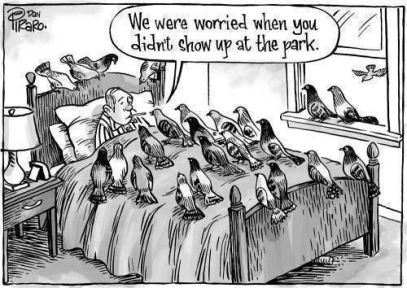
God loves us each uniquely and differently. God puts people and experiences and pets and rainbows and sunsets in our lives so that we may feel his love in all its depth – we are not alone, as Dan Piraro’s Bizarro panel here so tenderly illustrates.   Differently, not more than.  My dad loves my niece’s sense of humor – one quite similar to his own – and he loves her for even wanting to be his favorite, for boasting that she is.  That means something to her and to him.  God likes when we boast of his love for us, too.
When my children were young one of (the many) bedtime routines – after books and prayers – was to settle into a sort of litany of love. Laying beside them I would ask, “Who loves fill in the blank?” And my child would name someone, like their brother or sister. And I’d respond, “Yes, your brother loves fill in the blank.” And then I’d ask again, “Who else loves fill in the blank?” And on we’d go asking and naming all the family, friends, pets, teachers who my child knew loved him or her. I was always the penultimate one named, “Yes, I’d reply, mommy loves fill in the blank.” And at that prompt, my son or daughter would have settled in for the night – eyes closed, waiting to respond to the last, “Who else loves fill in the blank?” “God” he or she would say. “Yes, God loves you, sweet one.”

I can’t be sure but I believe this ritual gave each of my children a way to ‘feel’ God’s love, personally. Laying there all snug as a bug in their beds, my arms wrapped around them, recalling all the people God had put in their lives to love – it was a way to experience God’s love that the word alone, without modifiers or context,  doesn’t often deliver.

St Augustine wrote that God is love.  Yep, true that. But as much as I know this I don’t always feel through every cell of my being, God’s love. Perhaps because the word ‘love’ is so inadequate on its own.

There are so many ways to experience love – to love and receive love. Robert Johnson, author, psychotherapist, and former member of a Benedictine Monastery has written extensively about the inadequacy of the English word for ‘love’.  In his book, The Fisher King and the Handless Maiden, he writes:

“Sanskrit has 96 words for love; ancient Persian has 80, Greek three, and English only one. This is indicative of the poverty of awareness or emphasis that we give to that tremendously important realm of feeling. Eskimos have 30 words for snow, because it is a life-and-death matter to them to have exact information about the element they live with so intimately. If we had a vocabulary of 30 words for love … we would immediately be richer and more intelligent in this human element so close to our heart. An Eskimo probably would die of clumsiness if he had only one word for snow; we are close to dying of loneliness because we have only one word for love. Of all the Western languages, English may be the most lacking when it comes to feeling.”

It is helpful to remember that when speaking or writing or hearing anything about God’s love, our word for the truth doesn’t really function.  We have to employ modifiers such as ‘more than’ and contextualize to get the point that God is love.

The psalmist found one way to express the depth and dimension of God’s love for the chosen people of Israel – he employed the modifier:  The Lord loved us more than the people of within Jacob’s gates.

Ok.  But as I might say to my child,  “who else loves God?’   “The people of Jacob love God.”  And who else does God love?  God loves the people of Jacob.

God. Loves. Fill in the blank. More.

Praise God from whom all blessings – and love – flows.

Saturday Daily Office Readings: AM Psalm 87, 90; PM Psalm 136
2 Kings 11:1-20a1 Cor. 7:10-24Matt. 6:19-24

Posted in Whispers | Tagged , , , , , , , , , , | Leave a comment

Fine Robes, Copper Coins and Naked Ladies

Looks can be deceiving and blinding.  How often we need the eyes of the other to see God’s presence in God’s church.

In today’s gospel Jesus points to the scribes and priests fancy vestments as a way to distinguish them from the unadorned poor woman who quietly, without fanfare and position in the temple, contributes to God’s church.

‘Beware of the scribes, who like to walk around in long robes, and to be greeted with respect in the market-places, 39and to have the best seats in the synagogues and places of honour at banquets! 40They devour widows’ houses and for the sake of appearance say long prayers. They will receive the greater condemnation.’

42A poor widow came and put in two small copper coins, which are worth a penny.43Then he called his disciples and said to them, ‘Truly I tell you, this poor widow has put in more than all those who are contributing to the treasury.

A couple of days ago I was driving my father to a doctor’s appointment.  Of late, my dear dad has not been the conversationalist he was in years past as he struggles to recover physical strength lost after an extended stay in the hospital for aspirational pneumonia. Cognitively as sharp as ever, but a little slower getting a thought or observation from his head to his mouth to express.

So, there we were on our way to his doctor visit.  I had turned on some music knowing dad wouldn’t be chatting it up, short drive though it was.  He is hard of hearing and sitting in the passenger makes hearing me a challenge.

We had been on route only a couple of minutes before stopping at a 4-way intersection when he uttered something.  It was nearly inaudible so I thought he might be saying something to himself.  But as we came to a complete stop at the sign, he repeated and pointed across the intersection to the corner house – a house I had observed before and wondered about.  It was poorly taken care of in an otherwise neat and tidy neighborhood. It was a cottage like the others but had no wine-country, farmhouse charm. Eclectic is the best way of describing – bright, neon colors painted on some sections, funky stone work and an unkempt, overgrown yard.  I had surmised it housed, at best, a 70’s bohemian – maybe a poet or artist – and at worst, people dealing in drugs.

As he pointed to the house, he repeated his utterance but more clearly, “Naked Ladies.” I heard him but had no clue what he meant.  Hmm, I thought, maybe this odd looking cottage housed ‘naked ladies’, not drug dealers – and maybe they were in front and I didn’t see them? Or maybe dad was telling me something he knew and I didn’t?  He was smiling and repeated again as I searched for them.

As we proceeded through the intersection and passed the house in question, he said, “I haven’t seen those since we moved here!”  “What haven’t you seen, dad?”  Those flowers – those right there – those beautiful naked ladies.” And indeed, that’s when I saw the enormous border bed of flowers that completely surrounded the cottage. Naked Ladies[1] as in the Belladonna Lily.

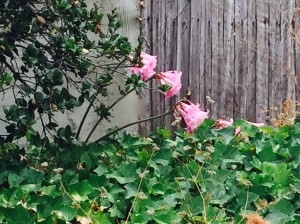
Looks can be deceiving.  When dad pointed across the street my mind’s eye took in only the house.  I didn’t know to look for the flower – gardener that I am I never learned the common name of the flower. So I heard him literally – naked ladies – and tried to connect dots with what I had pre-known or judged of the little cottage – concluding in that very brief moment that it just might have been a house of ill repute, housing a bunch of naughty naked ladies (these pictures to the right are not of the bed in front of the cottage my dad observed, but of blooms I spied on my morning walk in my neighborhood).
I had assessed wrongly relying upon my impression of such an ‘oddly dressed cottage’ to make sense of my dad’s smiling face while uttering, “naked ladies.”

The sight brought the sweet smile to my dad’s face because of all the years he had spent in Southern California where the lily blooms happily and heartily every summer.  And the sight of a that smile brought a smile to my face because of all the years my dear father has helped me see and know God’s presence and transcendence in our world.  My dad’s eye for beauty, for color, for design, and harmony has opened my eye to this otherwise ugly, colorless, shapeless world I sometimes feel I live in.

Sort of like Jesus did with his disciples today. Pause – stop and sit here with me loved ones and take in this beautiful little moment. Don’t be blinded by the robes and the rituals and the surrounding temple – all distractions to the beauty of this moment.  Look upon the poor widow with her copper coins, here in God’s church, doing the work we are all called to do.  That should bring a smile to your face.  

Praise God from whom all blessings – and Copper Coins and Naked Ladies – flow.

Friday Daily Office Readings: AM Psalm 140, 142; PM Psalm 141, 143:1-11(12) 
2 Samuel 19:24-43Acts 24:24-25:12Mark 12:35-44

[1] NAKED, BUT NOT NAUGHTY If you’re a warm weather gardener you’ve probably heard of naked ladies. It’s a name that one tends to remember. And the blossoms are pretty unforgettable, too. These big South African ladies are happiest in hot, dry locations so they’re custom made for the southwest and other warm places where conditions can be controlled by moving containers around. Belladonna lilies come into their full glory in the late summer, a time when many other flowers have passed their prime for the year. Plant some this fall and they’ll delight you with big, aromatic blossoms for years to come.

Posted in Whispers | Tagged , , , , | 1 Comment

Thy will be done..AUGH!!!!

If you attend a church that follows the first track (Track 1) of the Sunday lectionary, you have been hearing from Genesis the story of Joseph and his brothers.  For several weeks his story was broken into sections and closely aligned with the all the parables of the gospel readings from Matthew.  The threads of the Old Testament readings that wove into Jesus’ parables were many, but two stood out.  Trust and patience.  Trust God’s plan – he has one – and abide in that trust and it will come to pass.  In God’s time.  Which in Joseph’s case was decades.

The psalm today tells this story so beautifully.  Salvation history in a nutshell.

16 Then he called for a famine in the land *
and destroyed the supply of bread.

17 He sent a man before them, *
Joseph, who was sold as a slave.

18 They bruised his feet in fetters; *
his neck they put in an iron collar.

19 Until his prediction came to pass, *
the word of the Lord tested him.

20 The king sent and released him; *
the ruler of the peoples set him free.

21 He set him as a master over his household, *
as a ruler over all his possessions,

22 To instruct his princes according to his will *
and to teach his elders wisdom.

All the ups and downs of young Josephs’ life, the family dysfunction of brothers who would toss him aside out of jealously, the rescuing of him by Ishmaelites who export him to a foreign land, the opportunity provided while enslaved to use his Holy Spirit inspired insight to find favor with the leaders and people of Egypt to lead, later offering forgiveness to his brothers, saving the family from starvation, to ultimately ‘instruct his princes according to God’s will, teaching them wisdom.’  All this reported in these few verses of Psalm 105 to record this particular season of salvation history – of God’s story. Thy will be done.

Perhaps because we are coming into the fall football season, I was put to thinking of Joseph’s story as a quarter in football game.  The psalm read as a Post Game report. Always so much easier to see a game and its outcome in hindsight, don’t you think? Oh, that’s what God was up to in that season! All those first downs, those incomplete passes, interceptions, time outs – that was all part of the game plan, Joseph, to get you to Egypt! Because it is in Egypt where my next quarterback, Moses, will rise.  Let the next quarter begin.

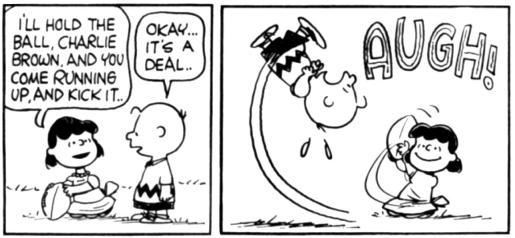
Whenever I encounter summaries of salvation history – Post Game Reports (most often in located in the Psalter) I think how nice it would be to have such a perspective of my own life – the hindsight perspective – wherein I could see the ups and downs as part of a grander plan, wherein I could see God’s hand trying to move me here, but me pushing it away to move there. Thy will be done as it is being done, lived – or not.  Like Lucy here, inviting Charlie Brown to play, but intending otherwise. Augh – such a selfish one, Lucy. How Charlie Brown continues to trust her, is patient with her.  I’ll bet Charlie Brown wished he could see read the Post Game report just once before he agreed to play again with Lucy.

I don’t want to belabor the whole football game metaphor.  Point is, the Holy Spirit pauses me often at these history lessons to think about how my story would or is being written. My story as a player on God’s team, a follower of Jesus Christ.  My story but God’s glory. How I long to know that the moves I have made so far are really and truly part of God’s plan for me and those with whom I am playing in this season of salvation history.

I appreciate the prompt from the psalm to think on these things, once again.  As much as I desire a Post Game Report of my life the past years and going forward as the psalmist does with Joseph’s story, a report that makes really, really clear what God had in mind for me this in this quarter, this season of God’s big game, I appreciate the peek at the game plan that God’s Word affords me.

God’s Word is the Post Game Report, the uber post game analysis.

By the power of the Holy Spirit I am paused to sift my life as a follower of Jesus Christ past, present and future, through the sieve of God’s Word.  Have I made any plays like Lucy?  Served myself, gone against game plan? Or am I like Charlie Brown?  AUGH!  Fool me once, shame on you.  Fool me twice, shame on me. Trust and Patience?  Am I abiding? Discerning?

Today the pause has me trusting that though I have wandered, I am not lost.  I was served a glimpse of the play book and I see that I am still in the game.  Maybe on the bench for a play or two.  But I’m all suited up patiently waiting for the call to go there, stay here, pass, kneel, hold the ball, defend.  Well, you get the point.  Just happy to be on the team.

Praise God from whom all blessings – pauses – flow.

Thursday Daily Office Readings: AM Psalm 105:1-22; PM Psalm 105:23-45
2 Samuel 15:1-18Acts 21:27-36Mark 10:32-45

Posted in Whispers | Tagged , , , , , , | Leave a comment

Mark’s post on the Transfiguration: LIKE! That cloud though!

Any number of biblical images capture my imagination and put me to thinking of the power of the Holy Spirit to connect the dots of all things seen and unseen; images that speak a thousand of God’s words.  But the image that grabs me every time – whether I am dwelling in God’s Word, worshiping in God’s church or making my way through another day in God’s world –  are clouds. I am simply captivated by the image of clouds the evangelists and scribes of the Hebrew Scriptures draw upon to describe God’s presence, God’s habitat, and God’s voice.

That being said, I don’t read scripture, worship, or go through the motions of my day with an eye towards clouds.  I don’t seek the image for a sense of the Holy, but the clouds do show up and most often where I least expect it to jar me out of a routine – even the routine of praying the Daily Office.

So it was this morning.  I really hadn’t allocated a bunch of time for praying the Office, so I entered hastily with a very very long list of TO DO’s at my right hand.  But golly gee – moving quickly through the scriptures was not what the Holy Spirit had in mind for me today.

The first was the pause at Psalm 34.  Ugh.  I have a history with this psalm and found myself recollecting how the verses have been a God-sent over recent years, how they have comforted me, and how they have continued application:

17 The righteous cry, and the Lord hears them *
and delivers them from all their troubles.

18 The Lord is near to the brokenhearted *
and will save those whose spirits are crushed.

Comforting, but also reminding me of how my spirit still feels crushed and how undelivered I am as of yet from my troubles.  I found myself hanging out in this space reading over past reflections from my journal.  I was tempted to cut the rest of the readings short.  Maybe I should rest with the reality check of the whispers of how little progress I have made, how my brokenness continues to need healing I thought to myself.

But as I read my reflections, I relaxed and allowed myself to be comforted by God’s reassurance articulated in the psalm and also to be comforted by my own words. After all, I am still here reading, praying, reflecting, allowing  the Holy Spirit speak to me and looking at my troubles through the lens of scripture.

So, despite the desire to wrap up early and get on with things, I moved ahead with the readings, landing at the gospel and the familiar story of the Transfiguration.

The Feast of the Transfiguration was this past Sunday, so honestly I thought I might have a good excuse to cut things short, after all. I was disinclined to read Mark’s version.  But. Well.  I read the gospel as if I didn’t know and hadn’t heard.  What might the Spirit be saying to me at this reading?

And there it was.  Hovering above.  In the clouds.

 7 Then a cloud overshadowed them, and from the cloud there came a voice, ‘This is my Son, the Beloved;* listen to him!’ 8 Suddenly when they looked around, they saw no one with them any more, but only Jesus.

What first came to my mind’s eye wasn’t the cloud itself, but oddly enough social media photo posts wherein someone is featuring a moment or a quip, and someone else comments back, “Those shoes, though!” or “That look, though!”  or “That sunset, though!” their eye noting something in the picture that trumps the thought posted.

I recently posted this snap of our family’s new addition accompanied by the comment that his parents had dressed him as a dragon for some event and that I wasn’t sure he was thrilled with the idea. A friend commented back, “Those eyes, though!”  Made me smile.  So on point.
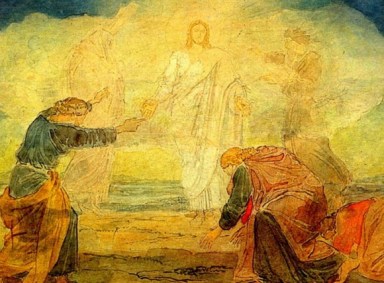
Well that’s how I would comment on the Transfiguration moment if it had been posted on the Lord’s Instagram account.   A snapshot of the scene would have Jesus in white, Peter and James stupefied and even frightened, and Moses and Elijah chatting with one another, and I would have LIKED, then commented, “That cloud, though!”

At the moment of transfiguration when the light emanating from our Lord was so intense as to have made Peter and James see things before unseen, God sends in the clouds. Covers the scene as to soften the shining white light enough for them  – for us – to see Jesus alone standing before them and to hear God’s voice.

God as in or of the clouds is an image that keeps me connected to what is already and always there – in scripture, in worship, in daily life.

I am grateful for the long pause at the psalter this morning.  For the tears I shed over the recollection that my brokenness is yet unhealed and the assurance that it will be.  And for the encouragement my own words offered to continue with the readings today all the way to gospel, where I encountered anew our loving God, hovering over us, softening the light around us enough for us to hear and hearken to his voice.  I delight in resting here today under the cloud cover where I will be delivered from my troubles.

Praise God from whom all blessings – and all the clouds – flow.

Thursday Daily Office Readings: AM Psalm [83or 34; PM Psalm 85, 86
2 Samuel 11:1-27Acts 19:11-20Mark 9:2-13

Posted in Whispers | Tagged , , , , , , , | Leave a comment

The Feeding of the 5000 mis-reported?: The significance of numbers in God’s Word

During this week’s bible study in which we prepare for the upcoming week’s worship by praying and discussing Sunday’s lections, (this Sunday, The Feast of the Transfiguration though our parish will hear Proper 13 instead)a parishioner was taken aback at my comment that the gospel story from Matthew  (14:13-21) has been mis-named as ‘The Feeding of the 5000.’  I was making the point that the number, in actuality, was probably closer to 10,000 or even above, because 5000 referred only to the men.

21And those who ate were about five thousand men, besides women and children.

The feeding was far more than 5000.

But the parishioner was taken aback because she considered the number 5000 simply symbolic of ‘a large crowd’ stating, who cares?  Why does it matter? Surely there weren’t even 5000 present – probably closer to a few hundred.  Do you really believe that numbers in scripture are anything other than symbolic?  

The discussion brought to mind the recent Inauguration and the story put forward by the incoming administration regarding crowd size – the largest ever, they claimed – citing numbers that were later invalidated.  It was a typically large crowd so what was the point of a head-count and drawing comparisons with previous Inaugural events?  It seemed to me the administration’s attempt was revisionist history in the making, believing that the largest crowd ever story line if recorded would somehow legitimize the new President’s purported popularity in a way that the general election hadn’t – at least in his mind’s eye. The storyline put out by the Administration worked at cross purposes and rather than elevating and instilling confidence in him as our country’s leader, his fragile ego now exposed introduced a tone of insecurity and suspicion that would shade all future stories coming from the Oval Office regarding leadership.

Numbers and head counts work differently in scripture.  Accuracy and symbolism are powerfully connected.  Yes, I replied to the parishioner – yes I believe that the crowd was enormous and may have even topped 5000. By calling the miracle the Feeding of the 5000 I suggested we miss the opportunity to talk about the significance of the number beyond the impression that a large crowd was fed.  Matthew was breaking with convention by reporting not only an actual number – instead of a phrase ‘a large crowd’ but also reporting that number didn’t include everyone present. The accepted practice of head counting a crowd by men only was not adequate to report the number of people who followed Jesus. Jesus broke all records so that even the record keeping methods had to be changed when the gospels were written.  And, the number had a deeper significance related to history and the Hebrew Scriptures[1].  I am not going to go down that bunny trail right now but suffice to say that all numbers found in the Bible have a deeper significance than we often pay attention to or acknowledge.

Both and.  Numbers are symbolic and they are literal, too.  Which brings me – finally – to today’s readings and the spot where the Holy Spirit paused me to wonder.  It was in the Hebrew Scriptures and the passage from 2 Samuel that recounts David’s anointing and kingship over Israel. My first thought was how the passage was populated with numbers – numbers that felt familiar even though I do not know David’s story in a familiar way. I know the outlines of his story, but the duration of his kingship, his age, the time he spent fighting the Philistines, I haven’t studied him enough to know these details.  Details which felt familiar but associated with Jesus, not David.

That was the pause.  The story line found in 2 Samuel about David’s anointing and Kingship over Israel align perfectly, number-wise, with Jesus’.  David was 30 years old – as Jesus was the start of his public ministry and served for 40 years (7 in one place, 7 a holy number, and 33 in another, 33 the age Jesus was at his crucifixion).  A total of 40 years. We all know the significance of ’40’  – those years in exile, those nights Jesus spent in the desert.  Here is the passage:

5Then all the tribes of Israel came to David at Hebron, and said, ‘Look, we are your bone and flesh. 2For some time, while Saul was king over us, it was you who led out Israel and brought it in. The Lord said to you: It is you who shall be shepherd of my people Israel, you who shall be ruler over Israel.’ 3So all the elders of Israel came to the king at Hebron; and King David made a covenant with them at Hebron before the Lord, and they anointed David king over Israel. 4David was thirty years old when he began to reign, and he reigned for forty years5At Hebron he reigned over Judah for seven years and six months; and at Jerusalem he reigned over all Israel and Judah for thirty-three years.

So.  Personal application?  Simply to appreciate the depth of God’s Word.   To pause and mine the depths and appreciate that each word, each number is given to us for a reason, as my favorite cartoonist (and I believe, theologian) Dan Piraro illustrates here.

Numbers are significant in scripture not simply to symbolize, but to connect and legitimize and have us take seriously, even literally at times, the truth of Jesus Christ.

The evangelists weren’t weaving some story together to make their guy look good, look like a leader. They were reporting actual events, actual numbers, and connecting the story of Jesus to the Hebrew Scriptures and to history.

Praise God from whom all blessings – and crowd sizes – flow.

Friday Daily Office Readings: AM Psalm 69:1-23(24-30)31-38; PM Psalm 73 
2 Samuel 5:1-12
Acts 17:1-15Mark 7:24-37

[1] 5000: The officers of the Levites gave 5000 from the flock (2 Chr. 35:9); 5000 men sent into ambush on the west of Ai (Josh. 8:12); 5000 men of Benjamin were overtaken (Judg. 20:45); 5000 fed (Matt. 14:21; Matt. 16:9; Mark 6:44; Mark 8:19); 5000 men (Luke 9:14; John 6:10); about 5000 men believing (Acts 4:4); 5400 articles of gold and silver (Ezra 1:11).


Posted in Whispers | Tagged , , , , , , , | Leave a comment

‘State of Anglican Communion’ an issue of the institution, not God’s church

Last night at the church where I serve we wrapped up a Newcomer’s Series on The Episcopal Church.  In addition to covering the final chapters of the study guide, we committed to answering questions posed at the beginning of the series that old timers and newcomers alike had posed.  A variety from ‘what is a Senior Warden,’ to ‘when are we to stand or kneel or sit’ in worship? ‘ to ‘what does apostolic succession mean? were discussed.

I addressed questions about TEC history and the current state of the Anglican Communion in the world – who was in, who was out – and why.  The broken state of the Anglican Communion has been an unsettling reality for our church for over a decade.  In recounting the history to these new Episcopalians, I was aware of how ‘institutional’ of an issue this was and is – meaning much ado about how we ‘do’ church and not much at all to do with the church God planted on the day of Pentecost.

And it occurred to me last night, and again this morning at the reading of Acts, how the institutional church has been beleaguered by this  question – who is in, who is out – and this kind of judgmental thinking since the church was born by the power of the Holy Spirit on Pentecost.

For the past weeks the Sunday gospel readings have had God’s people – and God’s church – thinking about what it means to be a follower of Jesus and about kingdom living on earth.  Jesus has used one parable after another to describe kingdom living – not as a destination but as a way of living in the here and now, transforming the world one stalk of wheat at a time.  We’ve heard much about – seeds of it, who sows it, where it falls, wheat and tares.  We have learned to look at the soil of our own faith lives to see how well prepared it was for the seed to grow, we have been encouraged to be patient, to trust the Lord’s way, and to not judge our neighbors, but to love them. Darnel (tares, weeds) looks pretty much like the wheat it grows alongside, the wheat that would be weakened should the weeds be torn out too soon, if at all.

I have found the Daily Office Readings from the Book of Acts a nice complement to the Sunday’s gospel from Matthew.  Both speak to our individual lives as Christians but also our lives as part of God’s church, part of community.  Both are speaking to how we live in community with one another – loving and not judging, growing stronger, being God’s person and church in the world.

The Book of Acts describes in part the formation of God’s church – how the seed was scattered, where it has landed and which people received, who sowed, who rejected, who watered.  And when it – the church – will be harvested and who will separate the wheat from the tares.  Spoiler alert – not us.

This is what Peter gets at in today’s passage from Acts – we cannot do the sorting.  Seeds were scattered and planted in places and in people none of us could of imagined.  And the Word has taken root in many of those places.

The way of circumcision and obedience to the Law of Moses to distinguish the wheat from the tares – who was in, who was out – no longer has agency. But it was how the Pharisees thought, asserting their priestly authority to make a judgment on worthiness based on what they observed.  From the Book of Acts in today’s reading:

5But some believers who belonged to the sect of the Pharisees stood up and said, ‘It is necessary for them to be circumcised and ordered to keep the law of Moses.’

It seems to me that church leaders through all time up to and including ours have been far too eager to make judgment calls as the Pharisees attempted on the composition of God’s church. Like hard-nosed, eager beaver, self-righteous Lucy, here.  

I think of all the groups that have ‘broken away’ from mainline institutional churches and I see eager beaver Lucy types.  Righteous or Evil?  I can make that call.  In or out?  You bet, I know the wheat from the tares!  Teaching and worship aligned with God’s Word?  Yep, it’s black and white, I know!

Except you don’t.  Anymore than the Pharisees thought they did. That call there?  That is God’s call. He is the one ‘who says‘.  God’s the one who knows. That burden – that judgment yoke has not been put upon any of us –  Pharisee or not, Episcopalian or not.

I didn’t have this passage from Acts to refer to last night as I was explaining to these new Episcopalians why some believers have left the Anglican Communion, suggesting a weakening of our presence in the world.  It would have been a good one to put in context the exit of a few, helping us all to see how God’s church is not impacted, and the institutional church only temporarily thwarted by the self-righteous,

…Peter stood up and said to them, ‘My brothers,* you know that …God, who knows the human heart, testified to (the Gentiles) by giving them the Holy Spirit, just as he did to us; 9and in cleansing their hearts by faith he has made no distinction between them and us.

10Now therefore why are you putting God to the test by placing on the neck of the disciples a yoke that neither our ancestors nor we have been able to bear? 11On the contrary, we believe that we will be saved through the grace of the Lord Jesus, just as they will.’

We – us, them – all in God’s church – are saved through the grace of the Lord Jesus.

Praise God from whom all blessings flow.

Thursday Daily Office Readings: AM Psalm 50; PM Psalm [59, 60] or 8, 84 
1 Samuel 28:3-20Acts 15:1-11Mark 5:1-20


Posted in Whispers | Leave a comment

The Happy Sower

Mark 4:1 Again he began to teach beside the lake. Such a very large crowd gathered around him that he got into a boat on the lake and sat there, while the whole crowd was beside the lake on the land. 2He began to teach them many things in parables, and in his teaching he said to them:3‘Listen! A sower went out to sow. 4And as he sowed, some seed fell on the path, and the birds came and ate it up. 5Other seed fell on rocky ground, where it did not have much soil, and it sprang up quickly, since it had no depth of soil. 6And when the sun rose, it was scorched; and since it had no root, it withered away. 7Other seed fell among thorns, and the thorns grew up and choked it, and it yielded no grain. 8Other seed fell into good soil and brought forth grain, growing up and increasing and yielding thirty and sixty and a hundredfold.’ 9And he said, ‘Let anyone with ears to hear listen!’

Today’s gospel reading from Mark was heard in God’s church just two weeks ago on Sunday, July 16, though read from Matthew’s gospel (13:1-23).  This passage known as ‘The Parable of the Sower’ is familiar enough, but on that Sunday it was the first time I heard the story from the sower’s perspective.  Through the years I have read and heard commentaries that have a lot to do with the seeds – where they land and how they grow or not – but very little about the sower, himself.  Even in one of my favorite of Van Gogh’s painting entitled, “The Sower”, it is the land and light that garner attention – a crop ready for the seed being thrown.  

I live in a region of the country that is peppered with crops of grapes, hops, apples, walnuts, almonds, olives and assorted grains.  Though I have never actually seen any of these crops ‘sowed’ – today by machine, not hand – I have seen all the preparation that takes place beforehand. The soil loosened and amended, weeds (tares) removed, furrows dug to specific depths, watered just enough to soften the growing space for the new seeds. And every few years, the crops dug up or the trees cut down so the soil can be restored, the crops fallowed. And all this takes place in certain seasons and specific times of the calendar year, adjusted when conditions such as drought and climate change manifest. Bottom line, the soil gets a lot of attention when it comes to growing rightly the seed of choice.

But, really, bottom line it comes down to the sower doesn’t it?  All that preparation means nothing if the sower has thrown the seed willy nilly into the soil, amended, watered, fallowed or otherwise.

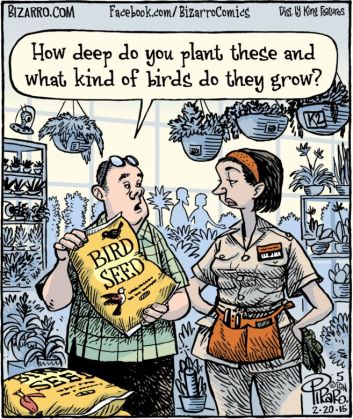
The parable Jesus tells us has the sower throwing the seed – God’s Word – everywhere; rocks, paths, cropland – here, there, everywhere – and not carefully cultivated and prepared fields. Surely the seed won’t yield fruit if aimlessly scattered, just as birds aren’t grown from the seed as depicted in the ‘Bizarro‘ panel by Dan Piraro inserted here.

Maybe we should look at the seed the sower throws differently.  Not as a word that doesn’t take root in some places and with some people, but as a gift from one who shows no partiality – who wants the good news scattered and the Word to be given freely to the world – to places and people most would say has no chance of taking root let alone yielding fruit.

Seeing this parable through the eyes of the sower – the one who throws the seed – and not through the eyes of the particular land or people on which the seed lands – helps me see God’s heart for all of us. The sower gifts the word, gifts grace, gifts faith – throws it out season after season, joyfully and hopefully.  “Here, loved one, here, take this.  Baptized?  Take this seed of faith and grow it, live it.  Imprisoned unjustly Jean Valjean? Take this seed, my Word, and let it grow in you and transform you. And here you in the desert lands of North Korea, here’s my Word of hope for you.”  

A happy scatterer, our Lord God is.  Season after season, in one craggy or soil enriched place after another, he sows.

Praise God on whom all blessings, seeds and words flow.

Monday Daily Office Readings: AM Psalm 41, 52; PM Psalm 44
1 Samuel 24:1-22Acts 13:44-52Mark 4:1-20

Posted in Whispers | Tagged , , , , , | Leave a comment

Long winded, unedited ‘word’ on Sunday’s ‘hot’ gospel: Churchgoer or disciple?

Third Sunday after Pentecost: Proper 7 Year A

Genesis 21:8-21
Psalm 86:1-10, 16-17
Romans 6:1b-11
Matthew 10:24-39

Matthew 10:24-39

Jesus said to the twelve disciples, “A disciple is not above the teacher, nor a slave above the master; it is enough for the disciple to be like the teacher, and the slave like the master. If they have called the master of the house Beelzebul, how much more will they malign those of his household!

“So have no fear of them; for nothing is covered up that will not be uncovered, and nothing secret that will not become known. What I say to you in the dark, tell in the light; and what you hear whispered, proclaim from the housetops. Do not fear those who kill the body but cannot kill the soul; rather fear him who can destroy both soul and body in hell. Are not two sparrows sold for a penny? Yet not one of them will fall to the ground apart from your Father. And even the hairs of your head are all counted. So do not be afraid; you are of more value than many sparrows.

“Everyone therefore who acknowledges me before others, I also will acknowledge before my Father in heaven; but whoever denies me before others, I also will deny before my Father in heaven.

“Do not think that I have come to bring peace to the earth; I have not come to bring peace, but a sword.

For I have come to set a man against his father,
and a daughter against her mother,
and a daughter-in-law against her mother-in-law;
and one’s foes will be members of one’s own household.

Whoever loves father or mother more than me is not worthy of me; and whoever loves son or daughter more than me is not worthy of me; and whoever does not take up the cross and follow me is not worthy of me. Those who find their life will lose it, and those who lose their life for my sake will find it.

This latest sermon was given June 26, 2017.  Once again I was scribbling thoughts late into Saturday night and on into Sunday morning on my drive into worship having unintentionally procrastinated in favor of travel.  Sigh.  Oh well.  It is the thought  – the one the Lord brings to us when we ask – that counts, right?

This audio version is from the 8 AM.  I did some heavy duty editing by the next two services, but did not record.  I thank God for the disciples attending 8 AM who patiently listened to the words of my mouth so that the meditations of all our hearts might have been acceptable to our Lord, God – our strength, our redeemer.

Onward. As a disciple in training. Ever stronger by and in him.

From the ‘hot’ gospel, the heated words of the one we follow: “Do not think that I have come to bring peace to the earth; I have not come to bring peace, but a sword.


Posted in Sermons | Tagged , , , , , , | Leave a comment