Family as Metaphor for God, the Gospel and Politics

Psalm 83:15 Drive them with your tempest *
and terrify them with your storm;

16 Cover their faces with shame, O Lord, *
that they may seek your Name.

17 Let them be disgraced and terrified for ever; * let them be put to confusion and perish.

18 Let them know that you, whose Name is Yahweh, *you alone are the Most High over all the earth.

I was surprised to see in my personal scriptural journal no reflection on Psalm 83 in all the years I have been keeping one. Surprised and yet not so much. This psalm reads to me as one I categorize as “Us-Them” – one that insists God take care of the enemy, that presumes God is on one side or another and thus on my or the ‘us’ side.  I don’t feel the Holy Spirit in psalms or prayers that ask God to do dirty work, to show ‘them’ – the other, the enemy. This psalm goes further – it asks not only that God disgrace and shame ‘them’, but also presumes that in so doing the enemy will seek and know God.  The psalmist prescribes for God a plan that will bring ‘them’ – the other – the enemy – to Him.  As if – as if shaming and terrifying the other is God’s way.  I picture God looking down in response saying,   “You want me to do what?” (an image found on Google attributed to The Family Guy).family_guy_god_incredulous00_display

Is this how non-believers come to God? Does it take the strong arm of God to ‘show them’? The strictest of disciplinarians? Is this the way non-believers get to God? By experiencing his wrath? What motivates a non-believer to change their world view?

One way is by nurturing, healing, loving and caring for one another in Jesus’ name, as illustrated in the reading from Acts, today:

11 God did extraordinary miracles through Paul, 12so that when the handkerchiefs or aprons that had touched his skin were brought to the sick, their diseases left them, and the evil spirits came out of them…When this became known to all residents of Ephesus, both Jews and Greeks, everyone was awestruck; and the name of the Lord Jesus was praised. 18Also many of those who became believers confessed and disclosed their practices. 19A number of those who practised magic collected their books and burned them publicly; when the value of these books* was calculated, it was found to come to fifty thousand silver coins. 20So the word of the Lord grew mightily and prevailed.

god-as-caretakerRather than employing the Holy Spirit to eradicate the enemy – in this case magicians trying to co-opt the name of Jesus to effect tricks of their trade – Paul becomes a vessel for the Holy Spirit to show ‘them’ God’s wonders and miracles.  The residents of Ephesus witness the healings and were awestruck  – not disgraced nor shamed or destroyed for not knowing God the Father, God the Son, and God the Holy Spirit was the way, the source of all life, the ‘Most High over all the earth‘ as the psalmist wrote.

The residents of Ephesus changed their world view and were transformed in their new belief system to the point that the word of the Lord grew mightily and prevailed.

Changing world views en masse is no easy task and certainly not as easy as the psalmist believes it should be.  Especially ones that stick – ones that usher in a sea change as what occurred in Ephesus and all of Asia during the first centuries after Jesus’ resurrection, turning households of Gentiles and Jews, cities, states, and nations to Jesus Christ.

Thinking of today’s political arena and how much a red state candidate would like to effect such change in a blue state.

Recent research has confirmed a hunch many of us have probably had about how we come to see the world one way or another, why it is so difficult to change our world views and why it is so hard to understand the world views of ‘the other’.  The research was focused on politics, but has relevant application to how a person understands God, the gospel and the other.

“Our political preferences are driven by hidden moral frameworks we’re not even aware of,” says linguistic researcher George Lakoff.

Turns out it is not as much about what you were taught or exposed to at an early age, but how you were parented. The research points to metaphor – a family metaphor as the framework. And within that framework, it is how we were raised and parented that has the most agency in our individual lives for creating the lens through which we comprehend God and the world.

I heard the research summarized on a podcast recently and couldn’t help but think of the gospel and how and why the truth revealed in scripture has cut through to some non-believers (the other, the enemy, etc as named in the psalm ) and not others.  Is it possible that this metaphor of the Kingdom of God as a family (relationship based, first relationship with God, the FATHER) ‘lay beneath the mutual incomprehension that believers and non-believers feel toward one another?’

Here is how Lakoff unpacked the idea when thinking of the divide between Republicans and Democrats that eventually lead to the research that confirmed his hunch:

“We have a metaphor that the nation is a family. We have Founding Fathers, we send our sons and daughters to war, we have homeland security, we don’t want missiles in our backyard and so on and so on,” he says. “And the idea that occurred to me is that if that’s the case, if you have two different views of the nation, you may have two different views of the family. So I worked backwards. I took the two different views of the nation, worked backwards through the metaphor and out popped two different views of the family.”

Lakoff explains the impact of the family metaphor on voting and the political landscape this way:

…differences in opinions between liberals and conservatives follow from the fact that they subscribe with different strength to two different central metaphors about the relationship of the state to its citizens. Both, he claims, see governance through metaphors of the family. Conservatives would subscribe more strongly and more often to a model that he calls the “strict father model” and has a family structured around a strong, dominant “father” (government), and assumes that the “children” (citizens) need to be disciplined to be made into responsible “adults” (morality, self-financing). Once the “children” are “adults”, though, the “father” should not interfere with their lives: the government should stay out of the business of those in society who have proved their responsibility. In contrast, Lakoff argues that liberals place more support in a model of the family, which he calls the “nurturant parent model“, based on “nurturant values”, where both “mothers” and “fathers” work to keep the essentially good “children” away from “corrupting influences” (pollution, social injustice, poverty, etc.). Lakoff says that most people have a blend of both metaphors applied at different times, and that political speech works primarily by invoking these metaphors and urging the subscription of one over the other.[11]

So, what does this have to do with the two readings from today’s Daily Office?  Just that there are many ways to God, and it would do all preachers and evangelists well to consider how we are framing the invitation to those we are blessed to witness and speak to. Are we looking for God to shame the non-believer into belief?  To disgrace ‘the other’ in order to elevate our positions before God as some sort of twisted example of righteousness?  Or perhaps and just because it is easier, are we indifferent to the non-believer or worse, indifferent to the shallowness of the faith lives of many church goers?

How does the family metaphor operate in your world view?  In your knowledge of God? What message – or how – would you bring a non-believer to Christ?  What kind of vessel are you for God’s Word?  What role does the strict parent play in your messages?  And what role the nurturer and healer?

Praise God.

Thursday Daily Office Readings: AM Psalm [83] or 146, 147; PM Psalm 85, 86
Esther 7:1-10 or Judith 12:1-20; Acts 19:11-20; Luke 4:14-30


Posted in Whispers | Tagged , , , , , , , | Leave a comment

My/Your/His/Her Story for God’s Glory

John 12:10So the chief priests planned to put Lazarus to death as well, 11since it was on account of him that many of the Jews were deserting and were believing in Jesus.

My eyes lifted at this line in today’s gospel – a sure sign that the Spirit has something to say or teach. I believe nothing is an accident in scripture – names, places, events are included for a reason – a data point, a dot, to connect to the big story.  God is in the details.

I’m aware of back to back readings that include details I have not mastered in scripture. Yesterday it was that Paul had required Timothy to be circumcised.  Today? That Lazarus – the Lazarus that Jesus had just raised from the dead only 4 days before in Bethany, the Lazarus who was brother to Mary and Martha, the Lazarus who was Jesus’ friend whose tomb he had arrived two days after Lazarus had died, this is the Lazarus Jesus wept over and then raised from the dead.  That Lazarus, as the verse reports today, was targeted for death by the chief priests, too.  I hadn’t put this together – hadn’t realized that Lazarus contributed to the chief priests concern over Jesus’ growing credibility and admiration amongst the Jews, to the point that he is named in the bible as having been targeted.

So he must have been aware – and Jesus, too.  But, wait – what happened to him?

you-know-my-name-not-my-storyI realized I had never given Lazarus much thought other than the role he played in one of the most significant miracle stories of the bible and Jesus’ ministry.  I had thought of him one-dimensionally and not considered the impact of his resurrection on his own life, but only as a prescient miracle of Jesus’ soon-to-be resurrection. I knew-  know – Lazarus’ name but not anything close to his story.

The whisper from the verse, So the chief priests planned to put Lazarus to death was enough to make me think about how stories are told, what we know, what we don’t know and who is telling.  I can’t think of a teaching or sermon I’ve studied or heard that explored the life of Lazarus beyond his resurrection.  Not to say they aren’t out there  – my quick internet search of his life surfaced myriad resources, sermons, and books too, chronicling all the named people in scripture. I have several such books in my office.  And yet – how did I not ever think to wonder more about the only other person to be resurrected in the New Testament from the dead?

I think I am speaking more about emphasis in the story – what is highlighted, what we glean from the life of the different characters in the biblical narrative.  And in this case, Lazarus.  He has, to my mind, been typecast as the one Jesus resurrected and the emphasis on that story – his story – is rightly with Jesus, the one ordained to save.

But the Holy Spirit didn’t intend for us to ignore or typecast or presume so little about Lazarus beyond his resurrection. He wouldn’t be named at this point in the gospel were there not an intention for us to wonder and to learn more about him. I think he is mentioned by John to beg the question, what happened to him?

Apparently, he fled the area once he learned the chief priests had targeted him along with Jesus. Fled?  Well, maybe not fled – but he did not show up with Jesus days later as Jesus made his triumphal entrance into Jerusalem. Lazarus is nowhere to be found and there is no further mention of him in the bible.  Plenty of online resources will fill in the story of Lazarus – of what became of him (Wikipedia‘s is good, actually) that you might find of interest. Lazarus lived long past Jesus – perhaps as much as thirty years. And though his role – his part, ends at John 12:10 in the bible, God purposed him for a life that glorified his maker.  He died in Cyprus and is known today as St. Lazarus of Bethany.

my-story-gods-gloryPoint is, the Holy Spirit pauses us to wonder about Lazarus today for a reason.  To think about his life – what it may have been like, how he was transformed, where he went, why he fled and abandoned his friend Jesus instead of walking with him to Jerusalem. These are the questions raised before me this morning – something about friendship and relationship is being stirred up – about Jesus as our friend – how we take from him but don’t give back, how we delight in him but flee his presence when we feel attacked or vulnerable.  And how we may yet live a life that glorifies God even when we flee.  Bottom line? It may be our story, but it is all for God’s glory.

I’ll be thinking on these things, today. Maybe you will, too.  I’m thankful for the prompt from the Spirit, to stop – to pause – to account for all the little dots and details woven into God’s Word that point me to Him and to how I am called to live a life that glorifies Him.

Our story – Lazarus’ story?  Yes, for God’s Glory.

Praise God.

Tuesday Daily Office Readings: AM Psalm 61, 62; PM Psalm 68:1-20(21-23)24-36

Job 40:1,41:1-11; Acts 16:6-15; John 12:9-19

Posted in Whispers | Tagged , , , , , | Leave a comment

What matters is not who baptizes you but into whom are you baptized

Paul* went on also to Derbe and to Lystra, where there was a disciple named Timothy, the son of a Jewish woman who was a believer; but his father was a Greek. 2He was well spoken of by the believers* in Lystra and Iconium. 3Paul wanted Timothy to accompany him; and he took him and had him circumcised because of the Jews who were in those places, for they all knew that his father was a Greek.

On the first read of the passage from Acts, I was paused at learning (re-learning!) that Paul required Timothy to be circumcised.  Really?  I had not recalled this little factoid.  After the huge stink he put up in Jerusalem insisting that Titus (a full Greek Gentile unlike Timothy whose mother was Jewish) specifically, not be circumcised and that new believers, generally, be allowed to join God’s church not through the Jewish door of the religious ritual of circumcision but through faith in Jesus Christ acknowledged in baptism.

As the Apostle to the Gentiles Paul was the first great ‘welcomer’, the first to preach, teach and write ‘there is no longer Jew or Greek’, the first open-table advocate, the first to ground all local expressions of God’s church in baptism.  Baptismal Ecclesiology is the term you’ll find in seminary curriculums which says simply that the biblical view of the whole church is the people of God where membership is effected through baptism.  Paul wrote as much in Galatians 3:

27 As many of you as were baptized into Christ have clothed yourselves with Christ. 28 There is no longer Jew or Greek, there is no longer slave or free, there is no longer male and female; for all of you are one in Christ Jesus. 29 And if you belong to Christ, then you are Abraham’s offspring, heirs according to the promise.

But not only does Paul appear to go against that line of thinking and his own words by having Timothy enter the church through the Jewish tradition of circumcision, he also says nothing about Timothy entering through baptism.  No mention – at all – anywhere – that  Timothy, who went on to be the first Bishop of Ephesus and a church saint, was baptized, let alone baptized by Paul who called him to serve.

My first thoughts about the circumcision piece of this puzzle leaned towards what role context and particularity plays in our faith journeys.  We live in Christ and he in us in a particular time and in a particular place.  Paul was sensitive to Timothy’s context – his family situation.  And Paul was a savvy marketer, to put it crudely.  Though Timothy’s mother was Jewish, he had not been allowed to be circumcised by his Greek father. Paul knew that Timothy’s testimony would have more agency with the unbelieving Jews of the area were he considered a full member of the Jewish church. The particularity of Timothy’s potential ministry was entirely different from Titus’ who Paul had fought so hard for against circumcision. There, in Galatia, the primary audience was Greek.  But here in Lystra and Iconium, Paul and Timothy were preaching to Jewish non-believers in Jesus Christ. To further the gospel, it is good for God’s church to be aware and sensitive to our contexts and particularities.

But as far as becoming one with God’s church, as far as the one action that unites all in believers in Jesus Christ, it is baptism and context and particularity really have no big role. From the Book of Common Prayer on Baptism:

Holy Baptism is the sacrament by which God adopts us
as his children and makes us members of Christ’s Body,
the Church, and inheritors of the kingdom of God (p858).

This catechism comes straight out of scripture and threads are found woven throughout Paul’s letters, so why no mention of Timothy’s baptism?

Paul didn’t baptize, that’s why.  Which didn’t mean that Timothy wasn’t baptized.  Indeed, he certainly was baptized and most probably by some of his brothers in Christ from the Jewish community he had been born into.  Because Timothy was a believer called to proclaim the good news of Jesus Christ it went without saying by Paul that he was baptized.

Why didn’t Paul baptize?  You’ll recall he wrote often about not doing any of the work for any reason other than to glorify God.  Paul went to great lengths to keep his name out of the mix, out of the churches he founded.  Recall him warning the church in Corinth not to get too attached to their teachers writing in 1 Corinthians:

What then is Apollos? What is Paul? Servants through whom you came to believe, as the Lord assigned to each. I planted, Apollos watered, but God gave the growth. So neither the one who plants nor the one who waters is anything, but only God who gives the growth.

Paul planted but the individuals entry into the church of God was through baptism.  And earlier in the same letter speaking to the divisions he had heard of arising from allegiance to one teacher over another, Paul clearly states why he doesn’t baptize:

For it has been reported to me by Chloe’s people that there are quarrels among you, my brothers and sisters.[b] 12 What I mean is that each of you says, “I belong to Paul,” or “I belong to Apollos,” or “I belong to Cephas,” or “I belong to Christ.” 13 Has Christ been divided? Was Paul crucified for you? Or were you baptized in the name of Paul? 14 I thank God[c] that I baptized none of you except Crispus and Gaius, 15 so that no one can say that you were baptized in my name.

In the words of another biblical commentator Paul is saying, “I avoid doing the baptizing myself, so that none of my converts will be tempted to say they were baptized in my name.”

What matters is not who baptizes you but into whom are you baptized.

Re-learning this about Paul softens my heart towards him.  I often push back at what has seemed to me to be his enormous ego that gets in the way of hearing what the Spirit is saying through him to God’s church.  I’ve written often about how I think Paul protests too much.  But today, I see him so differently, and understand him and his heart more deeply.

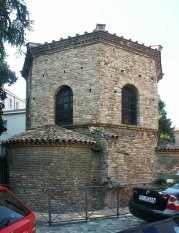
We – the church – would do well to think about Paul’s refusal to baptize when it comes to baptizing new ones in our churches.  How wonderful it would be for each town, city, borough, county to have a baptistery – a common font or pool where baptisms were done every quarter, officiated by the various faith community leaders of that place.  For we don’t baptize into any denomination, any particular church – but into God’s church.  We aren’t Methodists, or Episcopalians, or Lutherans, or non-denoms at baptism.  We are members of Christ’s Body, the Church, and inheritors of the kingdom of God.

Many churches have labyrinths or dedicated prayer and contemplative spaces for the public to access.  How lovely would it be to provide access to a community baptismal pool, integrated into the landscape of the church, (like the one pictured below which is the property of a local Dallas church).  baptism-pool-dallasOr perhaps all the faith communities of a region pitch in to build an old-school baptistery – a building separate from sanctuaries – dedicated to the sole purpose of baptizing all into God’s church (below are a few examples of baptisteries through the ages)? baptisterygohistoric_19376_mOne of my dreams to be a part of something like this one day.
What matters is not who baptizes you but into whom are you baptized.

pisa_italy_631452Praise God.

Monday Daily Lectionary Readings: AM Psalm 56, 57, [58]; PM Psalm 64, 65
Job 40:1-24; Acts 15:36-16:5; John 11:55-12:8

Posted in Whispers | Tagged , , , , , , , , | Leave a comment

Preaching on the Lord’s Day is not part of a whistle-stop tour

Acts 13: 5After the reading of the law and the prophets, the officials of the synagogue sent them a message, saying, ‘Brothers, if you have any word of exhortation for the people, give it.’ 16So Paul stood up and with a gesture began to speak:

26 ‘My brothers, you descendants of Abraham’s family, and others who fear God, to us* the message of this salvation has been sent. 27Because the residents of Jerusalem and their leaders did not recognize him or understand the words of the prophets that are read every sabbath, they fulfilled those words by condemning him. 28Even though they found no cause for a sentence of death, they asked Pilate to have him killed.29When they had carried out everything that was written about him, they took him down from the tree and laid him in a tomb. 30But God raised him from the dead; 31and for many days he appeared to those who came up with him from Galilee to Jerusalem, and they are now his witnesses to the people. 32And we bring you the good news that what God promised to our ancestors 33he has fulfilled for us, their children, by raising Jesus; as also it is written in the second psalm,
“You are my Son;
today I have begotten you.”
34As to his raising him from the dead, no more to return to corruption, he has spoken in this way,
“I will give you the holy promises made to David.”
35Therefore he has also said in another psalm,
“You will not let your Holy One experience corruption.”
36For David, after he had served the purpose of God in his own generation, died,* was laid beside his ancestors, and experienced corruption; 37but he whom God raised up experienced no corruption.38Let it be known to you therefore, my brothers, that through this man forgiveness of sins is proclaimed to you; 39by this Jesus* everyone who believes is set free from all those sins* from which you could not be freed by the law of Moses. 40Beware, therefore, that what the prophets said does not happen to you:
41 “Look, you scoffers!
Be amazed and perish,
for in your days I am doing a work,
a work that you will never believe, even if someone tells you.” ’

42 As Paul and Barnabas* were going out, the people urged them to speak about these things again the next sabbath.

Paul in synagogePaul is in Antioch and preaching in the synagogue on the Sabbath. His message is linked to the scripture readings assigned for the day from the Torah. He summarizes concisely biblical history and leads the congregants to know and believe that Jesus Christ was the promised messiah, attested to by the end of today’s passage:
 3When the meeting of the synagogue broke up, many Jews and devout converts to Judaism followed Paul and Barnabas, who spoke to them and urged them to continue in the grace of God.

So powerful. And yet the sermon itself reads rather dryly and didactically –  this happened, then this, then this and so on.  But this is just how it reads, not how it was delivered or heard. It makes a case for something and it persuades, which is precisely what a ‘word’ or an exhortation is supposed to do.  Persuasive preaching is an art form that delivers conversion, transformation, a change of heart, when grounded in the text and informed by personal experience.

Preaching launched from the day’s appointed readings – from the Lectionary – as Paul did in this house of worship on the Sabbath – is holy spirit inspired   – given breath by the Holy Spirit. Though the ultimate message was always the same, a sermon to the Gentiles and in town squares was much different than those he delivered in the synagogues.

Acts 17: 1When they had passed through Amphipolis and Apollonia, they came to Thessalonica, where there was a Jewish synagogue. 2As was his custom, Paul went into the synagogue, and on three Sabbaths he reasoned with them from the Scriptures, 3explaining and proving that the Christ had to suffer and rise from the dead. “This Jesus I am proclaiming to you is the Christ,” he declared.

Outside of the house of worship, the proclamation was determined by Paul, grounded first in his own personal experience and informed by his personal knowledge of the scriptures. Paul decided upon a theme, what we might think of today as a ‘sermon series’ to persuade the hearers of the good news of Jesus Christ.   It not only read differently, it looked different, too.  No Torah, no pulpit.  Men, women, children.

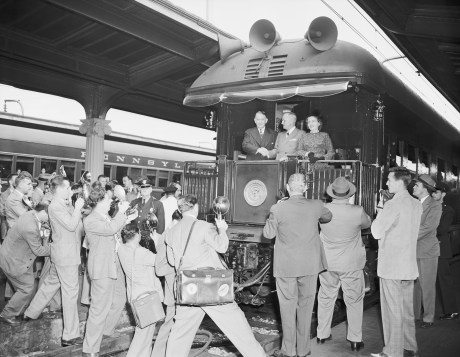
18 Sep 1948, Washington, DC, USA --- A battery of press cameras records the event as Senator Alben Barkley, of Kentucky, his running mate, bids President Truman (center) Godspeed as he left Washington's Union Station at the start of his trans - continental campaign trip. First mayor speech scheduled at Dexter, Iowa. --- Image by © Bettmann/CORBIS

Image by © Bettmann/CORBIS

I imagine these sermons packaged in a way politicians of yesterday packaged speeches delivered on whistle-stop tours. As the politician made their way across the country to address the undecided voter, they delivered sound bites – tightly crafted messages accompanied by bells and whistles to try to persuade folks to vote for them.

Paul traveled cross the country and had his testimony packaged up for delivery to the Gentiles – the undecided voter, if you will.  These sermons were different than the ones in synagogue.

Both ways bore fruit for the kingdom. People were converted and persuaded, came to Jesus Christ, gathered as the body of Christ.

On the Lord’s Day and at worship, I am much more receptive to preaching responding to the scriptures appointed for the day than I am to sermons boxed up into some biblical theme according to the whim of the preacher.   Those ‘messages’ are too much focused on the preacher – you’ll often find them spotlighted on a stage! – thus putting too much emphasis on personality and individuality and me, me, me. That message – personal salvation – was the one Paul delivered in the streets, to the gentiles. But in the synagogue? On the Sabbath? It wouldn’t have played well, I think is my point.

I think the difference is in how I understand worship and preaching on the Sabbath, on the Lord’s Day. The body of Christ gathers on Sunday to offer praise and thanksgiving to the Lord, God. The gathered time is really not about me – about the individual – but about God the Father, God the Son, God the Holy Spirit.

And the sermon, as part of that gathering, is a response to the scriptures the people hear during the worship – scriptures read from every season of the story of God’s people – the good, the bad, the ugly, the beautiful. A response, not a carefully crafted campaign speech.

I am grateful to be part of a worship community that is open week after week to hearing what the Spirit is saying to God’s people through his word.

Praise God.

Saturday Daily Office Readings: AM Psalm 30, 32; PM Psalm 42, 43
Job 22:1-4,21-23:7; Acts 13:26-43; John 10:1-18


Posted in Whispers | Tagged , , , , , , , | Leave a comment

Have you had a “Rhoda” moment?

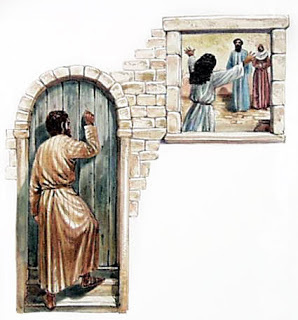
Acts12:12 As soon as he realized this, he went to the house of Mary, the mother of John whose other name was Mark, where many had gathered and were praying. 13When he knocked at the outer gate, a maid named Rhoda came to answer. 14On recognizing Peter’s voice, she was so overjoyed that, instead of opening the gate, she ran in and announced that Peter was standing at the gate. 15They said to her, ‘You are out of your mind!’ But she insisted that it was so. They said, ‘It is his angel.’ 16Meanwhile, Peter continued knocking; and when they opened the gate, they saw him and were amazed. 17He motioned to them with his hand to be silent, and described for them how the Lord had brought him out of the prison. And he added, ‘Tell this to James and to the believers.’* Then he left and went to another place.

My aunt suffered a major stroke nearly 10 years ago at age 70 – the same age her mother, my grandmother, suffered a similar stroke.  But my aunt’s was actually more severe.  She was alone in her office, working overtime, fell to the floor and was paralyzed, unable to reach a phone or call for help.  She wasn’t found until the next morning when her co-workers arrived for the new work day.  She was fortunate to have even survived through the night.  The hours spent under the desk took a heavy toll.  The left side of her face was frozen along with the entire left side of her body which was paralyzed.  She could not speak or swallow.  In the first days after the stroke the family was having to make decisions about treatment, DNR, and feeding tubes.  None of us expected her to live for long.

But she did.  Though the left side of her body remains paralyzed, her face, her speech, and her mind are fully recovered – nothing short of a miracle, actually.  Her mind had gone to a weird space during the first year of recovery but today, now nine years later, her memory and cognition are all but normal for an 80-year old.

But.  She continues to consider herself un-healed and in temporary state of paralysis. She has her church community praying unceasingly along with her for healing.  She knows the Lord can heal and trusts he will restore her to full health. To my aunt, this means she will walk again.

I was surprised to hear this from her when we visited last.  My purpose in the visit was to begin to get her thoughts on how she wanted to mark her entry into heaven.  When she died, what kind of memorial did she want, where did she want to be buried, who would she like to speak and lead the service, what hymns or scriptural readings did she prefer.  She was happy to discuss, but she added that she was still waiting for the Lord to heal her so didn’t think plans for her death were urgently needed.  And she reiterated, “I believe the Lord can and will heal me, I trust he will, I pray to him everyday and my friends are praying, too.  I just have to be patient.”

“But Auntie,” I said, “you have been healed.  Your prayers have been answered.  You wouldn’t be here today able to talk with me about any plans had the Lord not heard your prayer, our prayers, your church community’s prayers, for healing.”

At that, we revisited the early days of her stroke.  She remembered not being able to swallow and electing for a feeding tube, which some had advised against because they thought it was prolonging a life that should have passed, naturally.  We talked about her mother’s stroke.  How she had suffered one not as severe as my aunt’s and survived, but never recovered any faculties. She lived on for 8 years nearly blind, unable to speak, unresponsive to any stimulation, total memory loss and in a wheel chair.  “You have been healed,” I repeated.  “Your prayers have been answered.”

So hard to see, feel or experience sometimes the answer to prayer.  It can be right at the door knocking loudly, and we don’t answer – don’t let it in – because it is not what we are expecting.

Today’s passage from Acts reminds me to stay alert and answer the door, and be especially on the lookout for answers to prayers I have prayed unceasingly and over a long period of time. For prayers I have asked others to offer for or about me or a personal circumstance.

peter-rhodaPeter’s people – his tribe – his church community – had been praying unceasingly for his release. And it happened.  The Lord sent an angel to break him out, to return him to his people and to the work he had called him to do.  It wasn’t Peter’s time to return to the Lord, but to God’s people.  And little Rhoda doesn’t even answer the door.

Gospel singer Larnelle Harris wrote a song about this story that I’ve always remembered. It tells the story of today’s passage so well.  The lyrics are here, below.  Please listen as you read.

The Holy Spirit will likely lead you to consider your own ‘Rhoda’ moment – when you haven’t answered the door, when you haven’t seen a prayer already answered, when you’ve almost given up on the Lord to hear you, when you think you just need to keep at the prayer and be patient, when all along he was knocking on your door.

“But, you have been healed, auntie.”

Praise God.

RHODA by Larnelle Harris

Peter was thrown in prison
Made a scapegoat for Herod’s wrath
So a girl named Rhoda met with the saints
To intercede on this behalf
Hearing their prayers God answered
Like time and time again
And while still in prayer
Rhoda heard peter call
But ran to announce him without letting him in

And all of heaven said

Rhoda open the door
Don’t turn and walk away
Here is the one you’ve been praying for
And God answers when you pray
Oh don’t waste the time
Just open the door and find
That your answer to prayer is there
Rhoda open the door

Rhoda was so excited
And she shared it through many words
Though her testimony wasn’t believed
She was convinced of what she’d heard
Peter kept right on knocking
With worry on His face
Finally Rhoda opened the door
And all of her doubters just stood there amazed

All of heaven said

Rhoda open the door
Don’t turn and walk away
Here is the one you’ve been praying for
And God answers when you pray
Oh don’t waste the time
Just open the door and find
That your answer to prayer is there
Rhoda open the door

Are you an effectual fervent prayer
Casting your mountains to the sea
Or do you pray like these friends of peter
Not taking God seriously

Heaven said

Rhoda open the door
Don’t turn and walk away
Here is the one you’ve been praying for
And God answers when you pray
Oh don’t waste the time
Just open the door and find
That your answer to prayer is there
Rhoda open the door

Well now, Rhoda open the door
Don’t turn and walk away
Here is the one you’ve been praying for
And God answers when you pray
Oh don’t waste the time

Just open the door and find
That your answer to prayer is there
Rhoda open the door

Tuesday Daily Office Readings: AM Psalm 26, 28; PM Psalm 36, 39
Job 12:1,13:3-17,21-27; Acts 12:1-17; John 8:33-47

Posted in Whispers | Tagged , , , , , , , , | Leave a comment

Don’t forget to ask


Psalm 20

1 May the Lord answer you in the day of trouble, *
the Name of the God of Jacob defend you;

7 Some put their trust in chariots and some in horses, *
but we will call upon the Name of the Lord our God.

8 They collapse and fall down, *
but we will arise and stand upright.

9 O Lord, give victory to the king *
and answer us when we call.

Death on the Ridge Road by Grant Wood, 1935

Saturday Lectionary Readings: AM Psalm 20, 21:1-7(8-14); PM Psalm 110:1-5(6-7), 116, 117
Job 9:1,10:1-9,16-22; Acts 11:1-18; John 8:12-20

Posted in A Thousand Words | Tagged , | Leave a comment

O Lord my stronghold, my crag, and my haven

Been sort of stuck this past week in terms of being able to get up and out of my head and heart the Holy Spirit whispers that have come my way at the morning readings.  I shouldn’t be stuck.  I have no reason to be.  Ugh.

I left town last week to accompany a family member with a move, providing me with quiet time to connect some dots pertaining to my future ministry in God’s church as an ordained person.  I was really looking forward to seeing more clearly where God was leading me in this new season while serving and helping at the same time.

But all week I have been unsettled and on the anxious side as I make my way through the appointed readings from the Book of Acts. This morning was the icing on the cake – the protestation from Peter to Cornelius to not kneel to him, that he was only a mortal, not divine, not Jesus.

25On Peter’s arrival Cornelius met him, and falling at his feet, worshipped him. 26But Peter made him get up, saying, ‘Stand up; I am only a mortal.’

Reminded me of the priest of my home parish who instructed the congregation not to kneel at communion but stand, because it made him feel uncomfortable.  Thing was, none of us were kneeling to him in the first place.

But Peter’s humble protestation – though far from that of the parish priest I knew – triggered thoughts of all the ordained priests I know that have made ministry choices based more heavily on self – selfish – than on living into the ministry God called them to.  They occupy a spectrum. On the one end that narcissist who saw his ministry’s effectiveness only through the lens of how he was perceived.  And on the other end a priest who saw his ministry effectiveness through a universal lens blinding him to the particularity of the work God was doing through him at the local level.  In both cases, the lens is turned towards self with little regard to the folks in the pews – a sort of lack of empathy, or superiority, or at minimum an authentic interest in the personal stories of the people to whom they have been called to minister.

So all week, I’ve faced these reminders of what ministry was and does look like in God’s church as chronicled in the Book of Acts. And I’ve been taking stock of the fact that I am – have been, forever it seems – stuck at the entrance – door open – looking at all these people doing what I believed I was called to do, educated to do, trained to do, have been doing.   And yet, not all the way in the door.

IMG_2324And now, here I sit before this window looking out over Lake Michigan and staring at another set of clouds reminding me that my prayers and thoughts bubble up no matter where I am, to those that have gone before me and walked this path following Jesus, called to minister in God’s church.

But though reminded, I still feel stuck – stuck in the middle – stuck at the starting gate – stuck, stuck, stuck.  And wondering how all these priests that occupy the two ends of a parish ministry spectrum, got through at all.  And thinking about the fact that despite their dysfunctions, God worked – works – through them.  That maybe because of their dysfunctions and insecurities God purposed them for ordained ministry.

Maybe this is the thought bubble these Lake Michigan clouds of witnesses are sending me. Maybe the Holy Spirit isn’t whispering but shouting out to me loud and clear, “You have not been purposed for ordained ministry!”

The opening verses of Psalm 18 are what I am coming back to in this roller coaster of a reflection.

1 I love you, O Lord my strength, *
O Lord my stronghold, my crag, and my haven.

2 My God, my rock in whom I put my trust, *
my shield, the horn of my salvation, and my refuge;
you are worthy of praise.

I put my trust in God and in this little moment, I am trusting I have heard rightly.  I am not really stuck – maybe I’ve simply refused to move forward – refused to take the Lord’s hand onto the path He purposed for me all along,  I am not really clear where or what that is, but I am more clear in this moment it may not be ordained ministry.  And either way, my God is my refuge and worthy of praise.

Praise Him.


Thursday Lectionary Readings: AM Psalm 18:1-20; PM Psalm 18:21-50
Job 8:1-10, 20-22; Acts 10:17-33; John 7:14-36

Posted in Whispers | Tagged , , , , , , , , | Leave a comment

Eggs over easily

I was co-officiating at Evening Prayer this past weekend at a spiritual retreat – a retreat where all the attendees were long time lay and ordained ministers of God’s church. I hadn’t done Morning or Evening Prayer in community regularly since graduating from seminary two years ago and I was a bit anxious about officiating with this experienced community.

My colleague and I were pleased to find we liked to do EP the same way – we liked the same canticles, prayers, rubrics.  Since it was a Friday – a penitential day – we agreed the service should begin with Confession.  We sort of sailed through the planning when we reached the choice of the prayer at the close of the office – either The General Thanksgiving or A Prayer of St. Chyrsostum.  We both pointed to the latter.

And then he kindly looked up and said, “I know I should know but after all this time, how do you pronounce CHRYSOSTUM?  I have never figured it out exactly!”

“Me too!”  I responded.  “I pronounce this way, but frankly I am not at all certain.”

When he asked, I recalled in an instant how I had never mastered pronunciations – not just of Chrysostom’s but many biblical and historical names. Not that I hadn’t tried. I believed it important that when reading or praying or officiating at a liturgy it was my responsibility to ensure fluidity so that the hearer would not be distracted by a mispronunciation. And as a listener when someone is reading a scriptural passage and stumbles over a pronunciation or makes common errors in pronunciation, I can easily lose the train of thought and begin to wonder why the reader pronounced such and such ‘that’ way.

The final verses of the Old Testament reading from Judges reminded me of how tricky – dangerous even, ignorance of pronunciation could be:

 ‘Then say Shibboleth’, and he said, ‘Sibboleth’, for he could not pronounce it right. Then they seized him and killed him at the fords of the Jordan.

I wasn’t worried for my life when my colleague asked me to pronounce Chrysostom, but I was anxious. I said it one way, he said it another. We went with his pronunciation – it flowed more easily and sounded right and familiar (it was right – here is the phonetic pronunciation: chris sos tum).

I thought today of all the folks that come into a literary-based liturgy, one written centuries ago first in Olde English and since adapted to a variety of languages, including American English. But still. It is packed with long words here and there and the scriptural readings during the service are filled with names and places that don’t roll easily off an English-speaking tongue.

Not only is our liturgy literary, but it is also dense. We pack in a lot of words in our prayers and statements of faith and our hymns. For those worshiping week in and week out the liturgy rolls around in their heads like a familiar comforting melody. Folks who, like the gentlemen depicted in Dan Piraro’s strip, might order eggs the grammatically correct way – over easily.  Bizarro Eggs over Easily

But for those new to our pews, I am certain the density and literary style can be off-putting and inaccessible.  So much so that someone might choose to ‘just listen’ and not audibly participate. Thing is, the beauty of our worship is the corporate participation – it is not intended to be a recitation or proclamation from just the leadership, but from all the people and throughout the entire service.

I think it might be helpful to ask as my colleague did, and explain some things before worship. That gesture on his part allowed me to humbly confess my ignorance and then fully participate comfortably as an officiant with this room full of theology degrees and accomplishments far beyond mine. He didn’t set me up like the men of Gilead did to the fugitives, to fail.

We should practice the same with our parishioners each worship service. We should be sure the readers of the day have their pronunciations figured out. A simple text or email to ask if they have any questions about pronunciation will do. And then, at the welcome at the start of the service, perhaps we walk through the liturgy to point out page numbers, or rubrics (kneel, stand, respond silently or aloud, etc).

And we should also be aware that we have illiterate, hard of hearing, non-English speaking folks in our pews who we might encourage to listen for this or that. And we might simply slow it all down – the cadence – giving all a chance to chime in, find the place in the book or bulletin, and participate.

Let’s just anticipate better – ask, explain – so that all will get just what they came for in the worship – an encounter with the holy in God’s church.  Eggs over easy or easily – both work.

Praise God.

Monday’s Daily Office Readings: AM Psalm 89:1-18; PM Psalm 89:19-52
Judges 12:1-7; Acts 5:12-26; John 3:1-21


Posted in Whispers | Tagged , , , , | Leave a comment

Love _______like Jesus does

peter-and-john-with-the-crippled-man

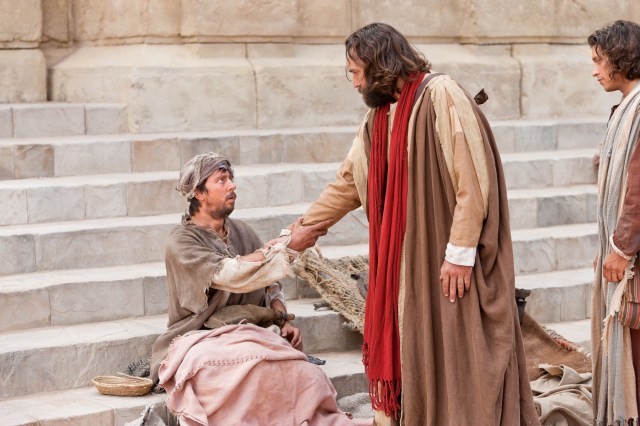
Acts 3:1 One day Peter and John were going up to the temple at the hour of prayer, at three o’clock in the afternoon. 2And a man lame from birth was being carried in. People would lay him daily at the gate of the temple called the Beautiful Gate so that he could ask for alms from those entering the temple. 3When he saw Peter and John about to go into the temple, he asked them for alms. 4Peter looked intently at him, as did John, and said, ‘Look at us.’ 5And he fixed his attention on them, expecting to receive something from them. 6But Peter said, ‘I have no silver or gold, but what I have I give you; in the name of Jesus Christ of Nazareth,* stand up and walk.’ 7And he took him by the right hand and raised him up; and immediately his feet and ankles were made strong.8Jumping up, he stood and began to walk, and he entered the temple with them, walking and leaping and praising God. 9All the people saw him walking and praising God, 10and they recognized him as the one who used to sit and ask for alms at the Beautiful Gate of the temple; and they were filled with wonder and amazement at what had happened to him.

11 While he clung to Peter and John, all the people ran together to them in the portico called Solomon’s Portico, utterly astonished.

A few years ago a homeless man began to sleep in our parish courtyard.  He arrived long after parish activity was shut down and was always up early enough to be off parish grounds before little ones arrived for pre-school. During the week he would occasionally drop into services on Wednesday or Sunday – always sat in the back, rarely took communion. Smiled but did not really engage with anyone.  Like many homeless, he looked a bit scary and distracted but behaviorally, he was calm, quiet and slow-moving. He kept to himself.

When I began serving at the parish I was introduced to “Steve,” by the Priest-in-charge, Fr. J.T., who had welcomed Steve from day one.  Apparently Fr. J.T. sort of tripped over Steve one morning having arrived earlier than usual on a weekday.  At that first meeting, Fr. J.T. set in motion the healing power of hospitality and love done in Jesus’ name.  He made him a cup of coffee and then opened the men’s room to freshen up.

Over time, Fr. J.T. invited Steve into his office just to chat – like he would any friend who happened to be in the neighborhood on any given day.   They share a cup of coffee, laugh together at the day’s news.

Steve was given some rules from the start – no smoking on the property and not to leave any of his belongings –most of which he wears or carries in a back pack – at the church. We didn’t have anything but a portico to offer for sleeping and we wouldn’t be giving him money, but he was always welcome.

Fr. J.T. outlined and offered the hospitality and the rules ‘in Jesus’ name.’  Like Peter and John, Fr. J.T. is gifted by the power of the Holy Spirit to heal.  His healing ministry was and is hospitality grounded in love – love of God and love of neighbor.  Steve, who was otherwise paralyzed by his station in life was lifted up in Jesus’ name and made strong.

Just last Sunday friends of mine came from out of the area to hear me preach. As all were exiting worship, my friend Dan was right behind Steve and heard Steve say to me how much he enjoyed the sermon. The gospel was the story of the Rich Fool. Steve and I shared a few words about its application in our lives. My friend Dan overheard and later commented how Steve’s insights were profound. Steve then put on his backpack over the several layers of clothing he always wears, and exited to the streets into the heat of the summer day. And my friend was amazed. He didn’t know Steve before but guessed that he was homeless by his appearance.

9All the people saw him walking and praising God, 10and they recognized him as the one who used to sit and ask for alms at the Beautiful Gate of the temple; and they were filled with wonder and amazement at what had happened to him.

Steve has been healed in so many ways, made strong and getting stronger every day. This season of healing for what ailed him – what made him homeless, without a job, and dealing with mental health issues on his own – was initiated by the healing gifts of hospitality and love from Fr. J.T.  There is substance behind the welcome he offers each and every soul that graces our parish grounds. He welcomes all in Jesus’ name. There is nothing more healing.

This is the difference between social services that abound in this community for the homeless, the mentally ill, the immigrant, the unemployed, seniors and shut-ins. Secular services that provide counseling, money, a bed, administrative assistance, meals – all good and necessary contributions. But as regards to healing and transformation these services rarely have the hand to pull someone up and make them strong, to move a person from a broken-state to wholeness – holiness.  No amount of money can effect that kind of change. Loving and welcoming and including the broken ‘in Jesus’ name’ simply has the power of transformation.

Acts 3 HealingFr. J.T. like Peter and John, reached down to Steve, picked him up, and said from the start, “We have no money to give you, but how about a cup of coffee and why don’t you come sit down and tell me about your story. And then, why don’t you join us for services this morning. We’d love you to join us. And, by the way, all are welcome to God’s table.”

Steve is now a smiling, engaged member of our parish community. He helps out with handyman jobs, washes dishes, attends as many services as he can, engages in sermon talks, participates in the kiss of peace and takes communion.

It didn’t happen overnight.  Fr. J.T. met and welcomed Steve nearly two years ago.  Steve still lives on the street, still wears all his earthly possessions, still battles mental illness. But he is no longer homeless. His home is our little parish. And we love him like Jesus does.

Thought of one one my favorite country songs as I was writing this blog post, Like Jesus Does.  We love Steve like Jesus does and all because Fr. J.T.  shows us day in and day out what loving God and neighbor really looks like.  Here’s the track for your enjoyment:

Praise God.

Tuesday Daily Office Readings: AM Psalm 78:1-39; PM Psalm 78:40-72
Judges 7:1-18; Acts 3:1-11; John 1:19-28

Posted in Whispers | Tagged , , , , , , | Leave a comment

We who are strong ought to put up with the failings of the weak, and not to please ourselves

JGBlock-Greener

Romans 15:1 We who are strong ought to put up with the failings of the weak, and not to please ourselves. 2Each of us must please our neighbour for the good purpose of building up the neighbour. 3For Christ did not please himself; but, as it is written, ‘The insults of those who insult you have fallen on me.’ 4For whatever was written in former days was written for our instruction, so that by steadfastness and by the encouragement of the scriptures we might have hope. 5May the God of steadfastness and encouragement grant you to live in harmony with one another, in accordance with Christ Jesus, 6so that together you may with one voice glorify the God and Father of our Lord Jesus Christ.

Neighbor. Putting up with the failings of the weak.  Making choices for the common good, not self.  Build up and encourage neighbor and the whole body of Christ is strengthened. Watering, tending, caring for your own turf – your neighbor, your people.   These are the thoughts that paused me this morning in light of news that yet another priest has left a weak, struggling congregation for greener pastures – the second I’ve learned of in just two week’s time.

One had served in the parish where I once served.  In his short time there he, along with his large family, had effected some big changes (namely, directing their outreach program to a favorite of his, a non-denominational mission in another country) and became a trusted, even loved, pastor. The parish had been withering away when the former rector had died unexpectedly.  There was a collective resistance to getting attached to a new rector. But after a long search, they  called someone who appeared to be pastorally inclined – as their late rector had been, and quickly became attached.

Then, after only 18 months, this new rector announced that he was leaving. Explained that he wasn’t really ever called to parish ministry – wanted to be out in the mission field, in greener pastures, traveling the world with his family. And away he went.

Sound effect of sucking sound here would be appropriate as the good folks of this parish felt like they had been kicked in the gut and the wind taken out of them. They are now struggling to gather the energy and enthusiasm needed to even begin a search for a new pastoral leader.  In the eyes of the departing rector, God’s church will be strengthened as he travels the world preaching the gospel – where he, apparently, feels more comfortable.  But what of the folks he has left behind?  How is God’s church going to fare in that neighborhood?  Who will water that little piece of God’s garden?

So, too, with another of God’s local churches whose pastoral leader has recently chosen to leave for a different neighborhood. He was called to serve at a parish barely holding on after having been abandoned by their pastor years before because of a profound disagreement with the national church’s position on human sexuality. This wasn’t the only parish to have been abandoned by ordained leadership for the same reason. Many left and actually took entire congregations with them to what they considered ‘safe harbors’ and better neighborhoods, aligning their congregations with a different organizational chart, if you will, of authority. This preoccupation with the national church’s platform and position on one issue caused a schism in the national church and many, many local folk – many local parishes – many in the body of Christ – were just left in the dust, grieving.

This particular parish had seen their priest exit, taking with him several congregants. Since then, they had been through a few interims. It took a lot for them to move past their collective resistance to bonding with any new leadership and yet they knew they had to else they wither away.  A match was finally found and that priest stepped in and up, was welcomed, and became beloved. He engaged with the community helping them identify where healing was needed, lead them to it and began to lead them through it.  The folks began to respond, to get attached, wanted him to stay on and lead them back to full health.

But it wasn’t an easy time for him and a bit of an uncomfortable fit at first. Theologically and doctrinally he aligned with those newly created neighborhoods the previous leadership had put together. He found himself challenged to do the work God sent him to do in this broken parish community and felt increasingly that his ministry in the broader church was unappreciated.  He’s always had issues with the national church and it wasn’t easy for him to ignore what he considered ‘insults’ on his ministry.  All this, despite the truth that he was encouraging the weakened neighbor, that he was doing exactly what Paul reminds us all to do with God’s people for the purpose of building up God’s kingdom.

Them bam.  One of these new churches reaches out to him – to his ego, for the good purpose of building him and thus, their neighborhood.  His ego is watered.  The pastures look greener over there.

Like the former pastor, he is loses sight of the folks he is pastoring – sees them not as neighbors he has been called to strengthen any longer. He casts his eyes outward in search of a place where ‘insults’ will be no more.  He leaves – abandons them for a safer harbor, for the suburbs, for a place that would make him feel comfortable.grass

In both cases, the existing community was in a weakened state when these two rectors stepped in to strengthen and encourage them in their faith.  They each accepted the call ‘for the purpose of building up the neighbor’, ‘living in harmony’ with them, so that together they – their community, God’s church  – would glorify God.  So what happened?

In both cases, the needs of self trumped the needs of neighbor.  Safe harbors were sought. Their ministries were excised from God’s church – cut out as if they existed in isolation – the minute they each decided to please self, take care of self, choose different neighbors and a different neighborhood.

Are we to ‘choose’ our neighbors?  Pick who we want to encourage and who we don’t?  Is this really our call?  Last time I checked it is clear everyone is our neighbor – so, no, we don’t get to pick our neighbors – any more than we pick our family of origin.

And when it comes to proclaiming the gospel and leading in God’s church, I can’t think of anything more offensive than leaving a wounded, hurting, weakened community high and dry because someplace else might offer me a chance of doing ministry the way I want to do ministry.

We who are strong ought to put up with the failings of the weak, and not to please ourselves. 2Each of us must please our neighbour for the good purpose of building up the neighbour.

I am saddened for the good people in both these parishes.  How will they ever trust again?

We who are in ministry leadership are wise to remember the local, personal nature of parish ministry.  We are called to serve very particular people in a particular place. When pastors fail to consider the people of God’s church as neighbors but instead as a ‘thing’ –  a parish (I am not called to be a parish priest, but a missionary) or as part of a national organization (I don’t agree with the national church on most issues) they are vulnerable to making self-serving ministry decisions – moves and decisions that do not glorify God but glorify self.

And God’s church is weakened.

Just makes me sad.

Thursday Daily Office Readings: AM Psalm 50; PM Psalm [59, 60] or 66, 67

Joshua 9:3-21; Rom. 15:1-13; Matt. 26:69-75


Posted in Whispers | Tagged , , , , , | Leave a comment