

We who are strong ought to put up with the failings of the weak, and not to please ourselves

JGBlock-Greener

Romans 15:1 We who are strong ought to put up with the failings of the weak, and not to please ourselves. 2Each of us must please our neighbour for the good purpose of building up the neighbour. 3For Christ did not please himself; but, as it is written, ‘The insults of those who insult you have fallen on me.’ 4For whatever was written in former days was written for our instruction, so that by steadfastness and by the encouragement of the scriptures we might have hope. 5May the God of steadfastness and encouragement grant you to live in harmony with one another, in accordance with Christ Jesus, 6so that together you may with one voice glorify the God and Father of our Lord Jesus Christ.

Neighbor. Putting up with the failings of the weak.  Making choices for the common good, not self.  Build up and encourage neighbor and the whole body of Christ is strengthened. Watering, tending, caring for your own turf – your neighbor, your people.   These are the thoughts that paused me this morning in light of news that yet another priest has left a weak, struggling congregation for greener pastures – the second I’ve learned of in just two week’s time.

One had served in the parish where I once served.  In his short time there he, along with his large family, had effected some big changes (namely, directing their outreach program to a favorite of his, a non-denominational mission in another country) and became a trusted, even loved, pastor. The parish had been withering away when the former rector had died unexpectedly.  There was a collective resistance to getting attached to a new rector. But after a long search, they  called someone who appeared to be pastorally inclined – as their late rector had been, and quickly became attached.

Then, after only 18 months, this new rector announced that he was leaving. Explained that he wasn’t really ever called to parish ministry – wanted to be out in the mission field, in greener pastures, traveling the world with his family. And away he went.

Sound effect of sucking sound here would be appropriate as the good folks of this parish felt like they had been kicked in the gut and the wind taken out of them. They are now struggling to gather the energy and enthusiasm needed to even begin a search for a new pastoral leader.  In the eyes of the departing rector, God’s church will be strengthened as he travels the world preaching the gospel – where he, apparently, feels more comfortable.  But what of the folks he has left behind?  How is God’s church going to fare in that neighborhood?  Who will water that little piece of God’s garden?

So, too, with another of God’s local churches whose pastoral leader has recently chosen to leave for a different neighborhood. He was called to serve at a parish barely holding on after having been abandoned by their pastor years before because of a profound disagreement with the national church’s position on human sexuality. This wasn’t the only parish to have been abandoned by ordained leadership for the same reason. Many left and actually took entire congregations with them to what they considered ‘safe harbors’ and better neighborhoods, aligning their congregations with a different organizational chart, if you will, of authority. This preoccupation with the national church’s platform and position on one issue caused a schism in the national church and many, many local folk – many local parishes – many in the body of Christ – were just left in the dust, grieving.

This particular parish had seen their priest exit, taking with him several congregants. Since then, they had been through a few interims. It took a lot for them to move past their collective resistance to bonding with any new leadership and yet they knew they had to else they wither away.  A match was finally found and that priest stepped in and up, was welcomed, and became beloved. He engaged with the community helping them identify where healing was needed, lead them to it and began to lead them through it.  The folks began to respond, to get attached, wanted him to stay on and lead them back to full health.

But it wasn’t an easy time for him and a bit of an uncomfortable fit at first. Theologically and doctrinally he aligned with those newly created neighborhoods the previous leadership had put together. He found himself challenged to do the work God sent him to do in this broken parish community and felt increasingly that his ministry in the broader church was unappreciated.  He’s always had issues with the national church and it wasn’t easy for him to ignore what he considered ‘insults’ on his ministry.  All this, despite the truth that he was encouraging the weakened neighbor, that he was doing exactly what Paul reminds us all to do with God’s people for the purpose of building up God’s kingdom.

Them bam.  One of these new churches reaches out to him – to his ego, for the good purpose of building him and thus, their neighborhood.  His ego is watered.  The pastures look greener over there.

Like the former pastor, he is loses sight of the folks he is pastoring – sees them not as neighbors he has been called to strengthen any longer. He casts his eyes outward in search of a place where ‘insults’ will be no more.  He leaves – abandons them for a safer harbor, for the suburbs, for a place that would make him feel comfortable.grass

In both cases, the existing community was in a weakened state when these two rectors stepped in to strengthen and encourage them in their faith.  They each accepted the call ‘for the purpose of building up the neighbor’, ‘living in harmony’ with them, so that together they – their community, God’s church  – would glorify God.  So what happened?

In both cases, the needs of self trumped the needs of neighbor.  Safe harbors were sought. Their ministries were excised from God’s church – cut out as if they existed in isolation – the minute they each decided to please self, take care of self, choose different neighbors and a different neighborhood.

Are we to ‘choose’ our neighbors?  Pick who we want to encourage and who we don’t?  Is this really our call?  Last time I checked it is clear everyone is our neighbor – so, no, we don’t get to pick our neighbors – any more than we pick our family of origin.

And when it comes to proclaiming the gospel and leading in God’s church, I can’t think of anything more offensive than leaving a wounded, hurting, weakened community high and dry because someplace else might offer me a chance of doing ministry the way I want to do ministry.

We who are strong ought to put up with the failings of the weak, and not to please ourselves. 2Each of us must please our neighbour for the good purpose of building up the neighbour.

I am saddened for the good people in both these parishes.  How will they ever trust again?

We who are in ministry leadership are wise to remember the local, personal nature of parish ministry.  We are called to serve very particular people in a particular place. When pastors fail to consider the people of God’s church as neighbors but instead as a ‘thing’ –  a parish (I am not called to be a parish priest, but a missionary) or as part of a national organization (I don’t agree with the national church on most issues) they are vulnerable to making self-serving ministry decisions – moves and decisions that do not glorify God but glorify self.

And God’s church is weakened.

Just makes me sad.

Thursday Daily Office Readings: AM Psalm 50; PM Psalm [59, 60] or 66, 67

Joshua 9:3-21; Rom. 15:1-13; Matt. 26:69-75


Posted in Whispers | Tagged , , , , , | Leave a comment

Wake up calls from Jesus

Matthew 26:41Stay awake and pray that you may not come into the time of trial;* the spirit indeed is willing, but the flesh is weak.’

I think this admonition from a grieving Jesus to his friends who fell asleep while he prayed in Gethsemane ‘My Father, if it is possible, let this cup pass from me; yet not what I want but what you want,’ played a significant role in my own prayer life for years. It got under my skin, sort of taunting me, challenging me to think about trials, faith, my prayer life, my ego, ambition, and vocation.

During the Prayers of the People, especially my mind would wander and wonder. Do I have such faith that in a time of trial I will respond and do what God wants? Or will I be weak, and not be able to handle a trial? Will I know God’s will? Will I talk with him about it?

I would then go on to name all the possible trials that were sure to come my way: everything from a natural disaster due to living in an active earthquake zone to health issues – my children’s or my own, to loss of income, premature death of a loved one. When a fellow parishioner faced a trial and we, God’s people, were asked to pray for the person or family, I would do so earnestly and then go to a sort of dark place where I wondered if I would even know to ask for prayers were I in such a situation.

Wake Up CloudsOne Sunday, as I was leading the Prayers of the People, I began to weep at a petition to pray for a family who had lost a son. My mind went to the ‘could I handle this?’ place. I thought of me in that moment – not the family – ugh.  How in the world? I had fallen asleep – the spirit willing but my own concern weakened me.  Just as the disciples had done when asked to watch out for Jesus.  It was a wake-up call.  Jesus was standing over me saying, “Really?  You couldn’t even stay awake for me?

I was scared, truth be told. Life was good on all fronts it seemed to me. Comfortable, full of love and life, God-centered. But I knew a trial would be coming – maybe already had and I hadn’t responded as God had intended.

The unspoken fear that I would not stay awake during the night for Jesus prompted me to get prepared. I wanted to be one of God’s people who stayed awake, who did God’s will, who discerned God’s hand and not one who took Jesus’ presence in my life for granted, who tired of the walk and was thus unprepared for any trial to come. And so I began a season of deepening my relationship with God, with God’s Word, and with worship.

But even Peter who was as deep in relationship with Jesus as any human has ever since, fell – asleep. Jesus admonishes him, along with others, ‘You have no idea – just no idea – what it is like to obey your Lord, God when it goes against every human inclination you have. You are so not ready for any difficulty.  You may think you are living by the Spirit, but news flash – not even close.’

This was one of the first wake-up calls to Peter.  Others would come, as in the night he denied Jesus three times.  But those trials matured Peter.  Good came of them and God’s will be done was fully realized in Peter’s life.

The trial that eventually came my way surprised me. In all the years of praying through the litanies of ‘what ifs’ the one I had never considered, hadn’t anticipated, had never crossed my radar screen – well that was the one that was visited upon me.  It took me awhile to recognize it as a trial at first.  But when I did , I felt equipped to walk through it with God. In fact, my first thought was, ‘This is why you have done all this preparation – just for this. Don’t worry, loved one, you can handle this.

So, I stayed awake, I was attentive, I prayed, I asked others to pray with me. I wanted to do what God wanted. I wanted to discern what God was doing.

As I look back now, I believed I was doing the right thing, responding as God had wanted me to respond, going where God was leading me. God’s will be done. That was really my bottom line prayer during that season.

I’m through that particular trial and I am slowly coming to realize that God’s will was done. But I have not reached the point where I comprehend, why – why this trial, why this test, what was the point? I see no good that has come of the trial. I don’t see the blessing.

Which leads me to wonder whether it is really over – this particular trial.  Is God still working on me – testing me.  Am I awake?  Paying attention?  Trusting where the spirit is leading my head and heart?   I’ve had others tests and trials along the way and in those I see blessings and God’s will so clearly.  Why not this one?

Though I see no blessing I have endured.  I am not cynical, just momentarily confused.  I suppose I am stronger spiritually from having come through and accepting God’s will was done.

I had hoped not to wonder or revisit this season of trial, again.  I feel so over it.  And yet, by doing just what Jesus prompted me to do so many years ago – to go deeper in His Word, deeper in Worship, deeper in my relationship with God, our abba Father – the Spirit sent me a wake up call – again.  Paused to remind me that nothing is over until the Lord, God says so.  Paused to remind me to stay alert, to continue seeing all things through the Spirit and not the Flesh.  And in so doing, His will be done.

Praise Him.

Monday’s Daily Office Readings: AM Psalm 41, 52; PM Psalm 44
Joshua 7:1-13; Rom. 13:8-14; Matt. 26:36-46

Posted in Whispers | Tagged , , , , , , , , , , , , , , | Leave a comment

No blue? Perceiving is believing

14 But how are they to call on one in whom they have not believed? And how are they to believe in one of whom they have never heard? And how are they to hear without someone to proclaim him? 15And how are they to proclaim him unless they are sent? As it is written, ‘How beautiful are the feet of those who bring good news!’ 16But not all have obeyed the good news;* for Isaiah says, ‘Lord, who has believed our message?’ 17So faith comes from what is heard, and what is heard comes through the word of Christ.*

Today’s passage from Paul’s letter to the Romans had me thinking about the folks in the world – many baptized Christians – who have heard the gospel from other folks sent to proclaim the Word, but at the end of the day haven’t believed in Jesus Christ as a personal savior and have no personal relationship with the triune God. Many in God’s church would say these folks are not ‘saved’, that they are not ‘real’ Christians. And those same people who would make that claim would be quick to site scripture to ‘prove’ that if someone hears the gospel then the job of the proclaimer is done and the ball is in the hearer’s court. Once heard, if you choose not to believe in Jesus Christ and call upon him, then, you will have to live with the consequences.

This interpretation develops from the point-of-view of a proclaimer – one called to preach the gospel to the four corners of the world. It presumes that because the proclamation is Holy Spirit inspired, the Word of God will be understood by all fortunate enough to hear. As on the day of Pentecost, when with a mighty wind the Holy Spirit descended upon all the tribes that had gathered in Jerusalem for the Passover so that they were each able to hear the good news Peter proclaimed. Not only heard but also understood and believed despite the plethora of ‘tongues’ (languages) peculiar to each tribe. The word was received in the hearing on Pentecost.

But how might we interpret Paul’s “hearing is believing” conclusion from the perspective of the proclaimer? In other words, if we don’t presume that all proclaimers get it right? Paul’s point is based on the gracious assumption that all call to proclaim the gospel, to walk the four corners of the earth so that all might be exposed to the gospel, are using language and witness and testimony that makes the Word known to the hearer.

I just don’t think this is a safe assumption. When I look around at God’s church, I see many filled with baptized Christians who don’t know what they believe or how to apply what they believe to how they then, shall live. There is some disconnect that has, perhaps, been ushered in not by the hearers, but by the proclaimers.

It seems to me the folks that assert that those who hear but don’t believe are not saved are assuming and presuming that the Word proclaimed through the prophets of today is comprehended. Some site Paul’s lack of success in Athens, for example, where the Word proclaimed through him was rejected. No church was established in Athens.

But I wonder. Was that the failure of the people to comprehend? Or was Paul’s message to that particular crowd the right one? How did he adjust his ‘pitch’ to fit his crowd, as Jesus so aptly does throughout his ministry using agrarian, royal, familial, political, economic, academic, religious language and metaphor to describe the realm of God, so that the hearer could perceive what they could not have possibly known or imagined. Helping the hearer perceive a truth that is beyond one’s imagination is just what Peter did, and Paul did for the most part, and all the apostles and disciples and church fathers, too. And many a preacher through time.

But that today’s church is filled with believers whose lives are not terribly distinct from non-church goers makes me wonder about what today’s proclaimers are preaching. How are we helping – or not – hearers perceive a truth beyond their imagination so that the truth would be applied in their lives, to be more like Christ, and less like the culture?

I find the research in color usage fascinating relative to perception. Did you know that ancient languages didn’t have a word for ‘blue.’ Scientists believe this is because our ancestors didn’t know the color existed. Say what?  Turns out that until we have a way to describe something, we may not see its there.[1]  So our ancestors did not see ‘blue’.

Not all of our ancestors.  Egyptians produced blue dyes and thus were the first ancient civilization to have a word for the color blue. Once their product spread others picked up on the color and began to integrate into their vocabulary and writing.  And they began to see ‘blue’ in the water, in the sky, in eye color.

Do you know that the color blue is not mentioned once in the New Testament and and its appearance in the Torah is questioned (there are two words argued to be types of blue, sappir and tekeleth, but the latter appears to be arguably purple, and neither color is used, for instance, to describe the sky).

Very few colors are named at all in the bible, which is so interesting to think about if you, like me, find the colors of God’s creation – in sunsets, in oceans, in mountains, valleys, skies, clouds, flora and fauna, in eye color, in skin tones, in sandstone, in night skies, in moons, in snow, in water, rivers, insects…well in absolutely everything, breath-taking. IMG_1555 IMG_1174 IMG_1388 photo 2 photo 3


I can’t tell you how many times I would say to my young children as we drove here or there, ‘look at the sunset God painted tonight’, or “see what palette God is using today to tell us something.” It is so hard for me to imagine a world where I don’t see a blue because there is no word for blue.

But this is how it is for the human brain, it seems. We have to have the word to know the Word. So my hunch for all those churches filled with folks who have heard but don’t believe as Paul presumes they will simply upon the hearing, is that the right words haven’t been preached. And the proclaimer in those places and on the street corners and on the television or podcast or wherever might do them and the Lord God a favor to think about the words they are using, what they are saying.  Preaching blue when blue is an unfamiliar concept?

Perception is reality. Yes. But if you are called to help God’s people to perceive a truth beyond their imagination so that they might comprehend and believe and apply that truth to their lives, I think you – we – have a huge responsibility to ensure we are using words that reveal the Word. Let’s not presume or assume. And let’s certainly not judge hearers who don’t practice what we preach. Let’s look at our messages. Is the Holy Spirit coming through?  And just how many colors are in your preaching pallet?  

Saturday Daily Office Readings: AM Psalm 20, 21:1-7(8-14); PM Psalm 110:1-5(6-7), 116, 117  Deut. 34:1-12; Rom. 10:14-21; Matt. 24:32-51

[1] http://www.dailymail.co.uk/sciencetech/article-2976405/Could-ancestors-blue-Ancient-civilisations-didn-t-perceive-colour-didn-t-word-say-scientists.html

Posted in Whispers | Tagged , , , , , , , , , , , | Leave a comment

Getting unstuck, changing the tire and moving into the open place

If I had ever had the discipline of memorizing scripture this would be a verse from today’s Psalm 18 that I would like to have mastered. It would lie in the top tray of my scriptural tool box where I could easily find it when I needed to fix a bad attitude.

 20 He brought me out into an open place;

*he rescued me because he delighted in me.

By bad attitude I mean anything that keeps me stuck staring at the problem and not doing anything to change it – expecting others or God, even – to resolve all by retreating and just waiting.

flat tireNot unlike the quip:  A bad attitude is like a flat tire. You can’t go anywhere until you change it. 

A bad attitude that keeps me on the roadside, holed up to deal with whatever problem I find myself facing, tricked into thinking anything will change.  I have to change the tire, for heavens sake.

A bad attitude oriented towards self protection and thus inward and blind to all the ways out – into the open – the Lord provides.  Fix the tire, with God’s help, and I can be on my way.

The idea in the couplet that God saves us from our own worst enemy – our selves – by bringing us out into the open is an easy one for me to grasp.

That God did so because he delights in me? That truth hasn’t really sunk in –  is not woven into the fabric of my being, as I like to say. But I do know that I can’t glorify Him if I am turned inward. If I am holed up. If I retreat into my own way of problem solving and doing things. If I am focused on self-preservation, me, myself and I. God brings me into the open because that is the only place where my life can be lived to truly glorify him.  But I have to be willing to go there with Him – to move out, to get unstuck.

A few years ago I hit the road to tour Frank Lloyd Wright designed homes, churches and commercial buildings having become increasingly attuned to the role architecture plays in a person’s relation with the physical space in which they live, play and work.

Wright built into his buildings the idea found in the psalmist’s couplet: being moved by some energy (God’s hand) from a restrained, compressed, uncomfortable, inwardly oriented space and into the open.

Wright used “compression and release” to make his buildings “speak” directly of freedom (openness)…Compression and release, which is also known as “tension and resolution” or “embrace and release,” were concepts that Wright used in many of his designs. This confining space, termed the “compress,” made the visitor uncomfortable and encouraged them to move from the entrance into the larger main room, hence the “release.” The “release” also imparts a feeling (or the impression) of freedom. [1]

Going through something uncomfortable to be released – saved? – into the open, well, this is just what I hear the Spirit saying in today’s psalm. As Wright designed openness into his structures, so our Lord God weaves it into ours; compression, hard times, uncomfortableness, trial, tension and retreat into self to at some point be released into the open where He wants us in order to glorify.

I can remember the first time I walked through Wright’s Taliesan home in Wisconsin. A dark, dank entry – room for only one person at a time – and then into the open room where the outdoors and indoors were one open, glorifying space. A person could not help but be moved and feel the peace and beauty in their bones. This is what it feels like to be saved,I thought, to be moved out of darkness, out of my own head, out of the hole I might have retreated into, and into the open.

I am paused at thinking about all the godly associations with the word ‘open’ as both the psalmist and Wright seemed to have understood. First, an open space has no walls or barriers, all of God’s creation is seen as was created – outdoors and indoors as one in Wright’s homes, for example. Second, finding yourself in an open space makes you more vulnerable and exposed, but at the same time more alive. There is nothing in me that wants to linger in the entry ways or hallways of a Wright home, especially after discovering what awaits. So, too with life. Why linger in the dark, dank space of a bad attitude? Why remain stuck in a hallway, with a flat tire.

Open.  God brings me into the open, time and time again.  He saves me from my self – my own worst enemy – boots me out of the dark entry way to life so that I may live it as He would have me do so – in the open, in the light.

Praise Him.

Thursday Daily Office Readings: AM Psalm 18:1-20; PM Psalm 18:21-50
Deut. 3:18-28; Rom. 9:19-33; Matt. 24:1-14

[1] The evolution of Wright’s architecture was briefly summarized by Donald Hoffman in “Understanding Frank Lloyd Wright’s Architecture” (Dover Publications, Inc., 1995).

Posted in Whispers | Tagged , , , , , , , | Leave a comment

CIP, Kaizen and Sanctification

The-Road-of-SanctificationRomans 6: 22 But now that you have been freed from sin and enslaved to God, the advantage you get is sanctification.

I’ve come to think of sanctification as the process of continuous improvement. At our baptism our individual lives – and the life of God’s church – are set upon a road of continuous revelation, conversion, modification and formation headed to perfection in Christ Jesus.  We arrive in eternal life with Him by way of our own road and our own process as determined by Him, and all in God’s time, fully sanctified.

The ‘continuous improvement process’ (CIP) is a business term coined by the Japanese organizational theorist, Masaaki Imai, in his 1986 book Kaizen: The Key to Japan’s Competitive Success.[5] (the translation of kai (“change”) zen (“good”) is “improvement”). As explained in Wikipedia, CIP

is an ongoing effort to improve products, services, or processes. These efforts can seek “incremental” improvement over time or “breakthrough” improvement all at once.[1] Delivery (customer valued) processes are constantly evaluated and improved in the light of their efficiency, effectiveness and flexibility.

KaizenThe Kaizen method includes the following that I find to have direct application to the individual and corporate Christian life, summarized to the right as CHECK, ACT, PLAN, DO  – then repeat:

  • Feedback: The core principle of CIP is the (self) reflection of processes
  • Efficiency: The purpose of CIP is the identification, reduction, and elimination of suboptimal processes.
  • Evolution: The emphasis of CIP is on incremental, continual steps rather than giant leaps.

Key features of Kaizen include:

  1. Improvements are based on many small changes rather than the radical changes that might arise from Research and Development
  2. As the ideas come from the workers themselves, they are less likely to be radically different, and therefore easier to implement
  3. Small improvements are less likely to require major capital investment than major process changes
  4. The ideas come from the talents of the existing workforce, as opposed to using research, consultants or equipment – any of which could be very expensive
  5. All employees should continually be seeking ways to improve their own performance
  6. It helps encourage workers to take ownership for their work, and can help reinforce team working, thereby improving worker motivation.

To my way of thinking Paul’s encouragement to the Romans is to commit to a process of self-reflection, a necessary feature of Kaizen, a necessary step in sanctification. And as Paul writes on about sin, I see him simply asking, to whom are you beholden? Are your day-to-day choices coming from the right place – from your ego (flesh) or from the Spirit within you? Are you day in day out ‘continually seeking ways to improve your own performance?’ Once we commit to Jesus Christ, we are to live according to the SPIRIT. We are launched, then, on the path of sanctification, fully committed to a process of continuous improvement.

A process that is better realized incrementally than a one-off.   A path marked by forward moving steps, stops, reflections and adjustments towards sanctification. A life-time of reflection, trial, and small improvements that strengthen our identity in Christ.

A key aspect to continuous improvement is the participation of all the employees. Everyone is to be on board and few are the top-down decisions that we so often think of in the business world.

God’s church, it seems to me, should operate likewise – participation from all of God’s people, all the time, in worship and in the in-between times in the world. We can’t improve on our own – we need one another – nor with an unengaged, limp effort every now and then. Sanctification is a process, an on-going way of living in this world.

How are you engaged in your own Christian maturity and formation? What role does worship play in your walk? How often are you self-reflecting? Does your worship community encourage you by asking you to participate or are you an observer of others? Are you entertained or are you engaged? Do you own your baptismal identity? Are you making incremental changes, day by day, by the Spirit and God’s word?

Time to get – or re-get with the program, perhaps?  Life, as we all like to say, is a journey and not a destination. It is a process or continual improvement and in Christ it is a process of sanctification.

Praise Him.

Monday Daily Office Readings: AMAM Psalm 106:1-18; PM Psalm 106:19-48
Num. 22:1-21; Rom. 6:12-23; Matt. 21:12-22

Posted in Whispers | Tagged , , , , , , | Leave a comment

#islike: Jesus shows us how to hear and be heard

Several years ago a distant relative who had looked to me during her pregnancy for tips, for baby showers, for the way of mothering, for the how-to transition from career person to full time mother, called me in a rage just after arriving home from giving birth to her first child. ‘You never told me childbirth was like this! Why didn’t you tell me how painful it was and how horrible I would feel afterwards?  This is the worst thing, ever! You and everyone else lied to me – said it would be easy. No one ever told me it was like this!’

She had a breast infection from nursing after only 3 days. I knew how painful that could be and I had great sympathy. But I was so taken back by her charge that ‘no one ever told her how awful giving birth was’ and her charge that I along with other friends and family had actually ‘lied’ to her, that I didn’t know what I could possibly say to comfort or assure her that the pain would pass. All I could do was offer to come over. Which I did – only to find her still in a rage and determined to never breast feed again.

As I held her newborn, I thought of what I could have said differently before her baby was born that would have prepared her on some level for the difficult part of birth and nursing. Anyone who has delivered a baby experiences varying levels of pain before, during, and after childbirth.  I did.  But it had never occurred to me then – nor even to this day – to point to that part of the experience as a way of preparation for childbirth.  I hadn’t lied to her, I hadn’t hidden anything. Pain simply did not define my experience in childbirth. Nor did postpartum depression.  I didn’t have that experience, so I could not have said so to her. But I wondered. Could I really have said anything to her – anything that would have helped, that she would have even heard?

How deaf are we to other people’s experiences in anything as a way of pointing us to our own experience of that anything. Everyone just talks at one another and no one hears – no one understands a word they have said.

Why didn’t anyone tell me it was like this?”

I hear from aging relatives a similar lament – though not as angrily charged as the new mother I referenced above.  ‘No one ever told me that getting old is like this!’  As they experience one loss after another – of their friends, of their sight or hearing, of their mobility, of their memory – they wonder why everyone seemed to have sugar-coated the final season.  ‘You’re not old, you’re wise,’ or the now popular, ‘getting older is like fine wine, you improve with age,’  feels like a lie to them.

But those quips aren’t un-truthful. They simply speak to the experience of some people who have been there.

How deaf are we to other people’s experiences in anything as a way of pointing us to our own experience of that anything.  Everyone just talks at one another and no one hears – no one understands a word they have said.

Jesus had a different way.  He didn’t talk at the people.  It was job one to ensure that what he was saying would be heard.

Delivering what some believe is the primary message of Matthew’s gospel – that the Kingdom of Heaven has arrived and been planted simultaneously in the here and now and in the not yet – Jesus points the people gathered to hear him – in his first public Sermon on the Mount –  to a life in God’s realm, in his kingdom, in obedience to God. He points them to an experience of God that contrasts with their own experience as people ruled by the Romans and living by the culture’s rules and values.

To them he speaks in parables for the purpose of clarity.  He uses a number of “is like” links in the teaching recorded in Matthew’s gospel:

  • The kingdom of heaven may be compared to (is like) someone who sowed good seed in his field
  • “Every teacher of religious law who becomes a disciple in the Kingdom of Heaven is like a homeowner who brings from his storeroom new gems of truth as well as ol
  • It is like children playing a game in the public square.
  •  “The Kingdom of Heaven is like a treasure that a man discovered hidden in a field.
  •  “Again, the Kingdom of Heaven is like a fishing net that was thrown into the water and caught fish of every kind.

Jesus teaches this way so that the people will  ‘hear and understand,’  referencing the parable of the seeds to the disciples to explain how it works –  the good soil is ‘the one who hears the word and understands it, who indeed bears fruit and yields…” (Mt 13:23).

In today’s teaching he offers two more parables to enable God’s people to understand the concept of the Kingdom of Heaven, the kingdom of God now arrived and planted.  He taps into the culture’s agrarian experience – the kingdom of heaven is like a mustard seed, the kingdom of heaven is like yeast.  They hear and they get it.

Remember he wasn’t preaching to the choir – he wasn’t ‘followed’ by anyone but the disciples at this point.  He was preaching to gentiles and Pharisees and Sadducees and Romans. He used ‘is like’ parables that all the folks could relate to and understand.  The choir, his ‘followers’ were his disciples who received a different kind of teaching.

I wonder how Jesus would persuade today’s crowd at the mount. What ‘is like‘ parables would he use to cut through the noise of all the messages populating the universe so that they would hear and understand. Would he have a social media presence?  A different message for the non-churched than what one might hear in church services where his followers would gather?

It might look like an Instagram post with a hashtag attached.

‘The kingdom of heaven is like a mustard seed that someone took and sowed in his field; it is the smallest of all the seeds, but when it has grown it is the greatest of shrubs and becomes a tree, so that the birds of the air come and make nests in its branches.’

‘The kingdom of heaven is like a mustard seed that someone took and sowed in his field; it is the smallest of all the seeds, but when it has grown it is the greatest of shrubs and becomes a tree, so that the birds of the air come and make nests in its branches.’

I hope not.  Though I use the juxtaposition of image and text to send out a Word from my own Instagram account, I am aware that the expression is more about me than anyone who might see or ‘hear’ my posts. My posts are more about observations of God’s presence in the world than persuasions or arguments to point the anonymous world out there to the realm of God.

The way we communicate with one another today is troubling.  Preacher preaching to the choir – talking at believers in short, stylized quips.  Politicians doing the same. Environmentalists preaching at their choir. Feminists preaching at theirs.  Everyone just talking at one another and no one is hearing what anyone is saying.

No one is really interested, truth be told. Seems, rather, all we are interested in is letting our followers know what we think or believe, what we have observed and concluded.  We don’t engage in dialogue – we pontificate.  These are my values  – they should be yours. Whatever our experience is of this or that we seem eager only to make it known. And tied to this is the subtext that my experience is the way it-something-anything is. And in so doing utterly fail at being heard, let alone understood.

No one told me childbirth is like a boxing match!  Getting older is nothing like I expected!

Jesus’ messages and teachings tapped into the experiences of the hearers. That was the starting point, the common ground.  He didn’t talk at the people, he enjoined them in a conversation, encouraging them to ask more, want more, imagine more with him.

And he started his teachings by honoring their experiences and particularities: “This  – heaven, God our Father, love – is like this thing you know and are familiar with – only better, much better.”

Jesus was heard. Such a simple thing and yet how hard to remember and use.  Grateful for the reminder from today’s readings.

Praise God.

Friday Daily Office Readings: AM Psalm 31; PM Psalm 35
Prov. 23:19-21,29-24:2; 1 Tim. 5:17-22(23-25); Matt. 13:31-35


Posted in Whispers | Tagged , , , , , , , , | Leave a comment

Bearing with one another in love

I spent yesterday afternoon with a friend who had been referred that morning by his physician to Hospice.  Treatment is no longer an option for his condition.  It was now time to make him comfortable – treat the symptoms of the disease at home, not in the hospital. It was a  transition day from curative to palliative care.

And yesterday was intake day – the day to meet the Hospice team, to sign papers and rearrange his day to day life to accommodate care takers, nurses, social workers, chaplains and others as needed. My friend lives alone – so coordinating the comings and goings of this well-meaning care-taking crew took some thinking through.  But he was on board, understood everything – from why his doctor referred him to Hospice to what lay ahead, day to day.

He answered all the nurses’ questions, embellishing a few with some sweet stories and remembrances.  Mixed in with the medical history were some reflections about end of life – what he had always thought it would be like.  He was happy to be home and was clear he did not want to ever return to the hospital.

Unseen or heard by the nurses, he expressed ‘how surreal this all was.’  He said something to the effect that life looked so differently just yesterday.  More than a  few times he whispered, ‘so surreal.’ And I noticed that if he paused too long at that thought, tears would well.

But for the most part it was a business-type day – insurance calls, equipment orders, meds explained, care takers to organize and he made his way through as the business-as-usual person he is. He had visitors coming in the evening, someone to make him dinner and someone else to spend the night. Today a new cadre of caretakers and nurses will visit and stay as the team sets in motion his care-taking for the near future.

I woke this morning with an ache in my heart and thinking how scared he might be waking this morning in this new reality. And in my mind’s eye I saw his face – like a close up from the scene of yesterday’s meeting. He was sitting across me, the nurses to his right, their heads focused on the paperwork they were completing. He was answering coherently all of their questions. I was looking at his face and thinking how healthy he looked – always has – bright eyes, good color, looking at least ten years younger than he is.

But the shot that I saw wasn’t of the room – it was his face, just his face and it was like the camera zoomed in to catch him in the private moment when tears welled up. His lip quivered. I could see him trying to re-set the vision he had before him – to be present in the moment and not allowing himself to look back. Or ahead.

I had resisted in those few moments speaking to the fear he was holding back. I could see him trying himself to ‘not go there,’ by squinting and putting his gaze elsewhere.

In ministry I’ve walked with others through the final season of their lives. It has been a blessing – probably one of the most meaningful blessings of pastoral ministry – to be called at a moment’s notice to pray, or to hold a hand, or to just ‘be.’ I’ve been present when people have died suddenly and unexpectedly, with others over time, and with families in the hours after a loved one’s passing.

But I haven’t before been at the start of a final season with anyone, like I was with my friend, yesterday. And I found myself feeling badly that I hadn’t spoken to the fear I had seen on his face and in his tears. Was that the moment I should have paused the intake session to let him have a moment – or more – to just cry? To pray? To breathe?

And the wondering turned into an evening then bedtime prayer that the Lord show me the way with my friend in the coming months. Where did he need me?  What would he want to talk about with me?  Did he want to be left alone with just his family?

Though he lives alone, he is not alone. He is a beloved member of his community and his worship community – of a church.  That’s the word the Lord sent me this morning in the passage from Paul’s letter to the Ephesians – to the church in Ephesus- to the local body of Christ.  Paul’s words remind me that in our churches we are to bear with one another in love.

I thought of the worship community that my friend is a part of  – a sweet, small but mature body of Christ.  One of the most active ministry’s of that community is a Prayer Shawl ministry.  They gather and in collective prayer they knit shawls, pocket crosses and baby blankets for persons going through a season of trial – physical, emotional and spiritual.  Perhaps it was Paul’s use of the word ‘knit,’ that triggered the thought of my friend’s church community.

15But speaking the truth in love, we must grow up in every way into him who is the head, into Christ, 16from whom the whole body, joined and knitted together by every ligament with which it is equipped, as each part is working properly, promotes the body’s growth in building itself up in love.

His church is joined and knitted together in other ways.  They hold a weekly Healing Eucharist where they pray, get anointed and lay hands on one another  –  to ‘promote the body’s growth in building itself up in love.’

And as Paul writes, amongst that community are a variety of saints:

11The gifts he gave were that some would be apostles, some prophets, some evangelists, some pastors and teachers, 12to equip the saints for the work of ministry, for building up the body of Christ, 13until all of us come to the unity of the faith and of the knowledge of the Son of God, to maturity, to the measure of the full stature of Christ.

#cloudsofwitnessesHis church – all the members of that little body of Christ, will be walking through this season with my friend.  He is not alone. He will be visited by the pastor amongst them, the teacher, the evangelist, the prophet.  Each gifted differently to share with him, as he has done with them over the years.  Bound together in Christ, in faith and in love he will greet each new day surrounded and held up by this little body of Christ.  Like a cloud of witnesses that will hover all his remaining days.

I was comforted this morning with this reminder.

Speaking the truth in love.  That is what the Holy Spirit whispered this morning.

Just speak to your friend in love.  Truth is, he may be scared – was scared – and does need to talk about that. But yesterday wasn’t the time – he had to get to the other side of the new reality – he had to do the paperwork to set things in motion to this new season.  And…most importantly, he is not alone – nor are you.  You, too, will be surrounded and held up by the saints of his church.  They will show you the way.

Praise God.

Wednesday Daily Office Readings: AM Psalm 101, 109:1-4 (5-19) 20-30; PM Psalm 119:121-144
Isa. 4:2-6; Eph. 4:1-16; Matt. 8:28-34


Posted in Whispers | Tagged , , , , , , , , , | 2 Comments

Better things ahead

Joshua 1:9 I hereby command you: Be strong and courageous; do not be frightened or dismayed, for the Lord your God is with you wherever you go.’

There are far far better things ahead than any we leave behindMoses has died.  Joshua is tapped to take the people forward into the promised land and God assures him that every step of the way, he will be there with him – that Joshua will hear from him, as Moses did. The Lord encourages him with a pep talk, ‘Don’t look back Joshua, you can’t go back, you have it in you to step into Moses’ shoes and keep moving forward. Strength and courage, Joshua, to not retreat into safety or defeat but to move forward as purposed.’

The entire passage is about moving forward – just as the entirety of God’s story is about moving forward.  And every step of the way, we are assured that God is with us, detours and all.

But what about moving backwards?  What if a person has moved forward in faith and courage, but then is derailed and seeks the seemingly safe harbor of the past ‘land’ – retreating back into the desert, into occupied territory because there is no courage to move forward.  Someone who thinks that the courage that had moved them forward, the faith that had moved them forward, the hand that had moved them forward into a new way of life or land or relationship was too hard to continue navigating?  The past looks safe, the known vs the unknown.

Does God follow us back?  Are we assured of his presence, his voice, his hand in our lives if we give up, retreat, go back? Does God lead us backwards? Or do we take ourselves back to times, places, ways of living, relationships thinking that what we lost when we left will be found, again.

I don’t think God abandons us ever but I do think he is harder to locate when we retreat into what we have deemed a safe harbor.  Harder to see God’s hand in the mix – to give the Holy Spirit room to speak into this particular do-over life with any energy to move us again out of it.

Different than  the prodigal who left of his own volition and was lead back by God’s hand to the place intended for him all along. But those of us who are lead forward into a new land, a new way of living life, or a new relationship but then get scared, defeated, disCOURAGED and return to land, life or relationship have to wonder, by whose hand did we return? And where is God’s voice in the retreat? When we take over the reins out of fear or lack of trust, what is in store for us?

aliceLike Alice in Wonderland – lead into the adventure for a reason and aware she could never return to yesterday – as safe of a harbor as it might have seemed to her.

Because we are different because we left the land, life or relationship by God’s hand. Our beings are shaped by those experiences trusting God to take us out of Egypt, through the desert and now about to enter the promised land.

As daunting as it must have felt to God’s people to move forward without Moses, they couldn’t have stayed put in the safe harbor of a life they had come to know in the desert. There were better things ahead than what they were leaving behind.

And I think they would have been pretty miserable. Abandoned? No. God is always with us wherever we may be, as he assures Joshua.  But maybe harder to see or feel if we settle for less than what he offers.

Like poor, sad Eeyore, here. Perhaps Joshua and crew has moved onto into the promised land trusting the Lord, God – into new territory, a new way of living, new relationships, while Eeyore stays put.

How much of the good, godly, joyful life we choose to lose when we retreat, give up, and not move forward as purposed.

Have strength and courage to stay the course, Joshua.  I will be with you every step of the way.

A good word for me, today.

Praise Him.

Monday Daily Office Readings: AM Psalm 89:1-18; PM Psalm 89:19-52

Joshua 1:1-9; Eph. 3:1-13; Matt. 8:5-17

Posted in Whispers | Tagged , , , , | Leave a comment

We are what God has made us and Jesus is our way of life

Ephesians 2:10 For we are what he has made us, created in Christ Jesus for good works, which God prepared beforehand to be our way of life.

Paul’s last line in today’s passage from his letter to the Ephesians would have been a nice alternative to the one I used with my children when they were young, Be true to yourself, as a way of guiding them through childhood to adulthood.

Of all the mantras and material I put before them, Be true to yourself engendered the most conversation between us and was the one that had the most traction through time. And as they got older, I added – to be true to yourself, you have to know yourself and who you were created to be.

Every human life comes from God.  I have written a few times about my guess that one day we will find a God-gene in human DNA.   Every human being is born with some innate (God-given) sense to seek meaning and at some point wonders why he or she is here.

We are what he has made us – human beings in God’s image.

That seeking leads some to God’s church – to the body of Christ.  At baptism – which God prepared beforehand to be humanity’s way of life – the answer to the question – why am I here – is answered.  To do good works as Jesus Christ did.

We are created to seek him and when we find him to participate in God’s plan and purpose for creation.  We are empowered by the Holy Spirit at baptism to see God’s imprint in scripture and in the natural world – in the Word and in the World.  And when we do – when we can identify God’s presence in a Word or in the World, we are to do good by it, cultivating the holy habits we see in Christ Jesus as a way of life.

Be true to yourself helped all of my now adult children make some tough, unpopular choices when they were young.  From discovering what they liked to read to what they wouldn’t compromise in themselves just to be part of a crowd.  The quip prompted each of them at different times to wonder out loud with me ‘who they really were’ and where they were headed.

But the quip won’t get them or anyone else close to their full purpose and a settled heart until the reality of baptism kicks in – until God’s grace begins to animate every cell of their being and in every sense.  Sight to see God in the face of the other (‘to love another person is to see the face of God’), in the crags and crevices of the ancient landscape, in the voice of God in their dreams and in God’s church, the feel of God from the inside out that brings warmth and peace and eases anxiety, the taste of God in meals made for them by another, and the fragrance of God in blooming gardens and coastal lands.

All of creation comes from God but not all of creation is purposed to do right by it – to do good works.  Only humanity is made first in God’s image to seek Him and then, by the power of the Holy Spirit, do good works for God.

Be true to self by being true to God.

Better said like this:

Ephesians 2:10 For we are what he has made us, created in Christ Jesus for good works, which God prepared beforehand to be our way of life.

Praise Him.

Friday Daily Office Readings:

AM Psalm 85, 86; PM Psalm 91, 92
1 Sam. 2:1-10; Eph. 2:1-10; Matt. 7:22-27


Posted in Whispers | Tagged , , , , , , , , , | Leave a comment

All are welcome to the table

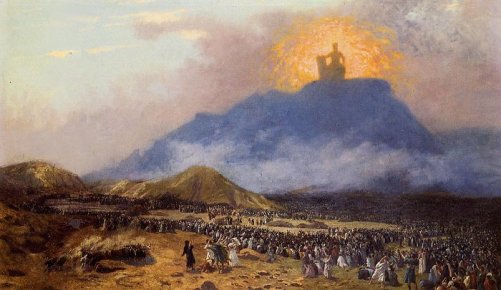
After the Exodus, God appeared before the Israelites on the summit of Mount Sinai. Painting by the nineteenth-century French artist Jean-Léon Gérôme.

After the Exodus, God appeared before the Israelites on the summit of Mount Sinai.
Painting by the nineteenth-century French artist Jean-Léon Gérôme.

Exodus 19:23 ‘The people are not permitted to come up to Mount Sinai; for you yourself warned us, saying, “Set limits around the mountain and keep it holy.” ’ 24The Lord said to him, ‘Go down, and come up bringing Aaron with you; but do not let either the priests or the people break through to come up to the Lord; otherwise he will break out against them.’ 25So Moses went down to the people and told them.

The passage from Exodus today is pretty straightforward. It is setting the stage for the revelation of God’s commandments. Setting the stage by setting apart the moment. Something special is about to come down. Setting the stage by setting apart the space. Setting the stage by setting apart those who will hear from the Lord directly from those who will hear the commandments from God’s chosen prophet, Moses.

Setting the stage is one way to signal something special is occurring. To set limits and boundaries around an event separates ordinary events from extra-ordinary ones.  In our everyday lives we each have times and events that are de-marked – delineated from others to indicate something special is happening.  Birthday celebrations. Baptisms. Weddings. Funerals. And throughout the day, dinner at the table distinguished from dinner on the go for example.

And this setting of the stage – setting the limits – is at play in God’s church. Most delineate (from Websters, dilineate: to indicate the exact position of a border or boundary) Sunday worship, the Lord’s Day, from other weekday gatherings. Limits are set around the ‘mountain top’ to keep it holy so that each who participate in the worship experience the holy. We honor and praise God. We participate in the great mystery. We reverence His holy Word. Confess. Pray together. Come together at God’s table. We say special words on Sundays. We move our bodies in special ways, kneeling, standing, bowing. 

I marvel at God’s wisdom in this seemingly little thing – showing us how to maintain the holy nature of a space by establishing some limits and boundaries.  God is present in all – the ordinary and extraordinary – to be sure. But it is a delight to see that God knows to instruct Moses on the how-to’s of keeping a holy, extraordinary, space, here on earth – as in heaven.

I have a fond recollection of Thanksgiving Dinners in my childhood home filled to the brim with family and friends. The dining room table was pulled out to its full length with six leaves and in a corner of the room, the kid’s table.  Typically a card table draped in a table cloth, fresh flowers, place cards and set as the grown-up table, complete with silver and candles. But.  Not quite the same.  It was the kids table after all.

The dining room table was set apart. It was special. Different conversation took place there it was imagined. Important things. Maybe holy things. Things we would hear about later from one of our parents. Only adults would find their names on the porcelain place cards.  No one questioned who was in, who was out, but every year the child closest to age 16 entered dining room with hope and anticipation that this was their year, the year they would be invited into the inner circle and find their name at the big table.

I continued the tradition with my own children when my home became the gathering spot for extended family and friends at Thanksgiving, Christmas and Easter.  But it only worked this way for a few years.  By age 8 my daughter put up a stink.  Little girl looking through a window into a doll's house like inWhy did she have to sit at the kid’s table? After all, she was helping prepare as much of the food as “you momma.” Indeed she and her brothers were setting the tables and making the table decorations and participating as hosts on par with me on every level. I was homeschooling my kids at the time and I used occasions like Thanksgiving to teach my them about hosting, about meal planning and cooking, about wearing special clothes for special occasions, about table manners and conversation.

My sweet but determined daughter made two final points; the dining room table was big enough for one more place setting and she was, after all, the oldest of the young people. Older than her two brothers and her cousins by, well, years!  In kid time being the oldest by 3 years is a lifetime.

We changed the tradition in our home after that. No more kids table. Because of the number of guests we always had two tables – or more – set up in the dining room. But we blended the group.  My kids learned not only how to prepare special feasts but also how to seat everyone, to recognize the blessing of sitting one person next to another, and to sit through the entire meal until everyone was done – probably the biggest challenge of all given how slowly the ‘old folk’ ate. They became wonderful conversationalists, fully engaged in the extra-ordinary, special event that was now without limits, but still set apart. Not to say they wouldn’t have had we not switched up the tradition by loosening the boundary lines on who sat at what table. But at the end of the day, our Thanksgiving fellowship was nothing but enriched by the inclusion of all at the table  – the space and time holy and the presence of God experienced by one and all.

Some of our church traditions, too, have changed over the years. Boundaries loosened, limits reduced.  Some of those changes have been uncomfortable for those raised up in the church in the old school ways, as I was raised up with a kids table at Thanksgiving with no questions asked.

At the end of the day it is the simple wisdom found in today’s Word from Exodus that we are to set apart some things to facilitate reverence and holiness.  Though God is present in the ordinary, the particular, the mundane,  it is a good thing to elevate, separate out, and set the stage for some moments and events to keep holy the space or event – to keep us in touch with the awe-inspiring, glorious, holy God.  Better to distinguish our worship, our tables, our fellowship on certain occasions in meaningful, even ritualistic ways and invite all into that communion than to dumb-down, regularize and blend the boundaries to bland in-distinction to what is to be holy.

Praise Him.


Wednesday Daily Office Readings:

AM Psalm 38; PM Psalm 119:25-48
Exod. 19:16-25; Col. 1:15-23; Matt. 3:13-17

Posted in Whispers | Leave a comment