Luke 6:6 On another sabbath he entered the synagogue and taught, and there was a man there whose right hand was withered. 7The scribes and the Pharisees watched him to see whether he would cure on the sabbath, so that they might find an accusation against him. 8Even though he knew what they were thinking, he said to the man who had the withered hand, ‘Come and stand here.’ He got up and stood there. 9Then Jesus said to them, ‘I ask you, is it lawful to do good or to do harm on the sabbath, to save life or to destroy it?’ 10After looking around at all of them, he said to him, ‘Stretch out your hand.’ He did so, and his hand was restored. 11But they were filled with fury and discussed with one another what they might do to Jesus.
It’s complicated. That’s where I end up today after some quiet time reflecting on the Sabbath and the Law referred to in today’s gospel passage. I revisited some source material to remind me of the tradition of sabbath-keeping, recalling that the day of rest was God’s action in Genesis, not an action intended for humankind. Not until Exodus 20 is keeping the Sabbath commanded. And not simply commanded but a detailed explanation of what it means to keep a seventh day ‘holy,’:
8 Remember the sabbath day, and keep it holy. 9 Six days you shall labor and do all your work. 10 But the seventh day is a sabbath to the Lord your God; you shall not do any work—you, your son or your daughter, your male or female slave, your livestock, or the alien resident in your towns. 11 For in six days the Lord made heaven and earth, the sea, and all that is in them, but rested the seventh day; therefore the Lord blessed the sabbath day and consecrated it.
What was important then, is so today. It is the intention behind the commandment. The intention behind God’s Word that we are to attend to. The scribes and Pharisees needed to be reminded from whence the commandment to sabbath-keep came. Bottom line, the intention was to rest – that’s all. Pretty simple. God revealed in Genesis what looks to be a healthy and balanced way of living – work and create, and take a rest, work and create, and take a rest. The body needs refueling, down time, quiet.
All the details added in Exodus seem to have distracted the faithful from the intention. The Pharisees are adhering literally and narrowly to a commandment that is so much bigger than they have interpreted. They are blinded by the fine print of the contract to see God’s intention.
Many of us are blinded and paralyzed by the fine print of commandments, covenants and contracts. The law says one thing and we interpret said law through a micro-focused lens of the fine print rather than the pano view. It makes sense to pay attention to the details of any contract – they are there for a reason – to protect us, the consumer. But if we keep our gaze only on the fine print we risk becoming blind to the big picture, the pano view.
That’s what Jesus is encouraging the Pharisees to do – to lift their gaze from the fine print – the letter of the law – up to the intention of the law. To let the light of the Lord illuminate their understanding.
 God is in the details many of us often say. True that. I see this most especially in nature – God is there in every flower, every insect, sand grain. I cannot look at anything through my camera’s micro lens without seeing and sensing and knowing God’s presence.
 But if God is in the details, then who I see most in the pano view, is Jesus. The law, like creation, was revealed by God, and Jesus came not to upend as the Pharisees wrongly charged, but to fulfill. To ‘fill out’ – to expand, enlarge, encompass, enlighten. I see Jesus in every intention of God’s creation, commandments and covenants. And I see Jesus asking me to think bigger, open up, trust the intention to be bigger and better than all the details and fine print others might suggest are set in stone. Keep the Sabbath, that was what was set in stone. Nothing more.
We are commanded to rest and as Christians honor the Lord on the Lord’s Day. That’s the big picture and intention. That is what Jesus illustrates over and over – he expands the view – opens up the lens – softens the hard edges of the details in the law. Not doing this or that – in this case healing – are details that simply point to a way to rest – some good suggestions, perhaps but not the law and not the intention. Like the fine print of any contract, details that may protect you but should not stop you from making the purchase. The details of the law as understood by the Pharisees paralyzed them – blinded them – not just to the intention of the sabbath, but more importantly to seeing and knowing Jesus as the Son of God.
Praise God.
Thursday Daily Office Readings: AM Psalm 105:1-22; PM Psalm 105:23-45
Hosea 5:8-6:6; Acts 21:27-36; Luke 6:1-11
 Rather than employing the Holy Spirit to eradicate the enemy – in this case magicians trying to co-opt the name of Jesus to effect tricks of their trade – Paul becomes a vessel for the Holy Spirit to show ‘them’ God’s wonders and miracles. The residents of Ephesus witness the healings and were awestruck – not disgraced nor shamed or destroyed for not knowing God the Father, God the Son, and God the Holy Spirit was the way, the source of all life, the ‘Most High over all the earth‘ as the psalmist wrote.
 I realized I had never given Lazarus much thought other than the role he played in one of the most significant miracle stories of the bible and Jesus’ ministry. I had thought of him one-dimensionally and not considered the impact of his resurrection on his own life, but only as a prescient miracle of Jesus’ soon-to-be resurrection. I knew- know – Lazarus’ name but not anything close to his story.
 Point is, the Holy Spirit pauses us to wonder about Lazarus today for a reason. To think about his life – what it may have been like, how he was transformed, where he went, why he fled and abandoned his friend Jesus instead of walking with him to Jerusalem. These are the questions raised before me this morning – something about friendship and relationship is being stirred up – about Jesus as our friend – how we take from him but don’t give back, how we delight in him but flee his presence when we feel attacked or vulnerable. And how we may yet live a life that glorifies God even when we flee. Bottom line? It may be our story, but it is all for God’s glory.
 Or perhaps all the faith communities of a region pitch in to build an old-school baptistery – a building separate from sanctuaries – dedicated to the sole purpose of baptizing all into God’s church (below are a few examples of baptisteries through the ages)?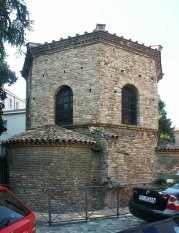
 One of my dreams to be a part of something like this one day.
 Praise God.
 Paul is in Antioch and preaching in the synagogue on the Sabbath. His message is linked to the scripture readings assigned for the day from the Torah. He summarizes concisely biblical history and leads the congregants to know and believe that Jesus Christ was the promised messiah, attested to by the end of today’s passage:
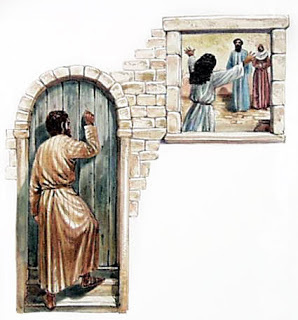 Peter’s people – his tribe – his church community – had been praying unceasingly for his release. And it happened. The Lord sent an angel to break him out, to return him to his people and to the work he had called him to do. It wasn’t Peter’s time to return to the Lord, but to God’s people. And little Rhoda doesn’t even answer the door.
 And now, here I sit before this window looking out over Lake Michigan and staring at another set of clouds reminding me that my prayers and thoughts bubble up no matter where I am, to those that have gone before me and walked this path following Jesus, called to minister in God’s church.
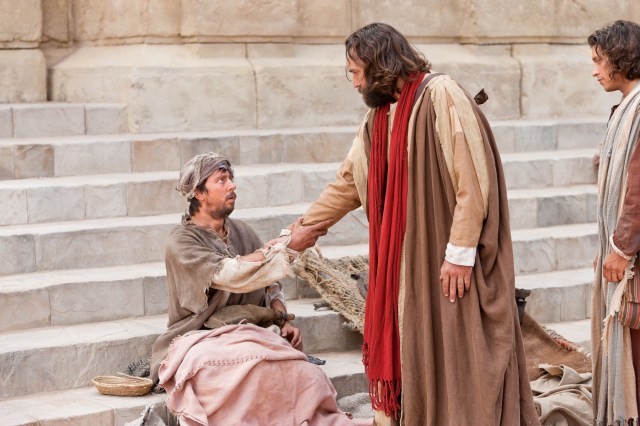
 Fr. J.T. like Peter and John, reached down to Steve, picked him up, and said from the start, “We have no money to give you, but how about a cup of coffee and why don’t you come sit down and tell me about your story. And then, why don’t you join us for services this morning. We’d love you to join us. And, by the way, all are welcome to God’s table.”
