
God’s Open Place and Poetry and How to Read Revelation

20 He brought me out into an open place; *
he rescued me because he delighted in me.

I have often reflected upon this verse from Psalm 18 because it is one – of many in the psalter – that totally speaks to me. The ‘open place’ – that is God’s territory – be it land, circumstance, family, heart or breath – the open place, the broad place, the house with many rooms, the body with breathing room. You get the idea.

Years ago when I began in earnest to dig deeper – to get below the surface of scripture –  I found myself pausing most often in the psalter.  It was accessible – an open space, if you will – for getting to know our very very big God and for knowing how to see and hear God in my very little life.  I didn’t understand at first what I know now – that the poetry of the psalms functioned as a hinge opening the door to my comprehending God’s revelation in the Word and the Word made flesh.

This hinge functions throughout scripture – in the compressed figurative language of the psalter, in the Old Testament prophets use of alliteration, in Jesus’ simile packed parables, Pauls’ metaphors and John’s imagery. Poetry releases God’s Word from the bondage of law and literalism into the open place, accessible to God’s people.  Poetry, is the language of our God. He is the Poet Laureate of all, from the beginning, world without end.  Amen.

I think I always read scripture through the poet’s lens. I was raised in a Christian tradition that taught ‘both and’ and not either-or, allowing for breathing room and space, juxtaposition and context, in God’s Word.

photo-2It has been more than a blessing to dig deeper, to mine the poem, the psalm, parable or metaphor to hear what God is saying through space and time. Indeed, this blog is my response to the awareness I came to late in life to get below the surface of the open place.  I have discovered a breath and depth to God’s revelation and will for his creation I had never had the capacity to imagine and cannot ignore.

The scriptural surface and lens through which to read the Bible was entirely different for one of my favorite theologians, Eugene Peterson. Peterson, author of The Message, was raised in a tradition that valued biblical literalism.  The meaning of this parable or that was exactly what was reported with little consideration for context, translation, allegory or metaphor.

He speaks of his Montana childhood home and church lovingly. But the broad place – the open place – the place that called him to wonder, was outside the confines of either. As a lonely and friendless 10-year old boy and inspired by the natural beauty of the world outside his lakeside home, Peterson sought company with God. Regularly, Peterson would pack provision for a day’s adventure to the base of the mountains, searching for Indians, arrowheads, and a quiet space to read his bible.  He started with the psalter.

intent-of-gods-lawAnd he couldn’t make sense of any of it – it was literally too confusing and at odds with what he had thus far learned of God. The big picture –  God and God’s intent  – obscured by the literal, technical lens he brought to bear upon the words (and as illustrated here in Dan Piraro’s Bizarro strip). Here’s what Peterson himself says of this time:

And I couldn’t understand them. “God is a rock?” What does that mean? “My tears are in your bottle?” What is going on here? And I just kind of struggled with that, but people had told me it was important to read the Psalms. And about a month into that, I realized what they were. And I didn’t know the term “metaphor,” but I realized what metaphors were. And so then I was off. And the Psalms were my introduction to poetry.

No Sunday school teacher could have taught this – he had to experience the open place for himself in order to have access to our very big God. And it was by locating poetry within the psalms and later all of scripture. The door was opened as it had been blocked by a literal or journalistic lens.  Later Peterson would write:

All the prophets were poets. And if you don’t know that, you try to literalize everything and make shambles out of it. (again illustrated to my mind’s eye by Dan Piraro in this Bizarro strip).

literalism

A metaphor is really remarkable kind of formation, because it both means what it says and what it doesn’t say. And so those two things come together, and it creates an imagination which is active. You’re not trying to figure things out; you’re trying to enter into what’s there.

Not trying to figure things out – making a mess of God’s word – but entering into what is already there. Brilliant. Yes. Amen.

So all of this is background to my pause at the New Testament reading today from the Book of Revelation.  I have avoided this book like the plague – avoided studying it or entering it for reflection even when it pops up in the lectionary cycle, though I have always appreciated how much of Revelation is incorporated into the liturgy of The Episcopal Church.

So, here it is today, and my first instinct was to skip over.  But, paused as I was at the psalm and recalling the hinge of poetry to the open place, which then prompted me to think of Eugene Peterson and his wisdom about entering into what is already there as opposed to trying to make sense of scripture through literalism or rationality, I went to the passage.  But first, I stopped in at Peterson’s The Message.  Ah – breathing room.  Read here how the poet reads Revelation – this from the introduction to the Book of Revelation:

Revelation

The Bible ends with a flourish: vision and song, doom and deliverance, terror and triumph. The rush of color and sound, image and energy, leaves us reeling. But if we persist through the initial confusion and read on, we begin to pick up the rhythms, realize the connections, and find ourselves enlisted as participants in a multidimensional act of Christian worship.

John of Patmos, a pastor of the late first century, has worship on his mind, is preeminently concerned with worship. The vision, which is The Revelation, comes to him while he is at worship on a certain Sunday on the Mediterranean island of Patmos. He is responsible for a circuit of churches on the mainland whose primary task is worship. Worship shapes the human community in response to the living God. If worship is neglected or perverted, our communities fall into chaos or under tyranny.

Our times are not propitious for worship. The times never are. The world is hostile to worship. The Devil hates worship. As The Revelation makes clear, worship must be carried out under conditions decidedly uncongenial to it. Some Christians even get killed because they worship.

John’s Revelation is not easy reading. Besides being a pastor, John is a poet, fond of metaphor and symbol, image and allusion, passionate in his desire to bring us into the presence of Jesus believing and adoring. But the demands he makes on our intelligence and imagination are well rewarded, for in keeping company with John, our worship of God will almost certainly deepen in urgency and joy.

This introduction alone is enough to invite me into what God placed here in John’s Revelation. That’s the application for me today of the readings – recognizing poetry as the hinge that opens the door to all of God’s Word, up to and including Revelation.

Praise God, the Poet Laureate of all from the beginning, world without end. Amen.

Thursday Daily Office Readings: AM Psalm 18:1-20; PM Psalm 18:21-50 Isa. 12:1-6; Rev. 1:1-8; John 7:37-52
Posted in Whispers | Tagged , , , , , , | Leave a comment

Be Still. Breathe. Know. Trust. Exalt.

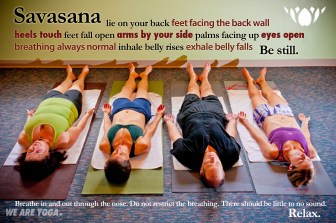
Just yesterday in yoga I was put to thinking on a new thing.  After the 45 minutes of standing positions, we moved to the floor to do the ‘real’ yoga.  The position is called, Savasana, translated as Dead Body Pose.savasana dead body pose As we lay down on our backs, the instructor said,
‘Be still – don’t itch the itch, or wipe the sweat.  Only by being still can you begin to get in touch with what is happening inside. Where are your muscles tense?  What side of your body is most loose?  Be still.  Only by being still will you ever learn from your body what it needs.  You must be still to know.”

I’ve practiced yoga a long time – this wasn’t news, but I heard it differently yesterday. “Being still” has been part of my thought bubbles this past Advent for two reasons.  The first is because it is the theme, if you will, for most liturgically inclined churches – churches that embrace the 5th century designed season to prepare the people of God’s church for  – not the nativity and Jesus’ birth – but instead for the second coming of Christ.  Church goers are admonished to ‘be still’, to walk through the four weeks of December quietly. be-still-adventSermons preached about final judgment, about being still so a person would know the presence of the Lord in their daily life. Bookshelves are populated with meditations and journals that encourage the Christian to slow down, be still, not anxious and wait in order to know that he is Lord.
Until I understood that the liturgical season of Advent was more about the second coming than about baby Jesus’ birth day, I pushed back against the call to ‘be still.’  It felt like a Zumba class teacher calling out mid way through the class, ‘Stop! Be still!‘ – it just didn’t jive with how I embraced the season.  I love the festive, go, go, go excitement that celebrates Jesus’ birth in a manger over 2000 years ago. I play lively Christmas Caroles, decorate my home with lights, trees, creches and Santas. I entertain, send cards, make, buy and wrap gifts.  I am hardly ‘still.’

But I am put to thinking differently about the need to be still – and most especially on this day, the day before the world marks and celebrates the birth day of Jesus – God incarnate – emmanuel.

Yesterday, when I was instructed in yoga class to be still, my first thought was of a friend who has quoted the biblical verse that comes from today’s psalm for the past 10 weeks or so as he accompanies his wife through treatment for cancer.  They have each – patient and patient’s partner – had to ‘be still’ – to rest in God’s hands trusting the process.  Only by being still are they able to walk through this literally one day at a time – some times just one hour at a time.

11 “Be still, then, and know that I am God; *
I will be exalted among the nations;
I will be exalted in the earth.”

12 The Lord of hosts is with us; *
the God of Jacob is our stronghold.

So while lying there in ‘dead body pose’[1] where I was instructed to be still in order to know where my body was healing or still hurting, to know how even or not my breathing was, I thought of her in a similar pose being still in her hospital bed and her beloved being still to know the Lord’s presence in her body – and in his.

be-stillRemarkable to me how this verse – this psalm – greeted me this morning.  All these thought bubbles bouncing out there in the universe of this one idea of ‘being still’ – coming together in a glorious sort of soft, comfy cloud of witnesses  to speak to me – and to you, encouraging all God’s people to be still, to take time to prepare the inn within for him this night.

Saturday Daily Office Readings: AM Psalm 45, 46;
Isa. 35:1-10; Rev. 22:12-17,21; Luke 1:67-80

[1] Interesting juxtaposition of death and life woven together in the name of this pose, wherein being still allows the blood and breath to move freely through the body – a juxtaposition I find in Advent wherein the death and resurrection of our Lord is held before us in Advent as reminders that we await his coming again for eternal life.


Posted in Whispers | Tagged , , , , , | Leave a comment

Divided, Ravaged, Darkness, Gloom – not


Joel 1:15 Alas for the day!
For the day of the Lord is near,
and as destruction from the Almighty* it comes.
16 Is not the food cut off
before our eyes,
joy and gladness
from the house of our God?

america-dividedToday’s and yesterday’s reading from the minor prophet Joel had me thinking of the election taking place today.  I feel as if our country has been ravaged by locusts – by the political ambitions and machinations of a few to deliver this country into their self-righteous hands. Divided beyond repair, lines drawn in the sand too wide to ever bridge.

And though I am sad that my country has devolved into electing emperor’s with no clothes – symbols and icons of this or that, the first this, the first that, the insider, the outsider, the Machiavellian, the rebel….on and on…though sad, not distraught.  My allegiance and trust is in the Lord and I believe through every cell of my being that His hand is and will continue to work in the people of this country, despite the collective rebellion against Him that has taken hold in far too many of our children, brothers, and sisters.

Psalm 78 of this morning readings reassured me of my belief – it comforts and reminds me who is the source of all.

1 Hear my teaching, O my people; *
incline your ears to the words of my mouth.

2 I will open my mouth in a parable; *
I will declare the mysteries of ancient times.

3 That which we have heard and known,
and what our forefathers have told us, *
we will not hide from their children.

4 We will recount to generations to come
the praiseworthy deeds and the power of the Lord, *
and the wonderful works he has done.

5 He gave his decrees to Jacob
and established a law for Israel, *
which he commanded them to teach their children;

6 That the generations to come might know,
and the children yet unborn; *
that they in their turn might tell it to their children;

7 So that they might put their trust in God, *
and not forget the deeds of God,
but keep his commandments;

The psalm gives me the lens through which to put this particular time, this particular election, into historical perspective.  And not this young country’s historical context, but in humanity’s context as revealed in scripture, reminding me of all the rebellious moments in time in which God reigned, never once abandoning his people.

locustsThe Joel passage too gives me perspective.  Joel prophecizes that the Day of the Lord is at hand citing the locust catastrophe that had devastated both the human community and the natural world.  Joel preached that this was God’s judgment on the people, and he called them to repentance.

The dire warning is familiar sounding – certainly in this election year we’ve heard from both sides the doomsday scenario should the opponent be elected.

tsunamiI’m recalling other times in history, too, when both political and natural disasters have signaled to many the end.  As Joel observed the destruction of the locusts, I imagine anyone who witnessed the tsunami in Japan a few years ago might have felt the end was at hand.  Or one who survived the earthquakes in Haiti and Italy just recently.  Going back further to the citizens of Pompeii when Vesuvius erupted – like Joel, they may have written:

Blow the trumpet in Zion;
sound the alarm on my holy mountain!
Let all the inhabitants of the land tremble,
for the day of the Lord is coming, it is near—
2 a day of darkness and gloom,
a day of clouds and thick darkness!
Like blackness spread upon the mountains
a great and powerful army comes;
their like has never been from of old,
nor will be again after them
in ages to come.

Up close and personal these events, like this election, feel, smell, seem dire, ushering in a kind of despair as one witnesses the end-of-life as they know it.  That is just what Satan banks on – our up close and personal assessment of a situation that loses sight of God. A narrowing in of the lens on just what we see before us – the locust ravaged crops, the land laid bare by an ocean wave, the absence of integrity in all political candidates running for office – a view which distorts one’s perspective, causing panic and despair.

This is how Satan works  – narrows our lens, holds up mirrors to our own particularity, our individuality, our own way of understanding the world, our egos.  By gazing only upon the ravaged land or ravaged political landscape we lose sight – lose sight of the one Holy God of all.

And we lose sight of where we sit – not under the rubble of a crumbled stone house, nor on the parched land of a grapevine orchard, not in a red state or a blue state, but in His hands.  We rest, loved ones, in His hands.

Praise Him.

Tuesday Daily Lectionary Readings: AM Psalm 78:1-39; PM Psalm 78:40-72
Joel 1:15-2:2(3-11); Rev. 19:1-10; Luke 14:25-35


Posted in Whispers | Tagged , | Leave a comment

Oh, grow up!

The gospel story of the Daily Office readings is one of seven healing miracles that take place on the Sabbath – each one illustrating the difficulty the scribes and priests have in seeing and knowing Jesus, blinded so by the legalistic practice of religion. Observing a law – a ritual – just because. No work on the Sabbath – that’s what law dictates.

But we know Jesus came not to abolish the law, but to fulfill. And in each instance of Sabbath healing, Jesus is filling out the intention of observance to give glory to God. What better way to glorify God than to demonstrate the power of His love and grace. And on the Sabbath.

But it was the first part of the story that paused me today – struck by the detail of ‘eighteen years’.

10 Now he was teaching in one of the synagogues on the sabbath. 11And just then there appeared a woman with a spirit that had crippled her for eighteen years. She was bent over and was quite unable to stand up straight. 12When Jesus saw her, he called her over and said, ‘Woman, you are set free from your ailment.’ 13When he laid his hands on her, immediately she stood up straight and began praising God.

The woman who came to Jesus for healing had been ‘crippled by a spirit for eighteen years.’ Details like this one intrigue me. Why eighteen? Why name any number at all? Why not, “crippled for years”?

The duration of eighteen years does have biblical significance in two basic areas. The first, most often found in the Old Testament, connects eighteen with a duration of oppression and stagnation. God delivers the people into the hands of enemies for disobeying (Judges 11) and after eighteen years brings them forth, humbled. Haggai laments that for eighteen years no progress had been made on the building of the temple. He calls the people out, preaching that for eighteen years they had been enslaved to their own desire, desires for well-being, safety, security, and success, while neglecting God’s dwelling place.

jesus-preaches-in-templeThe duration of eighteen years in scripture is also associated with maturity and adulthood and most interestingly to me, the unaccounted for years of Jesus’ life. Jesus heard his call at age twelve. He preaches in the temple at age twelve, staying behind as his parents make their way back home. When he returns, his worried parents try to make sense of his less than reassuring answer that he was ‘in his Father’s house.’

In this day and age Jesus might have been marked a child prodigy – a genius – a gifted preacher. He might have been directed to a special school for gifted youth. A local temple might have ‘hired’ him to preach, featuring him as ‘the youngest this or that’ to come to our house. Worse, his parents could have contracted him out as a sort of side show act – the boy wonder, who preaches in the temple.

bz-panel-02-19-14Ridiculous, of course, but this is what happens to child prodigies in our era – prodigies in every area – math, music, art, religion, athletics. The younger the better. And the innate, God-given gift is misconstrued to mean the child is wise beyond his or her years. Experience and practice play no part in the appreciation of the gift – we are just wowed by voice, the long drive, the composition, the staging and the lights. But how many tragic endings have we heard of those thrust onto the world scene too soon, as a child – those who have their day in the sun only to crash into adulthood with no developed life-skills for a new or different season. And adding insult to injury is the trend in our culture to prolong – put off – adulthood entirely – such a premium we have placed on youth.

Childhood lost and, more importantly, adolescence, ‘eighteen years’ lost. Years foundational for maturing, learning, honing the gift or skill, learning of the world, discerning the true call.  Years necessary to cultivate a life grounded in principles and ideas, not things or momentary fame.

Jesus may have preached and preached brilliantly at age 12, but his call, his purpose was so much bigger. A prophet and good teacher he was – and at age 12 that is all he could have known himself to be and all that his parents and others could have understood him to be – but he was more. The Son of God, delivered to the people for a singular purpose. The kingdom come on earth, to preach the good news in obedience to God all the way to the cross.

The last record of Jesus on the scene before he begins his ministry at age 30, is in the temple at age 12.  Now, in the gospel accounts, he’s all grown up and then some. Indeed, in his era, with life expectancy between 30 and 35 years, Jesus was already in the final season of his life. It is interesting to me, that God gave Jesus eighteen years to develop and mature – to find his way to himself, to cultivate the way to the Father.

Perhaps God gave the woman who appears before Jesus in today’s story that length of time, too, to mature and find her way to Jesus. For all we know, the woman was a peer, perhaps thirty, perhaps only nineteen. But either way, for eighteen years her body is occupied by a debilitating spirit. Like the Jerusalem Jews who had prioritized their own needs above making a home for the Lord in the temple – in their ‘bodies’ – for eighteen years? Or as those God delivered to the Philistines for eighteen years, had she now finally been humbled to know she needed God and came to Jesus?

I hear the Spirit saying to me today something about humility and the learning and work and practice necessary for ministry in God’s church. The church today might have grabbed Jesus up at age 12 and put him front and center with lights and microphones and slide shows and the like and it would have been too soon. Jesus needed the eighteen years to be what he was called to be and do what he was called to do. There is just something to be said for life experience – for living one’s faith through seasons of life.  And for being open, prepared, humbled to seek Jesus and receive grace from him.

Praise God.

Wednesday Daily Office Readings: AM Psalm 72; PM Psalm 119:73-96
Ecclus. 43:23-33Rev. 16:1-11Luke 13:10-17

Posted in Whispers | Tagged , , , , , , , , | Leave a comment

Good – no great – is God’s Word

Sirach 31:12 Are you seated at the table of the great?*
Do not be greedy at it,
and do not say, ‘How much food there is here!’
13 Remember that a greedy eye is a bad thing.
What has been created more greedy than the eye?
Therefore it sheds tears for any reason.
14 Do not reach out your hand for everything you see,
and do not crowd your neighbour* at the dish.
15 Judge your neighbour’s feelings by your own,
and in every matter be thoughtful.
16 Eat what is set before you like a well-bred person,*
and do not chew greedily, or you will give offence.
17 Be the first to stop, as befits good manners,
and do not be insatiable, or you will give offence.
18 If you are seated among many others,
do not help yourself* before they do.

The readings from Sirach this past week have been nothing but just good, no great – advice. Godly rules to live by.  Like Proverbs, Sirach is the consummate Miss Manners and Dear Abbey of their day.  Good, no great, advice.

Yesterday, The Episcopal Church commemorated the life of Alfred the Great who died in 899, the first monarch to rule all of the Anglo Saxons. And the only king or queen in England’s history to be honored with the epithet, ‘the Great.’  For good, no great – reasons.

He was an unlikely ruler, the youngest of five sons all killed in battles with the invading Vikings during the mid 800’s. A humble man of deep faith, but also an intellectual. Alfred had a heart for God and God’s people who he understood to be both the Anglo Saxons of his lands and also the invading Danes. Those Vikings were not only defeated but baptized into Christianity and eventually fully integrated into the land they had tried to occupy. He made deals –  treaties –  with the interlopers that secured their place in his country and in God’s church.

Alfred was wise and courageous and used his temporal power for the spiritual, intellectual, and economic advancement of his people.  The list of his specific contributions is long, impacting nearly every aspect of the daily life of the people: church and state, national security, military, education, commerce, language, and civic duty.

Alfred became convinced that those in authority in church or state could not act justly or effectively without the ‘wisdom’ acquired through study, and set up schools to ensure that future generations of priests and secular administrators would be better trained, as well as encouraging the nobles at his court to emulate his own example in reading and study.¹  In addition to the schools and books imported for this purpose, Alfred wrote his own ‘code of laws to be used by all the people of Anglo Saxon England.

doom-bookThe Doom Book, (Code of Alfred) was a code of laws compiled from three prior Saxon codes, to which he prefixed the Ten Commandments of Moses and incorporated rules of life from the Mosaic Code and the Christian code of ethics.

Yup.  The codified, legal guidelines for good behavior and justice was based entirely upon God’s word and the Mosaic Law specifically.

In his extensive Prologue, Alfred summarized the Mosaic and Christian codes…and importantly, he laid the foundation for the Spirit of Mercy in his code:[2]  The last section of the Prologue not only describes “a tradition of Christian law from which the law code draws but also it grounds secular law upon Scripture, especially upon the principle of mercy“.

This principle of mercy recognizes that the final judge of any dispute or injustice is God, Almighty.  Woven through all the codes of the Doom Book, then, is the mandate to first give thanks and praise to God so that one would and could love neighbor, give to poor, serve,  turn the other cheek, and love the enemy.

The title “Doom book” comes from dōm (pronounced “dome”) is the Anglo-Saxon word meaning “judgment” or “law” — for instance, see Alfred’s admonishment: Doom very evenly! Do not doom one doom to the rich; another to the poor! Nor doom one doom to your friend; another to your foe! …reflecting Mosaic Law: “You shall do no injustice in judgment! You shall not be partial to the poor; nor defer to the great! But you are to judge your neighbour fairly!” (Leviticus 19:15).

This work  – the Doom Book – went on to be the foundation for England’s Common Law. And later, of course, woven into our constitution.

But it all goes back to God’s Word. Any good, no great, advice or law or principle is grounded in God’s Word.  The Word for each of us to live by.  The Word for our nation to live by.  The Word for our world to live by.

Praise God.

Thursday Daily Office Readings: AM Psalm 50; PM Psalm [59, 60] or 33
Ecclus. 31:12-18,25-32:2; Rev. 12:7-17; Luke 11:53-12:12

Posted in Whispers | Tagged , | Leave a comment

The life-changing magic of…grace

I have begun a new project – again –  to clean up and out my home of  things and stuff I have stored for years. The home in which my three children were raised, the home that has four floors, atticincluding a huge attic, a full basement with four different rooms and bathrooms, a garage with built-in storage, and two outside structures filled with garden and pool ‘things’.attic

One of the things I had always loved about my home was that there was a place and space for everything.  This was the key to keeping an uncluttered, neat, home according to all I had learned about housekeeping.  And for the most part to anyone visiting, it looks uncluttered and neat.  A place for everything and everything in its place – but as you can see from the pictures, behind the scenes, just not so. And this is just the old stuff, the stored stuff. What about new things that arrive?

libraryA new book from Amazon? There’s a place for that, my office or any one of the five built-in book shelves around the house. Winter coats and boots during summer? Yup. Place for those, too.

In this home I have even gone so far as to designate one room in my basement to store things for my children and grandchildren and in another room and over the course of a year, I store clothing, furniture, household items, and sports equipment to donate either to my church or Goodwill. So, yes a place for everything and everything in its place – swept and neat. But.
Every summer as I prepared to deliver the stored donations I was stunned at how much I had accumulated. Hadn’t I given away all this stuff last year?  Hadn’t I gone through the kid’s rooms and cleared out their elementary and high school textbooks?  Why did I not get rid of that microwave last year?  These audio cassettes?  Ski boots?  As I write this, my basement is overflowing with ‘stuff’ yet again and yet again, I am befuddled at why I still have so much to get rid of.Holiday Deco room

Apparently I am not alone with the dilemma of keeping my house (life) in order and organized around a life-giving principle, not the haphazard put this here, that there, clear out next month, next year, tactics I’ve used up to now.

Last year Marie Kondo made her way onto the world stage promoting her book, a New York Times bestseller, “The Life-Changing Magic of Tidying Up: the Japanese Art of Decluttering and Organizing.”  Kondo’s system has been so well received that she branded her system the KonMari Method and millions of folks are cleaning up houses and lives based upon her method.  She debunks the strategy ‘everything in its place’ along with another favorite operating principle of mine, ‘tidy a little bit everyday.’ Bottom line in her method – tidying is a special event -a big one – and once your house (life) is in order, new life begins.  Your relationship with your people, your home, your things, your vocation even will be significantly altered once you learn to let go, clean out, simplify and create ‘space’ for joy.

This is what came to mind reading today’s gospel.  Transformation comes – new life comes – after, by grace, our unclean spirit – our flesh – is booted out so that the Holy Spirit can move in and direct our lives.

Luke 11:14 Now he was casting out a demon that was mute; when the demon had gone out, the one who had been mute spoke, and the crowds were amazed. 15But some of them said, ‘He casts out demons by Beelzebul, the ruler of the demons.’ 16Others, to test him, kept demanding from him a sign from heaven. 17But he knew what they were thinking and said to them, ‘Every kingdom divided against itself becomes a desert, and house falls on house. 18If Satan also is divided against himself, how will his kingdom stand? —for you say that I cast out the demons by Beelzebul.19Now if I cast out the demons by Beelzebul, by whom do your exorcists*cast them out? Therefore they will be your judges. 20But if it is by the finger of God that I cast out the demons, then the kingdom of God has come to you. 21When a strong man, fully armed, guards his castle, his property is safe. 22But when one stronger than he attacks him and overpowers him, he takes away his armour in which he trusted and divides his plunder. 23Whoever is not with me is against me, and whoever does not gather with me scatters.

24 ‘When the unclean spirit has gone out of a person, it wanders through waterless regions looking for a resting-place, but not finding any, it says, “I will return to my house from which I came.” 25When it comes, it finds it swept and put in order. 26Then it goes and brings seven other spirits more evil than itself, and they enter and live there; and the last state of that person is worse than the first.’

Jesus casts out demons from the mute man (an others).  The unclean spirit was driven out ‘by the finger of God’ so that  ‘the kingdom of God’ came to dwell within.  Jesus cleans the insides out of the man lock stock and barrel and by grace thereby making room in the man for the infilling of the Holy Spirit. This is no matter of ‘tidying up’.  Nothing of the unclean spirit remains.  He is a new creation in Christ.

This contrasts with other unclean spirits , Jesus says, who have merely ‘gone out’ of a person. Jesus is speaking specifically of “the demons which had been temporarily exorcised by certain Jewish priests who performed this function in his era. He was also referring to those who converted under John the Baptist who had fallen back into sin… by placing more trust in morality than grace-filled faith. The result was a moralistic hypocrite, no different to the Jewish priests condemning Jesus.”¹

Matthew Henry writes of the hypocrite:

Here is the condition of a hypocrite. The house is swept from common sins, by a forced confession, as Pharaoh’s; by a feigned contrition, as Ahab’s; or by a partial reformation, as Herod’s. The house is swept, but it is not washed; the heart is not made holy. Sweeping takes off only the loose dirt, while the sin that besets the sinner, the beloved sin, is untouched.

These folks had simply tidied up – swept up the dirt, if you will, but not cleaned house. Cleaned up, but empty.

The word for me this morning is to consider how much space I have allowed the Holy Spirit, Christ within in, to move me, to direct my thoughts, my actions, my decisions, my life day to day, moment to moment. Have I given Him free reign?  Or have I compartmentalized like I have done in my home – a storage room for donations, another for gifts, another for winter clothing.  Have I slotted the Holy Spirit into my worship and ministry rooms?  And throughout the rest of my house, have I simply swept the dirt away for the time being, getting by another day without anyone else knowing how messed up I really am.

OfficeTime to get this house in order – once for all. And life, too.

Praise Him.

Tuesday Daily Office Readings: AM Psalm 45; PM Psalm 47, 48
Ecclus. 24:1-12; Rev. 11:14-19; Luke 11:27-36

Posted in Whispers | Tagged , , , | Leave a comment

WWJuniorD: The stuff of bad dreams

I had very unsettling dreams last night.  I had tossed and turned through them right up to 5:30 AM when my eyes open. Not my favorite way to wake in the morning – with vivid, distressing dreams right at the forefront threatening to undermine what should be a good day ahead. Bad dreams threatening to triumph over me.

I have done dream work through the years with a Christian therapist and have come to understand them differently than some in Christian therapy.  I don’t consider my dreams divine messages from God – though I believe such messages do come to some in dreams – scripture tells us of many, actually.  But, I don’t think of dreams as messages, in general.

I do understand them as insights into how my subconscious – my flesh – is dealing with my conscious reality – my daytime situation.  Dreams are the ruminations of our unconscious more than messages  – they let my rational, God loving and God-loved self know what my irrational human-self is trying to work out.

The therapist I consult explains that dreams come from my ‘junior’ – the part of me shaped in my childhood – the irrational, Junior self  before adulthood and before Jesus.  I made some big decisions in those years ‘before’ – out of my undeveloped Junior, providing me with a lifetime of material to work out in my dreams.

I’ve come to know, too, that what seems like an obvious association in a dream, really isn’t. Direct associations to people and circumstances are easy to make but in most cases something much less frightening or troubling is at work.  And often not about the particular person in the dream, but about what they represent in my life.  More often than not certain themes pop up in a variety of ways, so that particularity is speaking to a universal until the universal is resolved.

For example, someone who experiences trauma in the first three years  – say abandonment – will find dreams peppered with particular situations and people that leave them feeling abandoned. That’s just Junior at work to keep the person convinced they will always feel abandoned.  Not a message, not divine.

Not always nightmares, dreams can also be pleasant but either way I have found it most useful to consider my dreams simply as information only my Junior is capable of bringing to my attention.  WWJD?  What would Junior do, what would Junior like to do, what is Junior worried about?    And now that I’m made aware of Junior’s agenda in the dream, I can attend to it – quiet it, turn my eyes away from this “J” to the other, Jesus.  WWJesusD?

Nipping that baby in the bud is what my counselor has helped me do, saying, “You know your Junior is just messing with you – and you now know how Junior feels about xyz, but you are not Junior.”

So, when I awakened this morning with another ‘unworthy’ dream, I dismissed my initial thought that the dream was prompted by the previous few day’s circumstances that had left me feeling so. Instead, I began my own ‘dream work’, hopeful that I might see something different and not allow Junior’s problem with worthiness persist, not allow it to triumph over me.

dreamsI set about to get all the information I needed out of the dream to reset the day as my rational adult self, my God-loving and God-loved, self. Dan Piraro’s strip here came to mind, but instead of ‘success’ I was going to give up this unworthy dream, for today.

I had just begun to recollect all the little pieces by remaining in bed with my eyes closed (that is the best way to call up details of a dream) when my phone began beeping with texts.  It was early – a friend in a different time zone trying to reach me before boarding a plane.  My dream work stopped for the moment.  I opened his messages and found several others from a different friend that had come in long after I had gone to bed.

She had had a bad dream.  A troubling one she called a nightmare.  It had awakened her. She had interpreted the dream as a message  – a warning – that she might not be as trusting of the Lord in her particular circumstance as she had thought she was.  Her last text before going back to bed said something to the effect that she needed to turn her eyes upward, that at the very least she was to ‘lift her eyes to the Lord.’

I responded to my friend suggesting she be grateful for the dream – to think of it as an exhale – that it didn’t mean that she herself was as anxious as she was portrayed in her dream, that she herself wasn’t responsible for the suffering of others, that the dream wasn’t a divine message from the Lord about her or how she was handling the present circumstance, but about a small part of her that didn’t trust the Lord’s presence in her and in her circumstance.  I encouraged her to yes, lift her eyes to the Lord, and to pause, to breathe in, and thank Jesus for allowing her to express her fears through her dream, and for now giving her time to put the nightmare into perspective for this day and the rest to come.

And immediately after sending this message, I turned to today’s readings

And, praise God, here are the first lines of the first reading from the Psalter, Psalm 25:

1 To you, O Lord, I lift up my soul;
my God, I put my trust in you; *
let me not be humiliated,
nor let my dreams, my Junior, triumph over me.

2 Let none who look to you be put to shame; *
let the treacherous be disappointed in their schemes.

3 Show me your ways, O Lord, *
and teach me your paths.

4 Lead me in your truth and teach me, *
for you are the God of my salvation;
in you have I trusted all the day long.

5 Remember, O Lord, your compassion and love, *
for they are from everlasting.

Yes – to you O Lord I lift my soul – I choose to leave Junior behind.  I put my trust – my plans, my prayers, my life, in you.

Praise God.

Monday Daily Office Readings: AM Psalm 25; PM Psalm 9, 15
Ecclus. 4:20-5:7; Rev. 7:1-8; Luke 9:51-62


Posted in Whispers | Tagged , , , , , , | Leave a comment

Your faith has made you well

28When he saw Jesus, he fell down before him and shouted at the top of his voice, ‘What have you to do with me, Jesus, Son of the Most High God?

7Then all the people of the surrounding country of the Gerasenes* asked Jesus* to leave them; for they were seized with great fear. So he got into the boat and returned. 38The man from whom the demons had gone begged that he might be with him; but Jesus* sent him away, saying, 39‘Return to your home, and declare how much God has done for you.’ So he went away, proclaiming throughout the city how much Jesus had done for him.

There has been a wealth of evidence in recent years showing the positive benefits of virtues such as kindness, gratitude and humility.  Among those potential benefits: Higher levels of compassion, fewer mental health issues, lower blood pressure, a greater sense of meaning in one’s life and stronger relationships.  It is a good way to live – good for the one expressing gratitude and good for the receiver.  Good for our families, our communities, our world. ¹

But the research also validates what pastors, priests, ministers, therapists, social workers know; that in the face of distress gratitude cannot be sustained on its own. In bad times, it is faith that sustains gratitude.  “Your faith has made you well“, says Jesus to the 10th leper (yesterday’s gospel).

Gratitude in good times is easy.
Gratitude in bad times is better, made possible by our faith in the Lord, Jesus Christ, our strength and our redeemer.

The demoniac of today’s gospel is living in bad times – he, like the 10th leper, is  in a bad state. But he, like the 10th leper, knows Jesus as the Son of the Most High – cries out to him to have mercy. He goes to Jesus, greets Jesus.  Has faith in Jesus. Jesus heals him. His faith made him well.

You’d think this would be a good thing for his neighbors to have observed.  Like the positive effects of simple gratitude, having witnessed a healing you’d expect they, too would fall at Jesus’ feet, praising the Lord, God.  You’d think the last thing they would have thought was to be fearful, to turn away from Jesus.  Who turns away from Jesus?  Who asks Jesus to leave?

I have a friend who is in a season of trial – really bad times, nothing from his perspective going right.  He has no faith – borders on atheism, actually.  Though raised in a Christian church, he never had an experience – a personal experience of the Holy Spirit to take root in his life.  He developed a skeptic’s disposition in his college years, one abetted by a gifted scientific mind to keep doubt and suspicion about a God properly distanced from his world view. For all intents and purposes, he asked Jesus to leave.

While no faith, he has tried to live gratefully.  He is known to his family and friends as a kind person. He appreciated what he had, what he had acquired, reveled in the gift of his children. But now, as I said, tough times.  Distress.  Life is not going the way it did for so many years and headed somewhere he had never anticipated. He’s not angry, he is not blaming others, but he is in despair.  It is easy to be grateful in good times.  Without faith, hard to sustain in the bad times.

At the outset of this trouble, I advised he switch his lens.  Instead of naming all the things that were wrong with his life – things for which he had no control – I encouraged him to express gratitude for what was good and right in his world.  I could see them.  He agreed and tried.  But it hasn’t lasted.  It was an exercise program that couldn’t stick because his heart was not in it. Like a vacuous New Year’s resolution.  No faith behind the expression. Even though he has seen how faith has sustained most of his friends and family through their tough times, even though he has witnessed miracles like the demonaic’s neighbors, he can’t get with the program.  He turns away from Jesus every time he is given a chance to draw near.  It scares him.

http://bizarro.com/tag/living-room/I don’t know how to help my friend right now, but I trust the Lord, does.  I know a cloud of witnesses hovers over him and his life.  Though they may look different to him than they do to you and me – the cynic, skeptic in him sees nothing but the world gone wrong, even in the skies (as Dan Piraro’s strip illustrates), I trust he’ll see differently one day.

I trust our God’s steadfast faith in him – a faith that sustains God’s gratitude for my friend, even in these tough times when my friend has rejected him. I trust that in due course and in God’s time, God’s faith will make my friend well.

Praise God.

Monday Daily Office Readings: AM Psalm 1, 2, 3; PM Psalm 4, 7
Micah 7:1-7; Acts 26:1-23; Luke 8:26-39

[1] http://www.huffingtonpost.com/david-briggs/how-to-foster-kindness-an_b_11186708.html


Posted in Whispers | Tagged , , | Leave a comment

When mirror held before you, be sure to look past to see he who is holding: Jesus

Luke 6:20Then he looked up at his disciples and said:
‘Blessed are you who are poor,
for yours is the kingdom of God.
21 ‘Blessed are you who are hungry now,
for you will be filled.
‘Blessed are you who weep now,
for you will laugh.

22 ‘Blessed are you when people hate you, and when they exclude you, revile you, and defame you* on account of the Son of Man. 23Rejoice on that day and leap for joy, for surely your reward is great in heaven; for that is what their ancestors did to the prophets.

‘But woe to you who are rich,
for you have received your consolation.
25 ‘Woe to you who are full now,
for you will be hungry.
‘Woe to you who are laughing now,
for you will mourn and weep.

Paused this morning in the gospel at the ‘woes’.  Not that I’m feeling woeful, but aware that as much as I appreciate what Jesus is teaching in the blessings, I know what is coming and I can’t really rest there, pause there, feel the blessing. Nope. The woes are just at the next verses and with them I feel stung, maybe burned.  I am not poor, I am not hungry, I am not depressed.  I ask myself, Can I find a way to insert myself in that first group – with those to whom Jesus blesses?  In the past I have been able to rest with those who mourn and weep.  Indeed I hung out there a long, long time, seeking God and knowing his presence in my sadness – knowing his love and blessing and feeling his saving grace.

But today, though grateful – so grateful – to no longer be stuck in sadness – the fact that the woes catch my attention, that I can’t rest with the ‘blessings’ group – just sort of unsettles me. So, I wanted to know more about the ‘woes’ – how and why is this word the counter to a blessing.  If a blessing is an action and or word of grace, is woe an action or word of condemnation and judgment? As in, am I in or out?  Part of the realm of God or and eternal salvation or not?

At its root, ‘woe’ represents a thought transformed into a feeling and expressed in a word—hoy, “woe!” (Bibliography. N. Hillyer, NIDNTT 3, pp. 1051–1054.).  A variety of interpretations of the word and the sentiment seem to agree that the way Jesus uses ‘woe’ is different than how it was used by the prophets and some New Testament writers.  In the latter case harsh judgment implied, but in Jesus’ case, the word is more full of sentiment and less harsh around the edges.

When Jesus says ‘Woe unto you’, he is not so much pronouncing a final judgment as deploring the miserable condition in God’s sight of those he is addressing…in the ministry of Jesus Christ, ‘woe’ is an exclamation of sadness over those who fail to recognise the true misery of their condition. (Holman Treasury of Key Bible Words)

So many people then and now just flat out don’t know they need God and don’t know that all they believe they need has come from God. That’s what I hear Jesus saying in his use of ‘woe’. It makes him sad for them. Breaks his heart.

I wonder if there weren’t a few of these folks in the crowd – curious perhaps of this man, Jesus. They show up and stand alongside the others deemed ‘blessed.’  Does this Jesus have anything to say to me? they wonder.

I don’t think Jesus countered his ‘blessings’ with the ‘woes’ for the sake of the blessed – to make them feel better about themselves.  He wasn’t being divisive, wasn’t pointing fingers and judging one group for the sake of making the poor, hungry and depressed feel righteous.

No. I think Jesus knew that in the crowd were folks who from the outside looked to have it all but who, on the inside, had questions about the meaning of ‘having it all.’

MirrorSo, Jesus does something very simple to provide them reflection.  To go deeper with their own question.  With the ‘woes’ he simply holds up a mirror. Now, they see what they have and what they have taken for granted. Tables are filled, cars in the driveway, homes are remodeled, paychecks regularly deposited, relationships loving, health in check.

Imagining Jesus holding up the mirror to these folks – am I part of this crowd? – two things occur.  First, they see only themselves and their ‘things’ and second, they don’t see Jesus. They can’t see Jesus.

But they could hear.  Just as we today, can hear in Jesus’ teaching what the Spirit is saying  – asking.  Are you full of yourself, your things, your businesses, your ambitions?  Do you hear/see this mirror?  And if so, like the folks in the crowd, perhaps you are being prompted to think more deeply and now avert your eyes from the mirror  – from your condition, from yourself – to see him. We have to look beyond our state, our things, ourselves to see Jesus.  To know him and to follow him.

Woe to those of us who hear but don’t see and follow.

Praise Him.

Friday Lectionary Readings: AM Psalm 102; PM Psalm 107:1-32
Hosea 10:1-15; Acts 21:37-22:16; Luke 6:12-26


Posted in Whispers | Tagged , , , , , , , | Leave a comment

Micro focus fine but I find Jesus most often in the pano view

Luke 6:6 On another sabbath he entered the synagogue and taught, and there was a man there whose right hand was withered. 7The scribes and the Pharisees watched him to see whether he would cure on the sabbath, so that they might find an accusation against him. 8Even though he knew what they were thinking, he said to the man who had the withered hand, ‘Come and stand here.’ He got up and stood there. 9Then Jesus said to them, ‘I ask you, is it lawful to do good or to do harm on the sabbath, to save life or to destroy it?’ 10After looking around at all of them, he said to him, ‘Stretch out your hand.’ He did so, and his hand was restored. 11But they were filled with fury and discussed with one another what they might do to Jesus.

It’s complicated.  That’s where I end up today after some quiet time reflecting on the Sabbath and the Law referred to in today’s gospel passage.  I revisited some source material to remind me of the tradition of sabbath-keeping, recalling that the day of rest was God’s action in Genesis, not an action intended for humankind.  Not until Exodus 20 is keeping the Sabbath commanded. And not simply commanded but a detailed explanation of what it means to keep a seventh day ‘holy,’:

Remember the sabbath day, and keep it holy. Six days you shall labor and do all your work. 10 But the seventh day is a sabbath to the Lord your God; you shall not do any work—you, your son or your daughter, your male or female slave, your livestock, or the alien resident in your towns. 11 For in six days the Lord made heaven and earth, the sea, and all that is in them, but rested the seventh day; therefore the Lord blessed the sabbath day and consecrated it.

What was important then, is so today.  It is the intention behind the commandment.  The intention behind God’s Word that we are to attend to.  The scribes and Pharisees needed to be reminded from whence the commandment to sabbath-keep came.  Bottom line, the intention was to rest – that’s all.  Pretty simple.  God revealed in Genesis what looks to be a healthy and balanced way of living – work and create, and take a rest, work and create, and take a rest.  The body needs refueling, down time, quiet.

All the details added in Exodus seem to have distracted the faithful from the intention. The Pharisees are adhering literally and narrowly to a commandment that is so much bigger than they have interpreted.  They are blinded by the fine print of the contract to see God’s intention.

Many of us are blinded and paralyzed by the fine print of commandments, covenants and contracts.  The law says one thing and we interpret said law through a micro-focused lens of the fine print rather than the pano view.   It makes sense to pay attention to the details of any contract – they are there for a reason – to protect us, the consumer.  But if we keep our gaze only on the fine print we risk becoming blind to the big picture, the pano view.

That’s what Jesus is encouraging the Pharisees to do – to lift their gaze from the fine print – the letter of the law – up to the intention of the law.  To let the light of the Lord illuminate their understanding.

God in the detailsGod is in the details many of us often say. True that.  I see this most especially in nature – God is there in every flower, every insect, sand grain.  I cannot look at anything through my camera’s micro lens without seeing and sensing and knowing God’s presence.

field-dandelions-panoramic-view-to-white-57739906But if God is in the details, then who I see most in the pano view, is Jesus.  The law, like creation, was revealed by God, and Jesus came not to upend as the Pharisees wrongly charged, but to fulfill.  To ‘fill out’ – to expand, enlarge, encompass, enlighten.  I see Jesus in every intention of God’s creation, commandments and covenants.  And I see Jesus asking me to think bigger, open up, trust the intention to be bigger and better than all the details and fine print others might suggest are set in stone.  Keep the Sabbath, that was what was set in stone.  Nothing more.

We are commanded to rest and as Christians honor the Lord on the Lord’s Day.  That’s the big picture and intention.  That is what Jesus illustrates over and over – he expands the view – opens up the lens – softens the hard edges of the details in the law. Not doing this or that – in this case healing – are details that simply point to a way to rest – some good suggestions, perhaps but not the law and not the intention.  Like the fine print of any contract, details that may protect you but should not stop you from making the purchase. The details of the law as understood by the Pharisees paralyzed them – blinded them – not just to the intention of the sabbath, but more importantly to seeing and knowing Jesus as the Son of God.

Praise God.

Thursday Daily Office Readings: AM Psalm 105:1-22; PM Psalm 105:23-45
Hosea 5:8-6:6; Acts 21:27-36; Luke 6:1-11

Posted in Whispers | Tagged , , , , , , , , , | Leave a comment