Psalm 145: 9 The Lord is loving to everyone *
and his compassion is over all his works.
10 All your works praise you, O Lord, *
and your faithful servants bless you.
11 They make known the glory of your kingdom *
and speak of your power;
12 That the peoples may know of your power *
and the glorious splendor of your kingdom.
13 Your kingdom is an everlasting kingdom; *
your dominion endures throughout all ages.
14 The Lord is faithful in all his words *
and merciful in all his deeds.
Before beginning my morning readings today I prayed for presence – presence with God’s Word so that I might get back in touch with the pauses I used to encounter so frequently in the early days of blogging. Of late, I have been questioning the usefulness of this exercise for my own spiritual formation and thinking of re-directing my writing energies to a different endeavor, a different story. But I haven’t done so. Just thinking about it and find myself ever drawn to the Word and wondering what will float over my brain cells on any given day – and well, here I am writing about that.
Perhaps because of the prayer to be present with the Word, I was aware very early in the psalm reading that my eyes had lifted as I thought about the verse God is loving to everyone and his compassion is over all his works. That means over all His works – the birds, bees, planet, skies, oceans. Over all our Lord has compassion. The Lord, God has domain over all creation and wishes it to be well. God is kind, compassionate, was delighted in all He created including the waters of the deep and the dome of the sky.
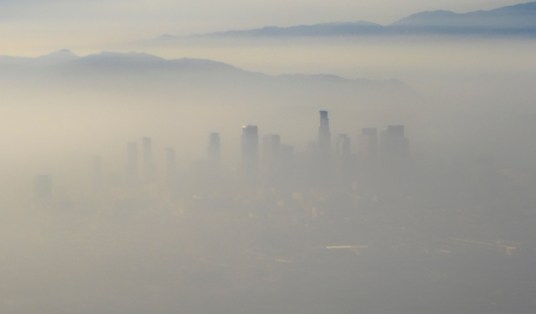 My family moved to Southern California from Northern California in the 1960’s. We lived in Arcadia for ten days before seeing mountains at our doorstep – the San Gabriel Mountains! The air was that smoggy. Smog was a totally unknown thing to all of the kids, though my parents had some inkling. At going-away parties thrown for them from the small town of Chico, California they were given empty mason jars filled with ‘fresh air.’ I recall my eyes itching a lot – but again, I was a kid and thought nothing more than this is just how it was in our new home. When we discovered we had mountains within walking distance of our backyard I was delighted, but the fact that I hadn’t seen them for 10 days didn’t register.
Here’s a short piece that describes the conditions we moved into in the late 1960’s written by Sarah Gardner of RadioGardner:
Los Angeles is a natural pollution trap. The surrounding mountains combine with temperature inversions to trap dirty air. Early on, smoke and fumes from steel and chemical plants, oil refineries and backyard trash incinerators – legal until the late 1950s – plagued the city.
As did pollution from automobiles. Los Angeles County had more than a million vehicles on the road as early as 1940. Just 10 years later, that number more than doubled as the post-war LA population and economy boomed.
… it wasn’t until 1975 that the U.S. required new cars to have catalytic converters, “the key piece of technology that allowed everything to change,” according to Mary Nichols, chairman of California’s Air Resources Board. In between, there were frustrating years of scientific research, industry denial, politics, protest and an unwavering attachment to the automobile.
City leaders, including the Chamber of Commerce, realized that air pollution threatened tourism, real estate and agriculture.
Aha! City leaders realized the negative effects of the smog on business and identified people’s role in messing up the air almost to the point of no return. Los Angeles had the worse air in the 1950’s and 1960’s because of the way the basin was shaped – God’s creation – but also because of the habits of the people who lived there. The toxicity from automobiles and the auto-related industries alongside massive population growth was all a human-made catastrophe.
With all the changes mandated over the next 20 years, air quality in Los Angeles has never been better. It took over 20 years but in the relatively short period of time the air was cleaned up and is now the cleanest it has ever been. It is astounding, actually – a true testament to our ability to reverse human-made disasters like air quality and climate change. God calls us to be accountable and participate in the healing of His creation.
In all the years between 1976 and today it was only  on New Year’s Day when the winds blew away enough smog to not just see the mountains, but too, to see them in detail. New Year’s Day in Pasadena somehow was reliably, predictably stellar. Crisp, clear blue skies – no rain – green mountains, temperatures in the upper 60’s. Locals used to say it was because of the national TV broadcast of The Tournament of Roses that showed LA at its best, encouraging too many folks to move to the area. Newcomers thought LA always looked like it did on January 1. It didn’t for years, but now it does.
God does have domain over all of His creation and wishes it – like us – to be well. God is kind and compassionate but we have to and do play a part in the wellness of ourselves and our environment. We can’t just willy nilly rely on God’s grace to make us well. We can pray to know God’s will for us is to be well – just as the environment and earth are to be well – but to tap into that available healing grace, we have to acknowledge our role in the illness, the disease, the toxic environment, the broken trust, the severed relationship. None of those who established Los Angeles as the dynamic community it did envisioned what a mess the air would come to be. It seemed to many to be just a result of progress. Recall my parent’s friends giving us the mason jars in jest – that’s just what you get in LA.
Sometimes brokenness and illness is simply inherited – passed from one generation to the next without pause. And illness and brokenness will perpetuate until someone, peoples, governments, God’s church, participates in the fix – enjoins God’s grace by prayer and action to heal.
God’s dominion endures through generations, eternally as the psalm reminds us today. For it to flourish as He willed, we must participate. As the leaders in LA did over 20 years ago, suggesting the peoples trusted things could change to bring back the “glorious  splendor” of God’s kingdom in Southern California.
Personal application? What part of my brokenness am I responsible for? If I inherited some brokenness, what can I do to stop living into it? What can I do with God’s grace to change how I think about something? How I am living my story for God’s glory?
Praise Him.
Saturday of Easter Week Lectionary Readings: AM Psalm 145; PM Psalm 104
Exod. 13:17-14:4; 2 Cor. 4:16-5:10; Mark 12:18-27
 Mary Magdalene proclaimed the good news of Jesus’ resurrection to the astonished disciples, putting in motion a forever changed world? Thy kingdom came, thy will was done.
 So, what better day than yesterday when Christian houses were filled to the brim with believers and seekers, sinners and saints to hear that gospel – the gospel of our Lord Jesus Christ according to John. Filled and brimming over with what church folk refer to as C&E Christians, or elsewhere, CEO’s – Christmas and Easter Only (pejoratively referred to as ‘cheasters’) – those who show up to worship the Lord, God on Christmas and Easter.
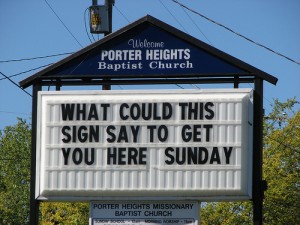 So I can’t help but wonder what preachers and pastors in God’s church could be doing differently on Easter Sundays to usher in a new season for God’s church. One in which most Americans will not only identify the meaning of Easter correctly, but also have moved out of the CEO category to regular worship. What could be said on Easter Sunday that would capture their imagination enough to want to live out what they know to be true – that there’s a new life, a new way of being in the world because of what Jesus did on the cross for them?
 At the Epistle this morning, I couldn’t help but recall my friend’s recent trial and the role prayer played in the good news she relayed today.
 I took to my friend my prayers, the prayer shawl and the prayers from my worship community. She wasn’t seeing visitors, so I left it on her front porch. I did not expect anything from her – and had told her so in the note – that there was no need to acknowledge anything right now – to just be comforted and know that she was not alone. To be still. To breathe. To pray.
 Once The Episcopal Church took the seriously declining numbers seriously, a concerted effort was put in motion, nationally, to be considered more welcoming and accessible. To that end, changes were made in practical and theological areas for how we ‘do’ church, including Worship. A few examples: we employ a wider variety of music, we print out the service in full rather than flipping pages through the Book of Common Prayer, we invite all baptized Christians to the table, and we speak about God in gender-neutral terms.
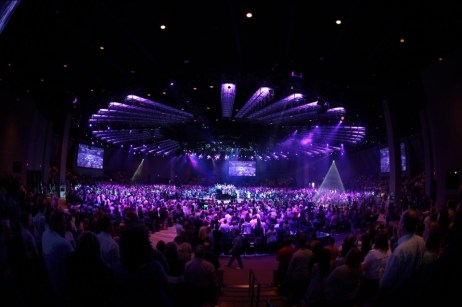 The Big Box Church is what some have named churches who aggressively go after such seekers and newcomers, whose mission or purpose seems entirely focused on getting new folks in the door. There is no liturgy, so to speak, there is no Eucharist. Rather worship is akin to a concert-like gathering complete with hip looking praise bands on stages, video back drops, light shows and featured ‘prophetizers’ Quite a contrast not only to what my tradition offers, but also to Paul’s recommended ‘decent and orderly’ church.
 I went through a stage where I hated my name and tried very hard to get people to call me by my middle name. I thought my first name was ‘too young’ sounding in those years when I wanted to be taken seriously. I was all of twelve when I tried to make the switch, and though quite young, I was looking ahead at life as a professional this or that and thought my first name would not do – wouldn’t get me there.
 But God is the tip off in scripture that God is going to mix things up – get His people back on track, prevent irredeemable actions that thwart His intentions for the world. As in today’s Old Testament story. Pharoah thinks the eradication of male Israelites will keep numbers down so God’s people won’t be threat to his power. But God intervenes through the heart and minds of the midwives. They just can’t do what they were ordered to do. And this makes the way for Moses to participate in God’s story, offering his life for God’s glory.
 A far cry from Jonah. Jonah -as in the belly of the fish Jonah? Yes. It is what came to mind at today’s gospel. Jonah was called by the Lord mid way through life – given his purpose as God purposed him. But Jonah had different ideas – a different career path in mind. A better plan. Than God’s. Yes he did – thought he knew better who he was to be.
 His traveling companions wake him with the same level of concern and anxiety as Jonah’s shipmates. But they don’t blame Jesus for the storm and Jesus doesn’t assume anything close to blame. No, the friends just want Jesus to make it stop. They ask him to calm the storm.
 Is God a mathematician? Maybe an invention of our minds, as Dan Piraro suggests in his illustration to the left?
 As these mathematicians talk about discovering rather than inventing great equations, Bach – arguably the most brilliant composer of all time – set out to discover the musical rules behind the universe – he never purported to invent them.
 Once this concept was invented, mathematicians started to discover all kinds of relations with this imaginary number. So – discover was in essence, forced upon by virtue of inventing a new concept.
 Recently I had a conversation with a priest about not-so-knew research describing the increase of pastors identifying with a PTSD diagnosis – Post Traumatic Stress Syndrome among Pastors. She was wondering about her own choices in ministry and thought she might have landed on an explanation for why so much of her 20-year run had been fruitful only in certain seasons. Though she is young enough to keep going for another 15 years, she wonders if she can. She is disgruntled with the demands of others on her time, laments that she never got things right between ministry and home life. She wonders if she has it in her to keep at this.
 TRINITY SEASONS